How many mpg do you get

Candle Power Forums

Help Support Candle Power:

I can not understand those people who for few bucks literally risking their own lives and endangering others. I have a serious dislike for this kind of behavior. I think there should be fines for that in a range of tens of thousands. so their stupid and outright dangerous "technique" cost them far more than saving few bucks on a tank, or stretching for several more miles.
Agreed. Going 45 mph on a highway is ridiculous. Statistically those going well under prevailing traffic speed cause the most incidents on highways.

You can follow a semi at a safe distance to dramatically increase your mpg (or range if driving an EV). Moreover, since they have a schedule to keep many semis will be going at least the speed limit. I love drafting semis and buses on my bike. Easy to do 40, even 50 mph.
+

geeeze, hope you don't think I drive like that.
Both of those things are really dangerous for sooo many reasons, especially going too slow

Interstate speeds here are 70mph, people go nearly 80 👍

~ Rolling into throttle instead of stomping on it, saves gas.
~ Lifting and coasting (without much loss of speed) into slower areas or Stop Signs, saves gas
~ Gathering extra speed before big hills keeps the car from down shifting going up the hill, that saves gas
~ *cannot recommend this* although if in an area with no one around, just yielding safely at Stop Signs keeps from coming to a complete stop,
that saves ALOT of gas

= Basically, smooth driving will save you Gas
One more thing gained from cycling experience. If you drive the same streets in an area eventually you get some idea of the signal timing. You know if you go x mph after you get the green you'll hit the next signal just as it's flipping from red to green. Or if you're unfamiliar with the signal timing just lift off the throttle as soon as you see a red signal ahead and start coasting. No point wasting energy, and then wasting brake pads, only to get to the next red signal sooner. If you're lucky the signal might even flip back to green before you reach the intersection. Ignore anyone honking behind you while you're doing this. If they want to waste energy to get to the next red signal sooner, let them go around you. It amazes me how few motorists look at least a few blocks ahead and drive accordingly. I can easily see LED signals 1/4 mile out. So can motorists.
 
Tell me you do not drive without telling me you do not drive. or please tell me what is safe distance to follow a truck at highway speeds?
 
My 2014 Ram 1500 truck gets 15-17 mpg around town and 23-25 taking it easy on the highway. My wife's little 2011 Eclipse gets about the same, it is the Sport version and geared very low from the factory. About 26mpg is the best we've seen from it. We are both retired and don't drive much like we used to. About 95% - 99% of my trips are under 5 miles one-way.

I use only Top Tier Ethanol-Free 90 octane gas in both, and I've paid between $4.70 - $5.35 per gallon. I am East Coast, U.S. for reference, U.S. dollars, miles, and gallons.
 
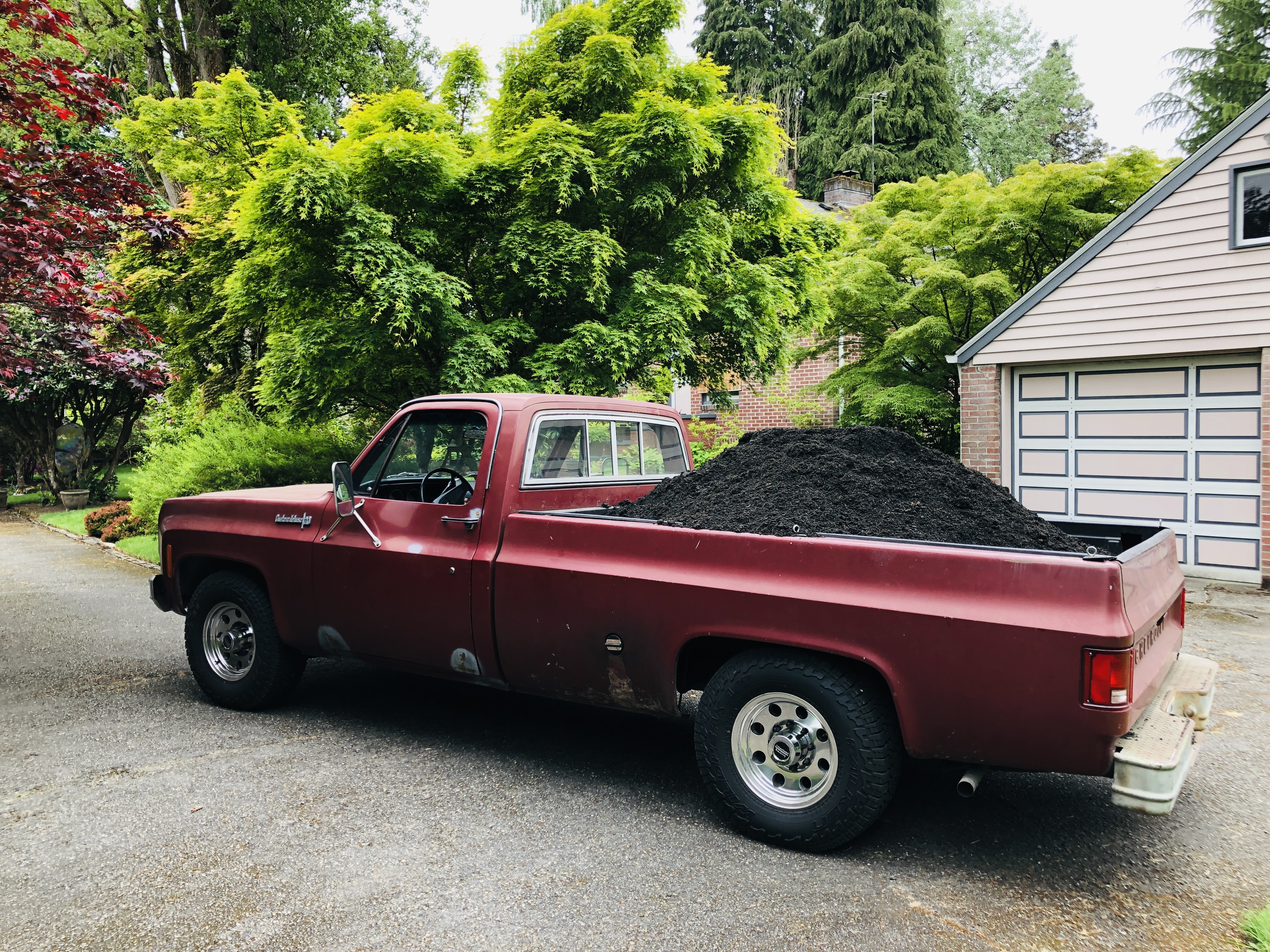
1974 Chevy 3/4 Ton, 454 Big Block, purchased new by my Dad. Now it's mine. One day, all too soon, it will be passed to our sons.

IMG_8731.JPG


Don't know. Don't care. Never checked. 🤓
 
I use only Top Tier Ethanol-Free 90 octane gas in both, and I've paid between $4.70 - $5.35 per gallon. I am East Coast, U.S. for reference, U.S. dollars, miles, and gallons.
+

Wish I could get 90 ethanol-free here, it'd save me a few bucks.
 
Tell me you do not drive without telling me you do not drive. or please tell me what is safe distance to follow a truck at highway speeds?
The rule of thumb is 2 seconds following distance-about one city block at 90 mph. You can get significant aerodynamic benefits following from that distance given the huge wake semis make.

EDIT: I found this. It sounds like you need to be within 200 feet to start seeing mpg improvements. 150 feet is even better. 150 feet still works with the 2 second rule of thumb if driving at 50 mph. I wonder if semis are actually dropping to 50 to 55 mph now given high fuel prices?

All this said, the best way to improve aerodynamic efficiency is by streamlining the vehicle to the maximum extent possible, not by drafting. Sadly the car makers mostly seem to have forgotten that lesson.

AI driving would make running "trains" of vehicles on highways very possible given the near zero reaction time.
 
Last edited:
As an Amazon Associate we earn from qualifying purchases. Product prices and availability are accurate as of the date/time indicated and are subject to change.
The rule of thumb is 2 seconds following distance-about one city block at 90 mph. You can get significant aerodynamic benefits following from that distance given the huge wake semis make.

EDIT: I found this. It sounds like you need to be within 200 feet to start seeing mpg improvements. 150 feet is even better. 150 feet still works with the 2 second rule of thumb if driving at 50 mph. I wonder if semis are actually dropping to 50 to 55 mph now given high fuel prices?
um...gotta put this out there...2 seconds is too far to draft at 200 feet, lol...200 feet is STOPPING distance at those speeds...
 
um...gotta put this out there...2 seconds is too far to draft at 200 feet, lol...200 feet is STOPPING distance at those speeds...
For a car, not for a truck. A semi takes something like 500 feet to stop from 65 mph best case. A smooth stop where you don't risk damaging or shifting cargo takes over half a mile. These things simply can't stop quickly.

I was laughing at this sentence from the link:

The proper following distance for semi-trucks is seven to eight seconds. Drivers should strive to maintain this distance and be ready to double it when the weather gets worse.

I guess they've never been to NYC. If you're following more than about 1 second behind invaribly someone gets in between you and the vehicle you're following.
 
For a car, not for a truck. A semi takes something like 500 feet to stop from 65 mph best case. A smooth stop where you don't risk damaging or shifting cargo takes over half a mile. These things simply can't stop quickly.
Dude. You have to just acknowledge the correction and not try to spin the argument to your own narrative, man. You do not drive, by your own admission. You have not tried to hide your disdain for commuter vehicles by any stretch, and it's a little obvious that you're just parroting information that you have either read or heard somewhere...

A 1 second lead is a HUGE timeframe for moving vehicles...moving at 50mph, let alone 90mph as originally stated, you will cover around 80 feet. You MIGHT benefit a little bit being that close to a truck; you'd likely be sitting at the tail end of the wake at that distance. However, that said, assuming that average reaction time is likely around 200-250ms without distractions, i.e. solely focused on the truck ahead, that is roughly 20 feet of distance unaccounted for. That leaves a drafter about 60 feet worth of braking distance, assuming they stand on the brakes the moment they react to the truck suddenly getting "bigger". To save a few cents per mile, the risk is total loss, possibly of life.

Please stop proliferating dangerous "advice".

**Edit, thank you for including the "not by drafting disclaimer".
 
Dude. You have to just acknowledge the correction and not try to spin the argument to your own narrative, man. You do not drive, by your own admission. You have not tried to hide your disdain for commuter vehicles by any stretch, and it's a little obvious that you're just parroting information that you have either read or heard somewhere...

A 1 second lead is a HUGE timeframe for moving vehicles...moving at 50mph, let alone 90mph as originally stated, you will cover around 80 feet. You MIGHT benefit a little bit being that close to a truck; you'd likely be sitting at the tail end of the wake at that distance. However, that said, assuming that average reaction time is likely around 200-250ms without distractions, i.e. solely focused on the truck ahead, that is roughly 20 feet of distance unaccounted for. That leaves a drafter about 60 feet worth of braking distance, assuming they stand on the brakes the moment they react to the truck suddenly getting "bigger". To save a few cents per mile, the risk is total loss, possibly of life.

Please stop proliferating dangerous "advice".
Not defending the people who do this but since semis can't stop as quickly as cars it's a bit less dangerous following them closely. Just don't follow any closer than maybe 100 feet behind.

Also, I think the people who do this don't do it to save money. It's more about bragging rights.
**Edit, thank you for including the "not by drafting disclaimer".
Really that disclaimer could be an entire diatribe. We should be designing and using much more efficient vehicles in general, as opposed to trying to save pennies by drafting.
 
We so need a face palm emoji.
The answer is obvious for anyone who drives, stay far enough to see exit signs that are in front of the truck well before you get to them. that gives you plenty of room to stop or swerve, especially in case a truck drops a gator, those who drive understand what truck alligators are.
 
The answer is obvious for anyone who drives, stay far enough to see exit signs that are in front of the truck well before you get to them. that gives you plenty of room to stop or swerve, especially in case a truck drops a gator, those who drive understand what truck alligators are.
If you were a cappuccino, you'd become a decappuccino...
 
We so need a face palm emoji.
The answer is obvious for anyone who drives, stay far enough to see exit signs that are in front of the truck well before you get to them. that gives you plenty of room to stop or swerve, especially in case a truck drops a gator, those who drive understand what truck alligators are.
That sounds like it's not even remotely practical unless you're on a pretty empty rural interstate. Anywhere else idiots will jump into the gap.
As a non-driver, to me it seems the best rule with semis is to not be behind them at all. When you see one get in front of them as quickly as traffic allows. I know I give all trucks a very wide berth when riding. I assume they can't see me at all, then act accordingly.
 
This was going to happen sooner or later. RTO was indefensible even prior to rising fuel prices. My sister had to go back three days a week. She says she's doing exactly the same things she can do at home. Hopefully we'll return to remote work for any jobs amenable to it permanently now. RTO was all about control, plus management which doesn't know how to manage a remote work force.

 
Indeed. I live on the edge of the populated center of a regional hub town of about 12K people, with about 7500 in the "urbanized area". The old Walmart used to be closer, but the new Walmart is only 5 miles away, easily reachable by bicycle (although the don't have a proper bicycle rack).

I am just a little over a mile from the center of town, with an Amtrak station that will take me directly to NYC, Philadelphia, and DC, if I need to travel outside the area. Amtrak is even building us a new train station right now.

If you can arrange things where you live in town and work in town, then it's easily possible, even in a rural area, to live without a car. I'm an elected representative in my town's government, and I sit on the town Planning Commission, and we are working for better bicycle infrastructure all the time. We have funding for 25 new bicycle racks on town properties in the downtown area this year.

If you like cheese and beer, you'll be perfectly at home in Vermont.

I was born in NYC and have lived in Center City Philadelphia, Pittsburgh, and Seattle. I'm definitely a City Girl.
Hahah, one of the guys I work with is from Vermont, and keeps telling me, "Man, you'd fit right in back home!" Hahaha

We'll see how things shake out over the next few years. It's been getting a bit too warm over winter, so I barely get much snow, anymore. I want to head north on account of that. I love the Midwest, but Chicago/Madison/Minneapolis seem to be creeping their politics further and further out, trying to turn is into some kind of California of the Heartland or something...which then makes some of the other states get reactionary, and want to be some kind of Texas of the Heartland.

We've always been solidly moderate and practical, so it's been a frustrating change. I'm no ideologue, but it seems like as America bifurcates across their "teams" of the political theater, everyone wants to pick one team or another :/
I just want moderates where you can't tell which party they're from, haha. That's what we used to have.

+

geeeze, hope you don't think I drive like that.
Both of those things are really dangerous for sooo many reasons, especially going too slow

Interstate speeds here are 70mph, people go nearly 80 👍

~ Rolling into throttle instead of stomping on it, saves gas.
~ Lifting and coasting (without much loss of speed) into slower areas or Stop Signs, saves gas
~ Gathering extra speed before big hills keeps the car from down shifting going up the hill, that saves gas
~ *cannot recommend this* although if in an area with no one around, just yielding safely at Stop Signs keeps from coming to a complete stop,
that saves ALOT of gas

= Basically, smooth driving will save you Gas
If you ever watched the BBC show "Top Gear" (the first few seasons were good), they had a bit about "Christian Driving," where they'd try to drive really casually and smoothly. To the frustration of Jeremy Clarkson, it was actually even FASTER to get places than speeding.

I've found essentially the same thing. BUT, it's because I spend more time moving, and less time sitting at lights, because the lights are timed for the speed limit - you end up getting to places faster.
Not defending the people who do this but since semis can't stop as quickly as cars it's a bit less dangerous following them closely. Just don't follow any closer than maybe 100 feet behind.

Also, I think the people who do this don't do it to save money. It's more about bragging rights.

Really that disclaimer could be an entire diatribe. We should be designing and using much more efficient vehicles in general, as opposed to trying to save pennies by drafting.
When I was younger, I'd draft behind semis for the funs of pumping up my mileage. While I'd generally agree cars stop a LOT faster than trucks, I think the bigger danger was that it took FULL, CONSTANT concentration to draft, because IF they did start to brake, you have still a very narrow window of reaction time.

It's also not great for the truck drivers, because they want to know who is around them. After hypermiling my MPGs up to about 75mpg, to see if I could, I pretty much stopped doing this, realizing it was definitely not an issue of IF there was an accident, but WHEN.

This was going to happen sooner or later. RTO was indefensible even prior to rising fuel prices. My sister had to go back three days a week. She says she's doing exactly the same things she can do at home. Hopefully we'll return to remote work for any jobs amenable to it permanently now. RTO was all about control, plus management which doesn't know how to manage a remote work force.

Fully remote jobs make hiring a nightmare, so fully remote has mostly disappeared. There are less remote jobs today than before COVID. COVID destroyed remote work. It became an entitlement to a certain percentage of the workforce, and they're entitled attitude makes them less desirable as employees (THEY shouldn't have to do anything they don't want to - at the job they're being PAID to do. Only the "other people" should have to do gross things like going to work, dressing like an adult, etc.). That was fine when hiring was tight, but the pendulum has already swung. The sooner people realize the WFH fantasy of COVID wasn't going to last, the sooner we can all move on.

Sure, some particular jobs work just fine as WFH jobs. They were remote before COVID, and will stay that way. Those people also tend to become progressively weirder from the isolation (and increasingly less professional), but hey. Fully remote is NOT expanding, and it's NOT going to increase.

Now, the good news is that hybrid work is here to stay, and it is expanding. First, it makes the hiring process INFINITELY better, plus you get to have both the advantages of in-office AND remote workers. It's truly a win-win. Tons of jobs you'd never expect to have a WFH option might now have 1-2 days remote work.

On the upside, with the economy on shakier ground, out of sight, out of mind is a very real problem, and it's WAY easier to lay off "the name on the list" than "John whose kids love fishing." People build networks through relationships. Sure, productivity is important, but it's not the end-all-be-all for most work. Not everything is measurable, and many important things cannot be measured. So, show up, be friendly (you don't have to be friends with anyone, though), and be helpful. You'll be higher on the "do not layoff" list than the dude hiding out in his basement. Also, you'll maintain those real world people skills - especially the professional ones. It'll probably actually end up helping you down the road.

If anyone is working at a job where going into your workplace is completely insufferable, PLEASE...just start applying to a new job. Life is too short to be that miserable. Even if you don't personally like the people you work with, working in person allows for much better collaboration and relationship building, so take advantage of that.

Sorry, I spend all day at work talking to people about these kinds of things, mostly trying to get people to come to terms with the world we live in, and not the world they wish they lived in, so I've just had to have this conversation - that no one wants to hear - like a billion times in the last couple of years, haha.
 
If you ever watched the BBC show "Top Gear" (the first few seasons were good), they had a bit about "Christian Driving," where they'd try to drive really casually and smoothly. To the frustration of Jeremy Clarkson, it was actually even FASTER to get places than speeding.

I've found essentially the same thing. BUT, it's because I spend more time moving, and less time sitting at lights, because the lights are timed for the speed limit - you end up getting to places faster.
I really wish more drivers understood the concept of signal timing. Instead, it seems they go from full throttle when they see green ahead to full brake when they're almost upon a red. I can't tell you how many times I might be riding at, say, 18 mph, only to get passed by some idiot doing 45 mph just to get to the next signal faster, and then I would catch up to them just as the signal flipped from red to green. Because I was already moving I was even ahead of them for half a block until they caught up and passed me, again doing 45 mph just because they think it'll get them there faster.

Highways are the only place where pretty much any speed increase will net you a significant travel time reduction.
When I was younger, I'd draft behind semis for the funs of pumping up my mileage. While I'd generally agree cars stop a LOT faster than trucks, I think the bigger danger was that it took FULL, CONSTANT concentration to draft, because IF they did start to brake, you have still a very narrow window of reaction time.

It's also not great for the truck drivers, because they want to know who is around them. After hypermiling my MPGs up to about 75mpg, to see if I could, I pretty much stopped doing this, realizing it was definitely not an issue of IF there was an accident, but WHEN.
Yes on the concentration part. I love to draft buses from about 10 or 15 feet behind. And it's perfectly safe if you stay hyper alert. The primary hazard is I can't see potholes in time to react, so I only have done this on portions of streets I had recently ridden and knew were free of potholes. That said, in the long run I'd rather just get a velomobile to go faster than draft buses. The best velomobiles let a person travel at 45 mph on their own power.

Cyclists in a peloton average about 5 mph faster than riding alone but I'm generally not interested in group rides. I like to ride when and where I want.
Fully remote jobs make hiring a nightmare, so fully remote has mostly disappeared. There are less remote jobs today than before COVID. COVID destroyed remote work. It became an entitlement to a certain percentage of the workforce, and they're entitled attitude makes them less desirable as employees (THEY shouldn't have to do anything they don't want to - at the job they're being PAID to do. Only the "other people" should have to do gross things like going to work, dressing like an adult, etc.). That was fine when hiring was tight, but the pendulum has already swung. The sooner people realize the WFH fantasy of COVID wasn't going to last, the sooner we can all move on.
They only saw it as an entitlement because management treated it as perk, rather than just the logical thing to do to save money on office space and save employees time/money commuting. As for the supposed myths about lost productivity, I have two things to say about that. One, it's very easy to determine who is doing their job and who isn't. If you can't within a matter of days, then perhaps the position isn't needed at all. Two, remote work does require a different management strategy. Because we jumped into it quickly, we didn't have time to train managers.

I've also looked at this extensively from all points of view. It seems the primary reason behind RTO once you get past the BS like collaboration and "company culture" is that many companies are invested in commercial real estate. Without forcing employees back to the office the value of that investment drops. Not the employee's problem. Another reason behind RTO is to reduce your workforce without resorting to layoffs which require severance pay and/or unemployment insurance. Get an employee disgusted enough to quit, you save on all that.
Sure, some particular jobs work just fine as WFH jobs. They were remote before COVID, and will stay that way. Those people also tend to become progressively weirder from the isolation (and increasingly less professional), but hey. Fully remote is NOT expanding, and it's NOT going to increase.
Fully remote should be the rule for any job which doesn't have a physical need to be there. Doing this reduces the crowding on roads and transit for those who have no choice but to commute. It also saves money for both employers and employees.
Now, the good news is that hybrid work is here to stay, and it is expanding. First, it makes the hiring process INFINITELY better, plus you get to have both the advantages of in-office AND remote workers. It's truly a win-win. Tons of jobs you'd never expect to have a WFH option might now have 1-2 days remote work.

On the upside, with the economy on shakier ground, out of sight, out of mind is a very real problem, and it's WAY easier to lay off "the name on the list" than "John whose kids love fishing." People build networks through relationships. Sure, productivity is important, but it's not the end-all-be-all for most work. Not everything is measurable, and many important things cannot be measured. So, show up, be friendly (you don't have to be friends with anyone, though), and be helpful. You'll be higher on the "do not layoff" list than the dude hiding out in his basement. Also, you'll maintain those real world people skills - especially the professional ones. It'll probably actually end up helping you down the road.
It depends upon the terms here. If there are crunch times a few times a year where it's beneficial for everyone to be together for a week or two that's fine, so long as you're fully remote the other 45 to 50 weeks of the year. Having people go in x days per week just to click off the badge counter makes no sense. It's what my sister has been forced to do. There's no collaboration or anything else she couldn't easily do from home.

Also you don't need to go to work to maintain people skills.
If anyone is working at a job where going into your workplace is completely insufferable, PLEASE...just start applying to a new job. Life is too short to be that miserable. Even if you don't personally like the people you work with, working in person allows for much better collaboration and relationship building, so take advantage of that.
To me and lots of others, the problem IS physically getting to the workplace, not actually being there. If people could magically teleport themselves to offices there would be little demand for remote work. I've worked from home since 1990. I didn't resent being in a workplace prior to that. I DID resent wasting 1.5 to 2 hours of my life every single day without pay getting there, and on top of that having to pay what amounts to another tax in terms of commuting costs. The equation would quickly shift to remote work with legislation requiring employers to pay employees for commuting time and expenses. Since they require it, they should pay for it.
Sorry, I spend all day at work talking to people about these kinds of things, mostly trying to get people to come to terms with the world we live in, and not the world they wish they lived in, so I've just had to have this conversation - that no one wants to hear - like a billion times in the last couple of years, haha.
I could say the same about the bosses who live in another world. They have no idea how much time, aggravation, and money getting to work costs.
 
I noticed amount of cylinders does not always translates to more miles, I had an old 4 cyl 2.5L, chevy celebrity, then I got an oldsmobille with a 3.8L v6, i had better highway mileage with v6 than 4cyl. at 60mph my chevy ran at 2500rpm, while my v6 was at 1500rpm. in the city it was same story, I had to press harder, and spin L4 faster than my v6. My chevy had a 3 speed automatic, oldsmobille had a 4speed auto with overdrive,
 
Back
Top