jon_slider
Flashaholic
- Joined
- Mar 31, 2015
- Messages
- 6,823
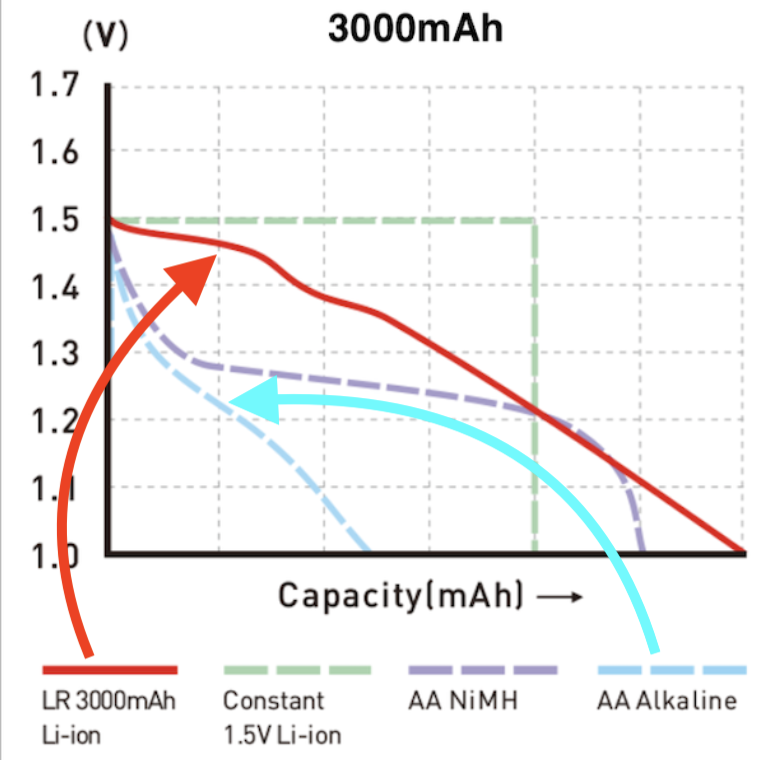
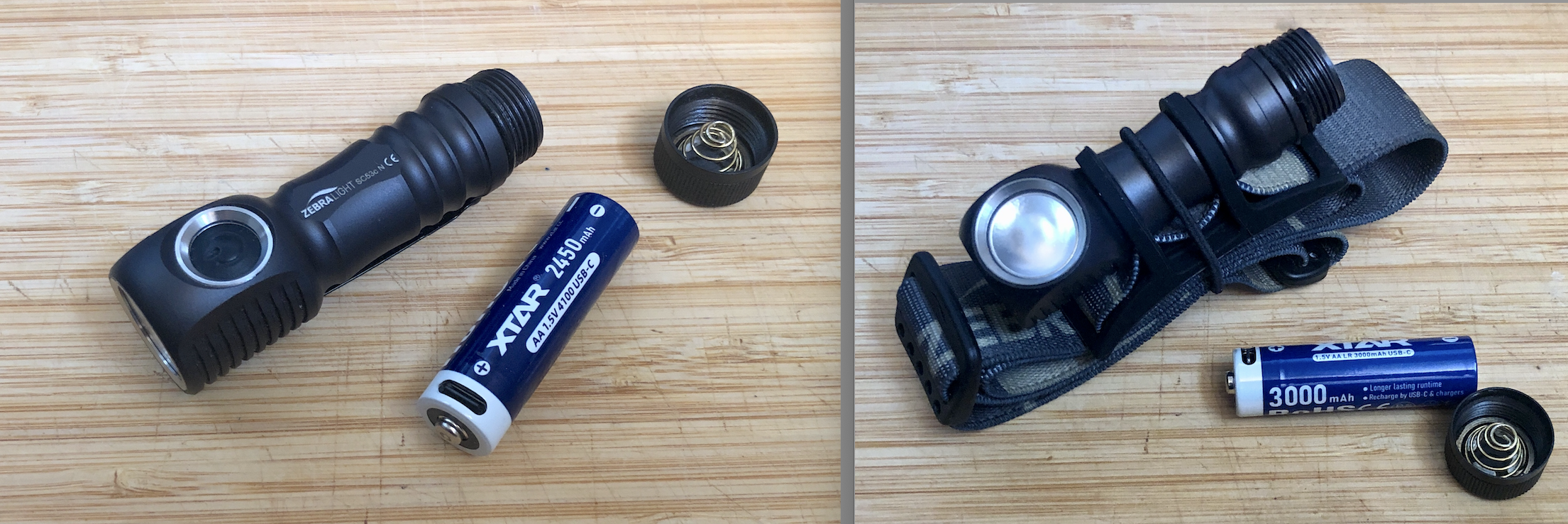
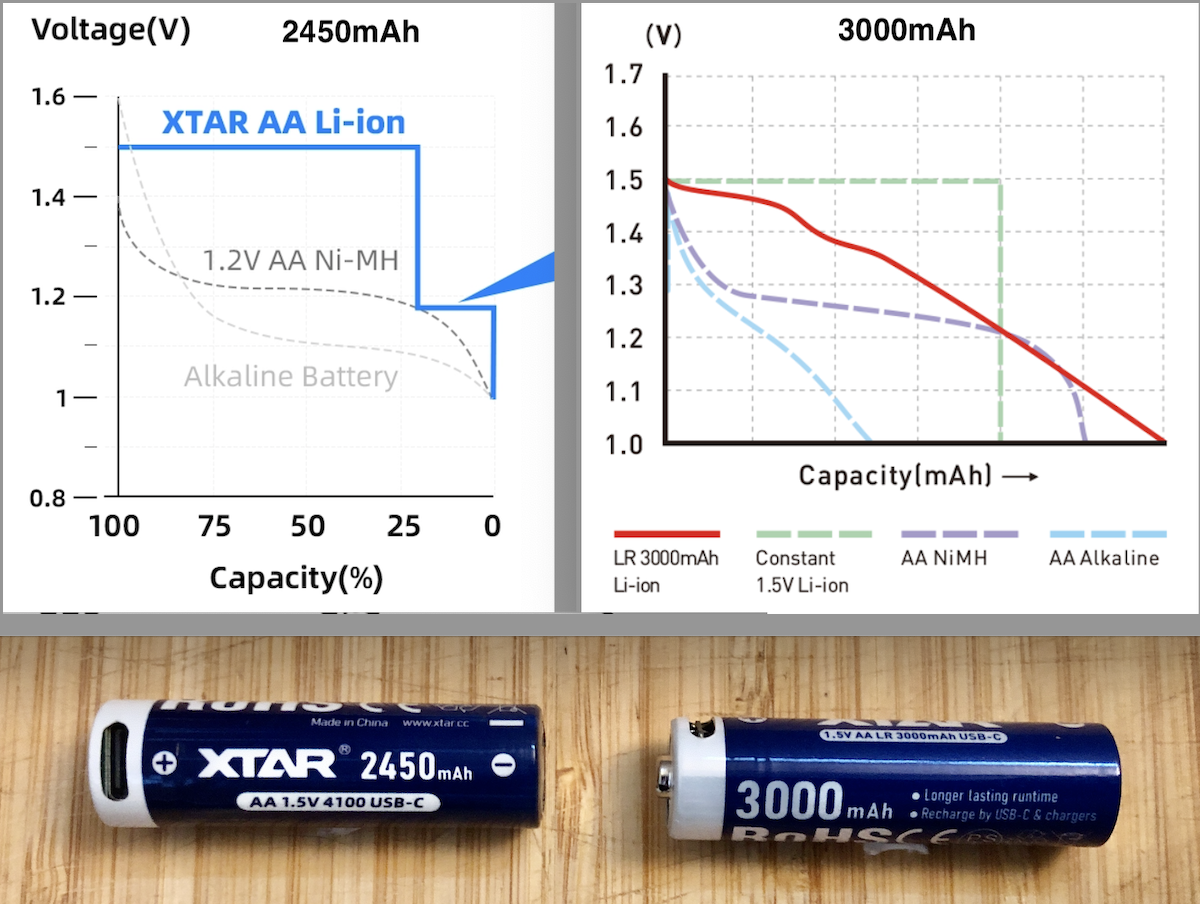
I received some XTAR LR 3000mAh 1.5V LiIon as a gift from XTAR, after doing a review of some of their other batteries and chargers. This 3000mAh version, is the type whose voltage declines at a tapered rate.
I previously have been using the CLR 2450mAh version, whose voltage stays at 1.5V for the first 75% of the runtime, and then at 1.20V switches to that Voltage, to help give advance Low Voltage Warning, before the battery shuts off completely. I posted a review here.
These are the discharge curve types for the two battery designs:
I used an Emisar KR1AA w NTG 4200K, with ceiling set to 90/150 = 340 lumens
My testing goal was to determine at what Voltage the LR 3000mAh design could no longer start, when not hot, at my selected ceiling.
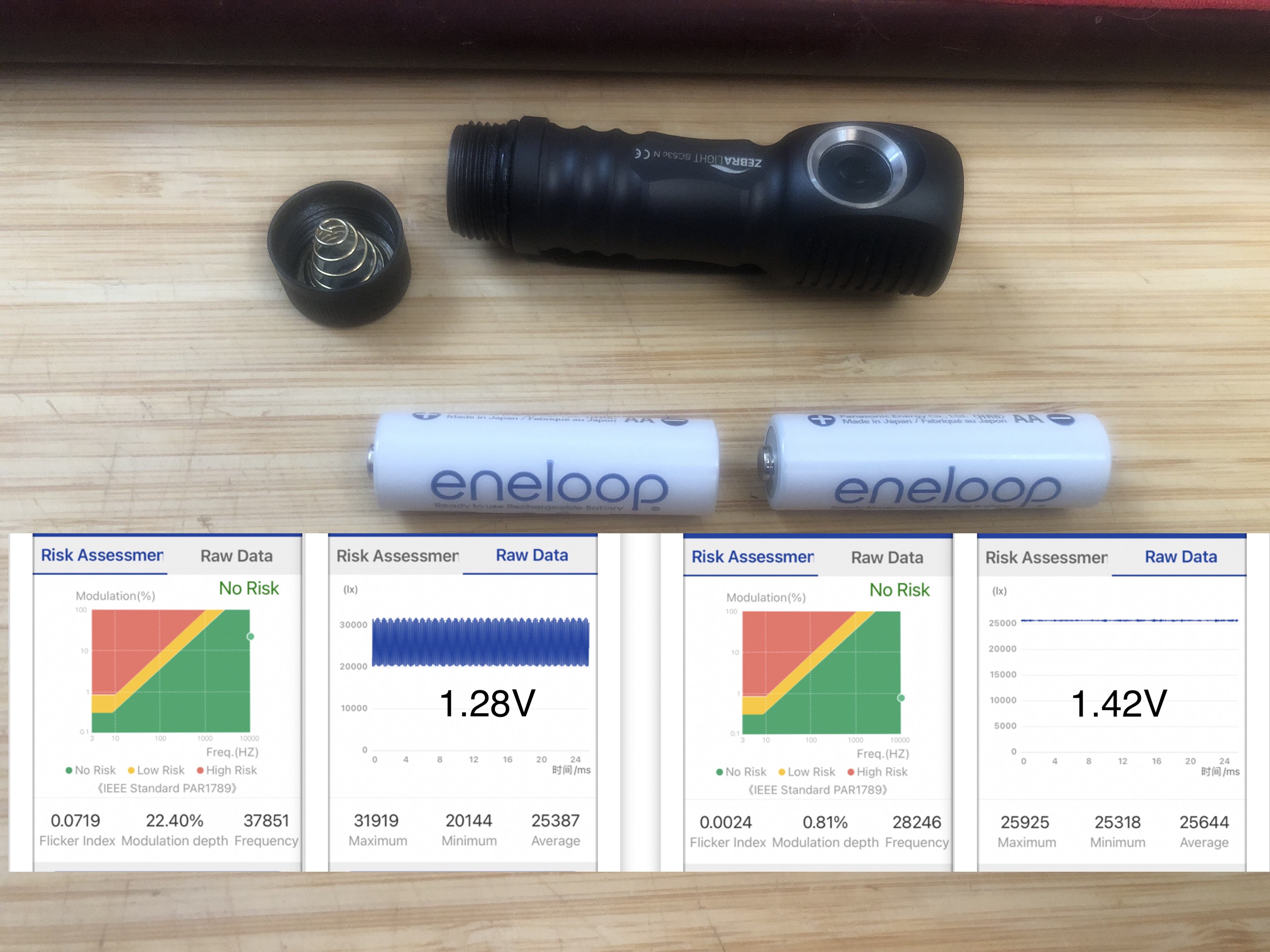
my results are that at 1.30V it still started at 340 lumens
(with breaks in the On time, to let the light cool down about every 10 minutes)
at 1.26V it started at 160 lumens..
The Thermal Step down in the KR1AA reduced output to between 160-180 lumens as the light heated up, this took about 5 minutes, each time I restarted the test from 340 lumens, when the light had cooled down.
What I learned is that:
Below 1.30V, the declining voltage type battery can no longer hit my chosen ceiling of 340 lm
We can infer that the constant 1.5V battery, when it switches to the 1.2V low voltage warning phase, also can not sustain 340 lm
my conclusion is that the two versions of the battery have very similar output performance..
their output is limited primarily by Thermal Step Down, Not by the Voltage
imo these 1.5V LiIon batteries are most useful for low and medium outputs, with the ability to produce a higher output briefly. They seem to work similarly well as Eneloop, with the added convenience of USB-C charging and longer runtime.
Compared to the sustained 1.5V design, rated 2450mAh, I see a couple of Advantages to the declining Voltage version rated 3000mAh:
1. Voltage check gives me more advance notice, to help me anticipate when it will need to be recharged...
2. More capacity, so it has a runtime advantage.
I previously have been using the CLR 2450mAh version, whose voltage stays at 1.5V for the first 75% of the runtime, and then at 1.20V switches to that Voltage, to help give advance Low Voltage Warning, before the battery shuts off completely. I posted a review here.
These are the discharge curve types for the two battery designs:
I used an Emisar KR1AA w NTG 4200K, with ceiling set to 90/150 = 340 lumens
My testing goal was to determine at what Voltage the LR 3000mAh design could no longer start, when not hot, at my selected ceiling.
my results are that at 1.30V it still started at 340 lumens
(with breaks in the On time, to let the light cool down about every 10 minutes)
at 1.26V it started at 160 lumens..
The Thermal Step down in the KR1AA reduced output to between 160-180 lumens as the light heated up, this took about 5 minutes, each time I restarted the test from 340 lumens, when the light had cooled down.
What I learned is that:
Below 1.30V, the declining voltage type battery can no longer hit my chosen ceiling of 340 lm
We can infer that the constant 1.5V battery, when it switches to the 1.2V low voltage warning phase, also can not sustain 340 lm
my conclusion is that the two versions of the battery have very similar output performance..
their output is limited primarily by Thermal Step Down, Not by the Voltage
imo these 1.5V LiIon batteries are most useful for low and medium outputs, with the ability to produce a higher output briefly. They seem to work similarly well as Eneloop, with the added convenience of USB-C charging and longer runtime.
Compared to the sustained 1.5V design, rated 2450mAh, I see a couple of Advantages to the declining Voltage version rated 3000mAh:
1. Voltage check gives me more advance notice, to help me anticipate when it will need to be recharged...
2. More capacity, so it has a runtime advantage.