Best Battery Tester

Candle Power Forums

Help Support Candle Power:

Aurora Jackalis

Newly Enlightened
Joined
May 23, 2017
Messages
18
Hi guys,

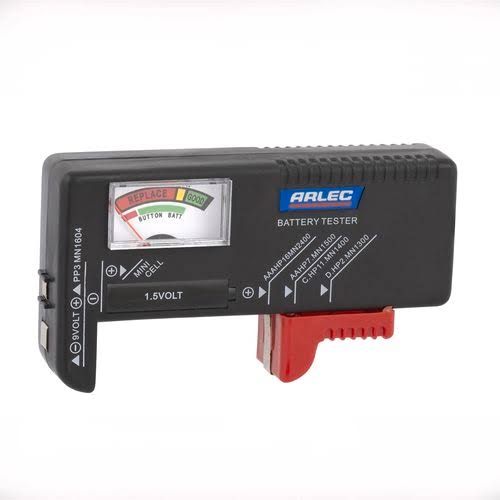
I’ve had a few of these battery testers:
IMG_0752.jpeg

& noticed they would all vary slightly in their reading.

I’ve noticed there are digital versions in a very similar housing. But I am sceptical of them being any more accurate.

Are there more reliable options? Got a recommendation?

Thanx
 
PS The labeling states 1.5 Volt. Does this mean it is inaccurate for 1.2 Volt batteries?

Another reason to look for something more reliable.
 
those measure absolute voltage, so if you measure a 1.2V battery it will always measure it as more depleted if it's not...
also I can echo what was said before, buy a decent multimeter and just be done with it.
A more budget version is the UNI-T UT210E, a more professional one would be an IDEAL 747, or the basically industry standard Fluke 115.
 
I've used the ZTS MBT-1 for many years, it seems the algorithms they use to test the various battery types are accurate, I'd highly recommend it. It isn't cheap but mine has to be a decade old now and still going strong.

Most batteries you can test until you see no change in the reading, they told me that with lithium primaries just run the test 2x.
 
Testing batteries under a load will always be more accurate than a no-load reading using a VOM with an extremely high impedance input. A load will reveal the battery's internal IxR losses.
 
Can anyone tell me what Ohm resistors are most appropriate to test the viability of different common battery types under load (using a multimeter)?

100 Ohm seems to be good for AA NiMH cells, but what about for 3.7 V Lions, etc?

Is there a formula or a reference sheet? I'm aware of Ohm's Law, but not sure how/if it applies to this specific usage. Thanks
 
100 Ohms was recommended in the YT video that I had watched a year or two ago, but they did not specify different resistances for different cells as far as I recall. I believe that the channel was "The Engineering Mindset" if you'd like to seek it out yourself. Based on the design of the ZTS MBT-1 mentioned above, it is clear that there is more to consider than just resistance if you are seeking very accurate results.
 
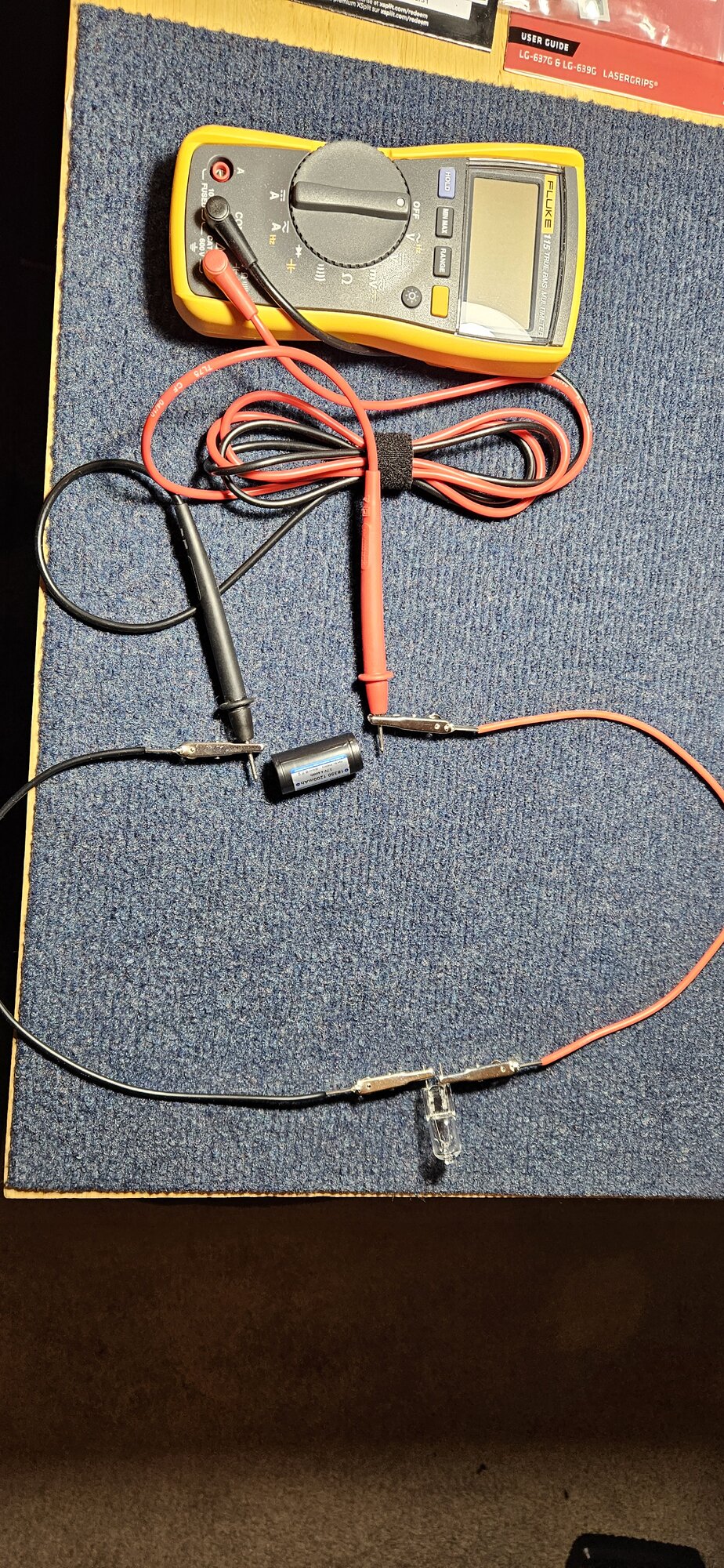
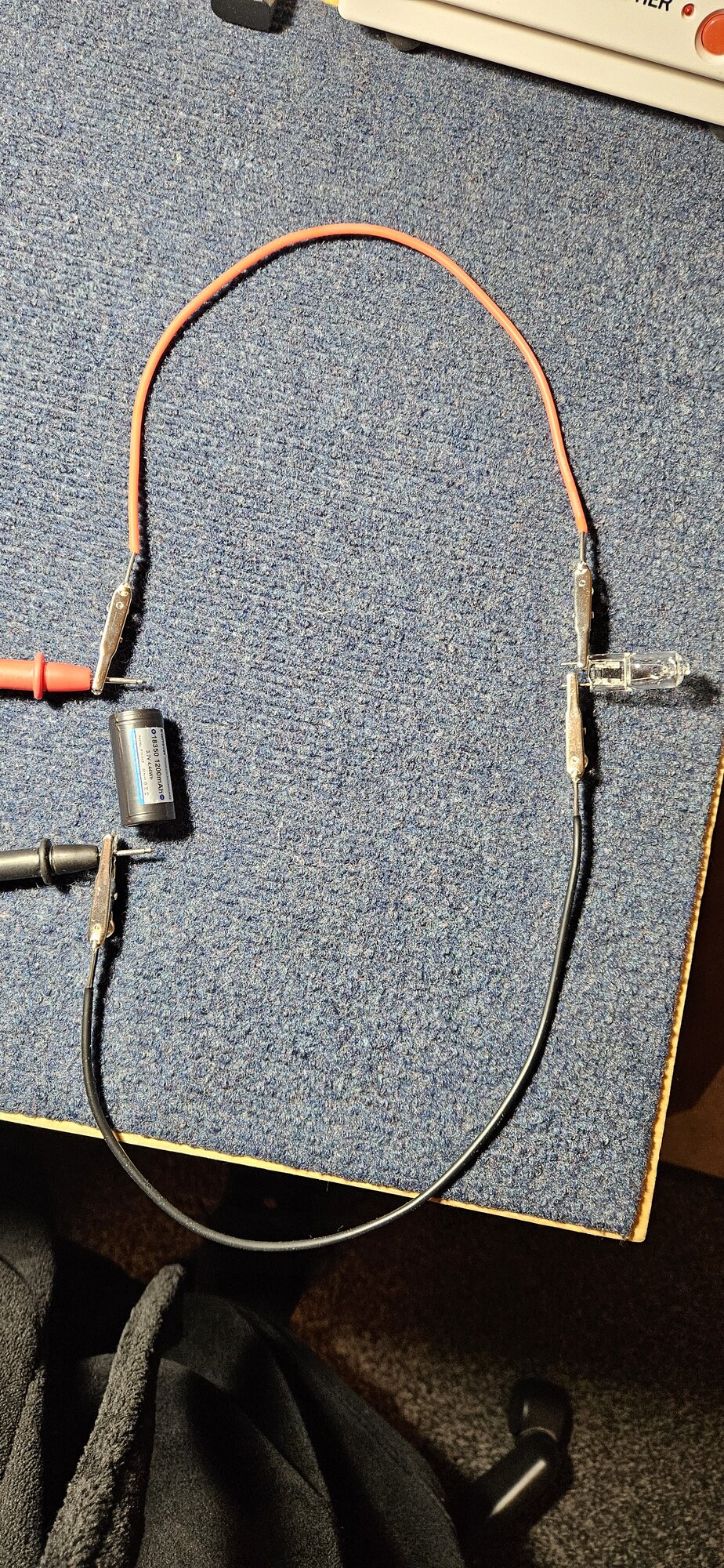
Thanks @Voider of Warranties. With your display in post #9, is that just a generic led you have on the opposite ends of the alligator clips to test if that 18350 will give you a 3.7V read under load? If so, would any generic LED or resistor work?

Practically what I'm trying to discover is what kind of resistor I would need to test the voltage on a similar lithium ion battery under load. Presumably a 100 Ohm resistor would not work for all batteries. I'm pretty sure I drained a half-spent 3V watch battery trying to test it under load using a 100 ohm resistor.
 
Try an esr meter like the **** smith/ anatek blue.
Leave out or remove the protection diodes.
Its made for capacitors but works fine for testing ir of batteries.
For common household batteries i have a mallory tester from the 60's.
Low,medium,and high drain setting and voltages up to 45
 
Thats actual
Thanks @Voider of Warranties. With your display in post #9, is that just a generic led you have on the opposite ends of the alligator clips to test if that 18350 will give you a 3.7V read under load? If so, would any generic LED or resistor work?

Practically what I'm trying to discover is what kind of resistor I would need to test the voltage on a similar lithium ion battery under load. Presumably a 100 Ohm resistor would not work for all batteries. I'm pretty sure I drained a half-spent 3V watch battery trying to test it under load using a 100 ohm resistor.
That's actually just an incan microwave bulb. It produces about 68 ohms of resistance, but it gets the job done for me. My goal was simply to compare primary cells to each other under load to see which were healthier than others. (Basically, which ones dropped the most under load.) It sounds as if a ZTS MBT-1 might be just what the doc ordered in your case. I have not used one, but I trust the opinions of the guys above who have vouched for it.
 
That's actually just an incan microwave bulb. It produces about 68 ohms of resistance, but it gets the job done for me. My goal was simply to compare primary cells to each other under load to see which were healthier than others. (Basically, which ones dropped the most under load.) It sounds as if a ZTS MBT-1 might be just what the doc ordered in your case. I have not used one, but I trust the opinions of the guys above who have vouched for it.
Thank you. The ZTS MBT-1 looks great, but a handful of different resistors would be less economically taxing (already have the multimeeter). 100 Ohm resistors have worked bueutifully for Eneloops, the same way you have that microwave bulb wired up. Less so for testing Lithium Ions. I'm not an engineer, but figured there might be a chart somewhere or a formula that could be used to calculate what resistor would be appropriate for testing V under load. Guess not.

I may just try testing different batteries under load using different resistors. 68 Ohms resitance to test a for a 3.7 18350 gives me a good reference point point. Found some other reference to use a 10 Ohm 1/2 watt resistor works for an 18650. I'll wear eye protection just incase I send hot ceramic shards ricocheting through the gargage!

Wish me luck.
 
I actually only use this setup to test partially drained cr123s. I used the 18350 in the pic because it was sitting close by when I staged the shot. My intention was to represent where to put a cell in the setup and not to imply this was for 18350s per se. I think that you're on the right track experimenting with multiple resistances, but I don't know of any chart or formula to access for the info you require. Good luck.
 
10 ohms across a nominal 3.7 volt cell will only draw about 370mA, perfect for testing but the resistor will dissipate about 1.5 watts. A half-watt resistor will get very hot very quickly. Safety suggests you need a 5-watt resistor, readily available, which will remain comfortably warm.
 
Admittedly, this is a bit of a contraption, but I slapped it together fairly quickly to provide a load on suspicious cells that otherwise read high but perform underwhelmingly. It's cheap as long as you already have a DMM.


View attachment 57954View attachment 57955
I used to do it that way, but it has become much more cumbersome with the number of battery types increasing all the time. Often the easiest way to determine what kind of resistor or lamp will work for a particular battery was to use what ever is in the flashlight modified by dividing the voltage for the number of cells. Now, with LED lamps, I am not so sure. At work, I used an inexpensive sealed beam headlamp (three load levels available) to test the sealed lead acid batteries we used to back up the alarm functions in coolers if the power dropped out. Finally, I had to look up the specifics and choose a resistor for some AA-size Li-SOCl2 batteries for the transmitters on a mesh wireless equipment alarm network. There is a built-in way to look at battery conditions in that system, but it is in very short pulses that ended up with voltage all over the place that I found inpossivle to interpret.

Ideally, I guess, it would be adventagous to set up a breadboard with a series of resistors and a volt meter (or two, or a connection for the multimeter, most likely). and just add a resistor or lamp for every battery in my inventory then add another with a new battery or battery pack if I need to. It would end up looking something like a deconstructed ZTS unit.

I have a tester that looks like the AALEC above. I can't find it at the moment, but I believe that it has different loads for the different size cells and the specifics are listed on the back. That's not to say that all that look like it do vary the loads. I've seen lots of them advertised, but with minimal information.
 

Latest posts

Back
Top