HDS Systems #23

Candle Power Forums

Help Support Candle Power:

Since we got another light in with fried electronics from an emitter swap, I thought I would bring this up again as it is a costly problem and happens far too often.
While HDS does move at the speed of light (if Light is the name of a mummified tortoise buried under the Egyptian sands) we do eventually get most emitters as an option that folks request... it just takes a lot of patience.

From the HDS FAQ:
Your flashlight was not designed to be modified after it has been assembled. To make your flashlight as reliable as possible, all connections are soldered together and all of the electronics have been potted. This seals the electronics and makes your flashlight very rugged. There is no safe or cost effective way to swap LEDs.

The LED board is thermally, electrically and mechanically joined to the power supply as well as the metal superstructure. Thus, there is no good way to remove the LED board or otherwise modify it. Getting the LED board hot enough to melt the solder holding the LED to the board requires getting the whole head to the melting point of solder, which takes a lot of time and a lot of heat and will easily exceed the thermal ratings on all of the parts in the power supply, not to mention the LED itself. A broken light is the typical result.

Many people have tried to replace the LED on their light and have destroyed the power supply in the process. If you break the power supply, it will cost you the current price of a head less the cost of the reflector assembly to replace it. Even skilled modders have paid for new power supplies. So don't try to modify your light.

The least expensive way to upgrade the LED in your flashlight is to sell your flashlight on the used market and then purchase a new one. Our lights retain their value even after they have been well used and so there is a thriving used market for our flashlights. This is a testament to how durable our flashlights are and how good our warranty service is.

Or consider gifting your old flashlight to a family member or one of your friends.
 
It could be. It seems warmer than 3700k. To me it is more 3000k to 2700k.
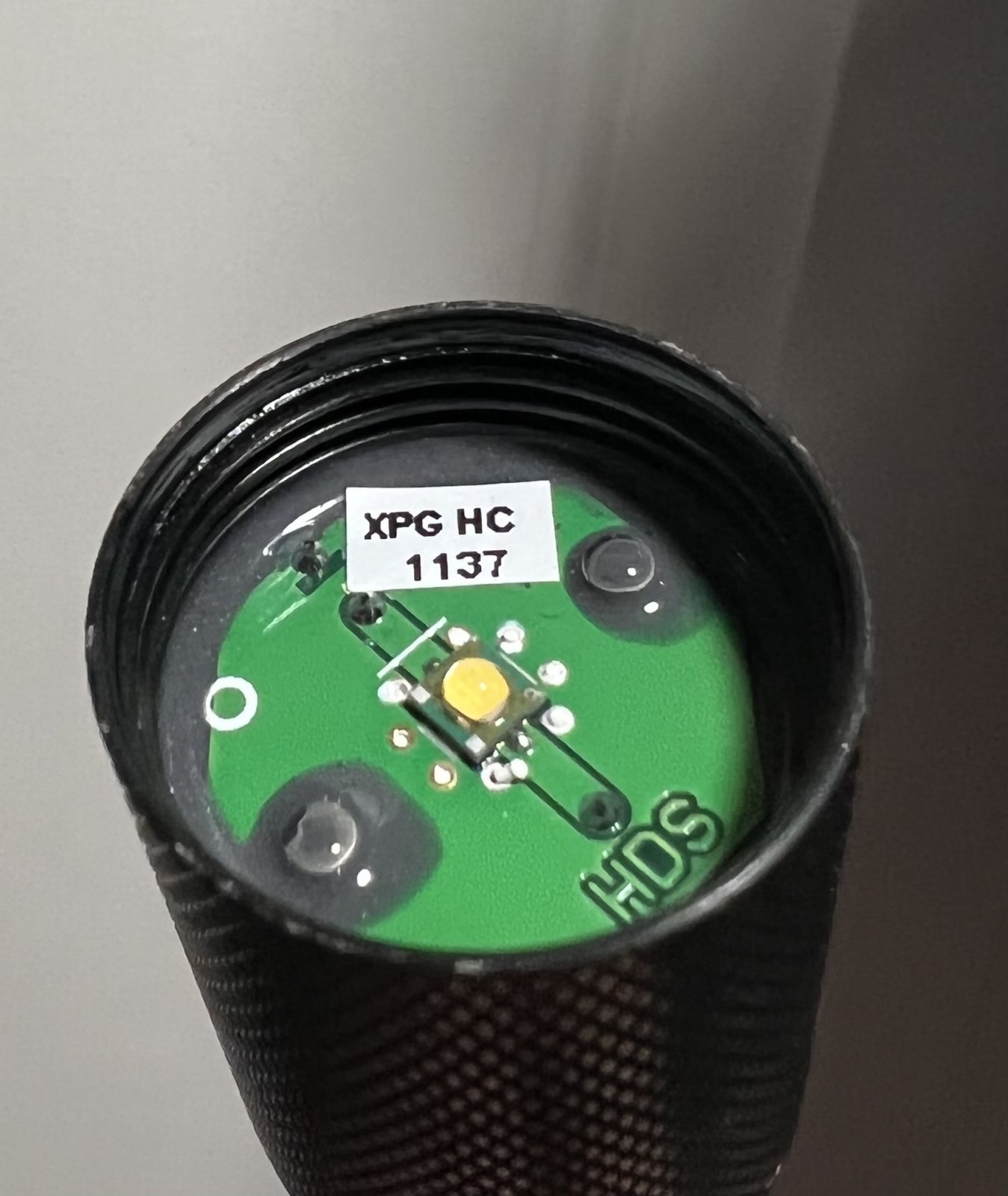
Should be 3700k. Looks the same as the one I have. Mine is also warmer than the NB35 I have, considerably so. Agree around 3000k or maybe even warmer. Attaching photo of my light’s LED for reference.
 

Attachments

  • B5EC8420-179D-451A-811B-AF44D9D03994.jpeg
    B5EC8420-179D-451A-811B-AF44D9D03994.jpeg
    173.3 KB
Should be 3700k. Looks the same as the one I have. Mine is also warmer than the NB35 I have, considerably so. Agree around 3000k or maybe even warmer. Attaching photo of my light’s LED for reference.

I wouldn't have guessed 3700k. Thanks for the information. Is yours 120 lumens (green ring) as well?
 
The LED board is thermally, electrically and mechanically joined to the power supply as well as the metal superstructure. Thus, there is no good way to remove the LED board or otherwise modify it. Getting the LED board hot enough to melt the solder holding the LED to the board requires getting the whole head to the melting point of solder, which takes a lot of time and a lot of heat and will easily exceed the thermal ratings on all of the parts in the power supply, not to mention the LED itself.

I learned the hard way on a Zebra. It's all joined together as well.
Just because you can doesn't mean you should.
I don't see a way to modify without degrading reliability.
Same with HDS.
 
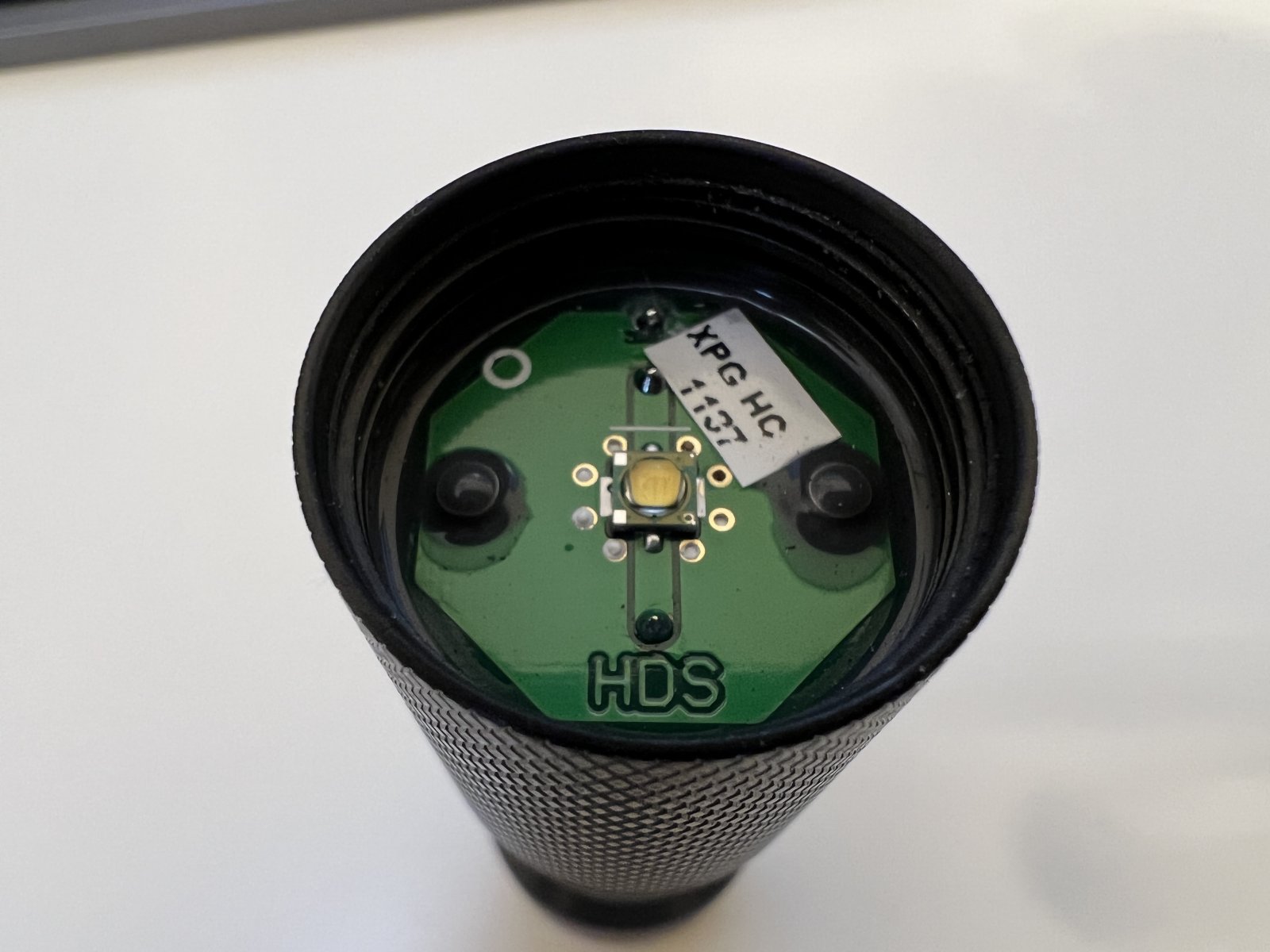
I have an older EDC Clicky and am trying to figure out what LED it has. I get that it is an XPG. What does the HC and numbers mean? It is a very warm (I would say around 3000k) light. One of my all time favorite lights.

View attachment 34036
It is a Cree high CRI XP-E. Without putting it on a sphere, I can't tell you the exact color temp but probably around 3k as mentioned earlier.
 
I have one also. Mine has a blue sticker on the spring. I think blue is 140 lumens? 🤔
One of my favorite lights. It was a clicky but had it upgraded to a rotary a while ago. I always thought it was sold as 3700k. At least that’s what I have in my notes. It does appear warmer than that tho.
 

Attachments

  • 151B285D-3803-4193-B947-295B8E7B387E.jpeg
    151B285D-3803-4193-B947-295B8E7B387E.jpeg
    193.3 KB
So a Cree HCRI XP-E 3700k. It truly is my favorite light. I put my HDSRB on it and can't believe how much throw it has. Perfect combination.
 
I wouldn't have guessed 3700k. Thanks for the information. Is yours 120 lumens (green ring) as well?
Yes green ring here.

Here is full item description dump from an old website where light was previously available.

The EDC High CRI 120 lumens flashlight (EDC-E1S-Hcri) is a high color rendering model for medical and science applications requiring accurate color differentiation. Plant, earth and skin colors take on a natural look, instead of the typical pale appearance. The special LEDs used in this flashlight have a color rendering index (CRI) of over 90 compared to a typical LED's color rendering index of around 72. The flashlight's color temperature is around 3700°K so it is considered to be warm white in appearance. And the light is conveniently small and light weight so you can carry it with you wherever you go.

The EDC High CRI 120 lumens flashlight provides the following features:

Elegant single button interface - simple access to 4 preset brightness settings.
Lowest cost of ownership.
Turns on to: 15 lumens, runtime: 12 ANSI hours.
Press-and-hold preset: 120 lumens, runtime: 1.25 tactical hours, 2 ANSI hours.
Double-click preset: 42 lumens, runtime: 4 ANSI hours.
Triple-click preset: 0.3 lumens, runtime: 128 ANSI hours.
Potted electronics for the ultimate in reliability under extreme conditions.
Sealed gold-plated switch for maximum reliability.
Anti-damage battery compartment protects battery during extreme abuse.
Nearly unbreakable ultra clear glass lens with anti-reflective coatings.
Durable Acme threads used throughout.
Constant brightness through constant power regulation.
Elegant low battery warning.
Designed for both regular lithium batteries and rechargeable Li-ion batteries.
Protects rechargeable batteries from over-discharge.
Full thermal management - never gets too hot.
Aerospace aluminum body protected with black military Type 3 hard anodize.
Silver stainless steel crenelated bezel.
Single 123 battery.
Each output preset can be customized to any brightness level, tactical strobe, emergency strobe or SOS signal.
Other custom options include selectable turn-on preset, momentary operation, automatic shut-off, button lock, locator flash and burst control.
Pocket clip, bezel down carry, black.
Water/dust proof - IP67, 20m (66 feet) of water.
Dimensions: Ø 25.4mm x 93mm (Ø 1" x 3.7").
Weight: 102g (3.6oz) including battery.
 
Hi all—

Planning on ordering a rotary soon—any idea what the approximate turnaround time is these days? Days? Weeks? Months?

Thanks!
 
Where're you going to order from in that case?
The HDS site—I just couldn’t seem to find shipping timeframes there. Open to ordering anywhere that sells rotaries of course, I just haven’t bought an HDS in years.
 
Just because i’m lazy (and because there’s just way too many to navigate properly), does anyone know the locator beacon runtimes on the newer (2018 -) models? I’ve found the older ones quoting numbers of 3+ years but as i’ve understood it at least one person was doing it on the newer models but i’ve yet to see the results.
 
Last edited:
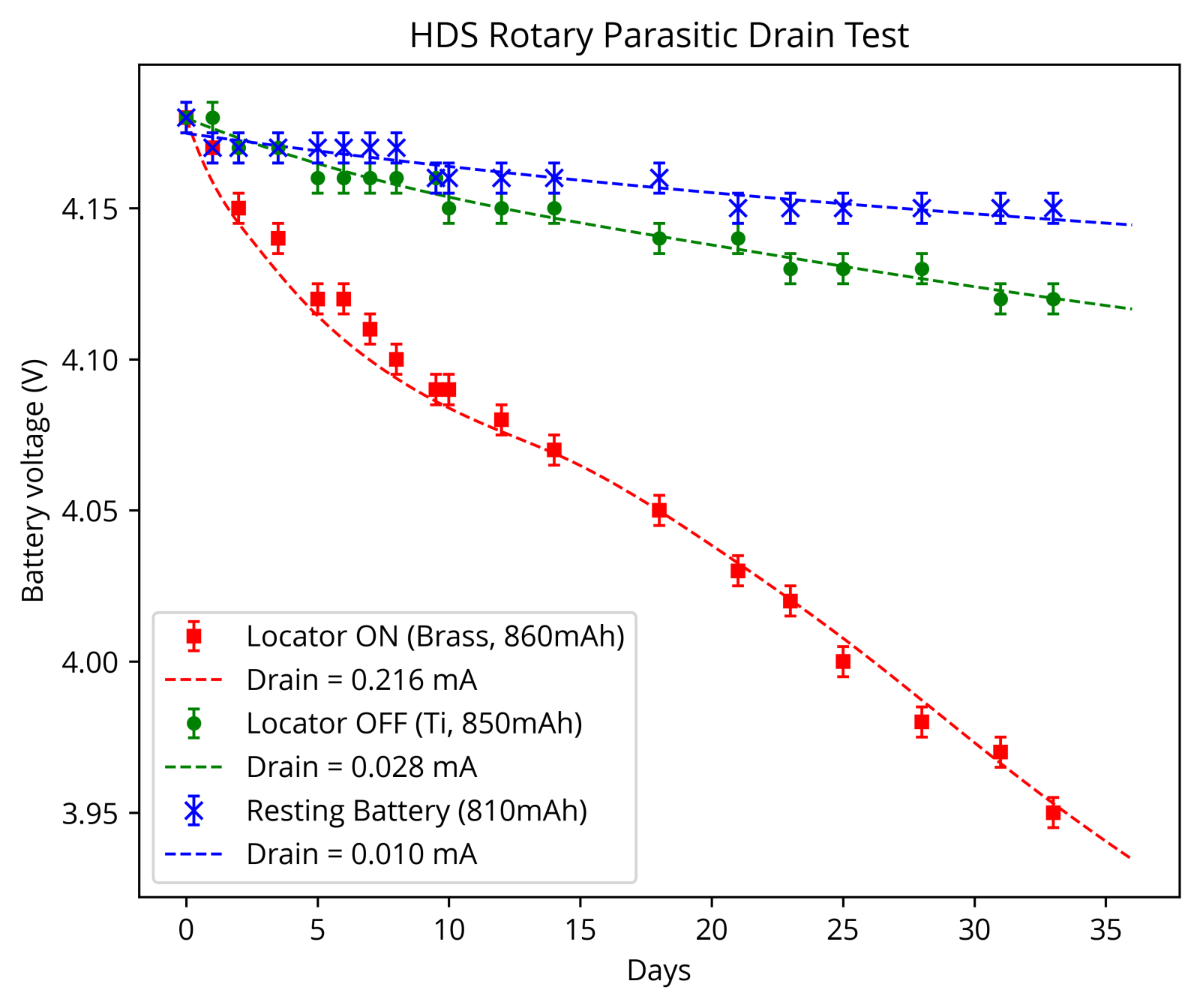
A bit more than a year ago, I was curious about the parasitic drain of my rotaries and the effect of using the locator beacon. I devised a crude experiment around being able to measure voltages to 0.01V precision: I have tested (to my best effort) the capacities of three of my 16340 cells, and after a full charge put them 1) in Brass rotary (NB40) with locator beacon ON; 2) in Titanium rotary (NB45) with locator beacon OFF; 3) to rest on my desk. I measured the voltage of each the cells at approximately regular intervals for ~1 month (see caveats below) and obtained the following graph:

HDS_drain.png


Markers are raw voltage measurements (with error bars indicating my measurement precision). I then digitized the cell's nominal discharge curve at low current draw from lygte-info.dk and constructed discharge functions normalized to measured capacities of each cell. Non-linear least-squares fit provided an estimate of the actual drain of each cell.

I think it is fairly clear that the locator beacon has a significant impact on standby current. Very approximately, the locator beacon would fully discharge a 850mAh cell in about 160 days, or about nine months for a CR123A with 1400mAh (ignoring for now the different voltages between 16340 and CR123A, since this is all very rough to begin with). This more or less matches my experience, where an otherwise unused rotary with beacon on would indicate low battery after a few months. With the locator beacon off, standby only adds a very small parasitic drain to the self-discharge. It would take on the order of years to fully drain a rechargeable cell, at which point the self-discharge would have already done so. For a CR123A, this would take significantly longer since primaries have less self-discharge.

My take away is that if you are actively using the light and cycling through cells with any regularity, then the locator beacon adds insignificant amounts of battery consumption. On the other hand, it doesn't seem advisable to activate the beacon with a battery inside if it's in storage for more than a few months.

Now for the caveats: 1) I would have like to have measured for many more days, but life got in the way; 2) I did have to remove the cells to measure the voltages, which means these measurements are not in situ. However, this shouldn't be a big effect, since the current draw is so small; 3) Removing the cells in between also meant that sometimes I wasn't quick enough to replace the cells before the lights reset, so the reset flashes and/or the extra on/off cycles to turn off the locator beacons would contribute to the drain. I roughly approximated the effect and it comes out to a few percent difference averaged over the course of every measurement cycle, so I think it is acceptable. Nonetheless, all of this should be taken to be upper bounds of parasitic drain, since more careful and less perturbative measurements are certainly possible.
 
A bit more than a year ago, I was curious about the parasitic drain of my rotaries and the effect of using the locator beacon. I devised a crude experiment around being able to measure voltages to 0.01V precision: I have tested (to my best effort) the capacities of three of my 16340 cells, and after a full charge put them 1) in Brass rotary (NB40) with locator beacon ON; 2) in Titanium rotary (NB45) with locator beacon OFF; 3) to rest on my desk. I measured the voltage of each the cells at approximately regular intervals for ~1 month (see caveats below) and obtained the following graph:

View attachment 34159

Markers are raw voltage measurements (with error bars indicating my measurement precision). I then digitized the cell's nominal discharge curve at low current draw from lygte-info.dk and constructed discharge functions normalized to measured capacities of each cell. Non-linear least-squares fit provided an estimate of the actual drain of each cell.

I think it is fairly clear that the locator beacon has a significant impact on standby current. Very approximately, the locator beacon would fully discharge a 850mAh cell in about 160 days, or about nine months for a CR123A with 1400mAh (ignoring for now the different voltages between 16340 and CR123A, since this is all very rough to begin with). This more or less matches my experience, where an otherwise unused rotary with beacon on would indicate low battery after a few months. With the locator beacon off, standby only adds a very small parasitic drain to the self-discharge. It would take on the order of years to fully drain a rechargeable cell, at which point the self-discharge would have already done so. For a CR123A, this would take significantly longer since primaries have less self-discharge.

My take away is that if you are actively using the light and cycling through cells with any regularity, then the locator beacon adds insignificant amounts of battery consumption. On the other hand, it doesn't seem advisable to activate the beacon with a battery inside if it's in storage for more than a few months.

Now for the caveats: 1) I would have like to have measured for many more days, but life got in the way; 2) I did have to remove the cells to measure the voltages, which means these measurements are not in situ. However, this shouldn't be a big effect, since the current draw is so small; 3) Removing the cells in between also meant that sometimes I wasn't quick enough to replace the cells before the lights reset, so the reset flashes and/or the extra on/off cycles to turn off the locator beacons would contribute to the drain. I roughly approximated the effect and it comes out to a few percent difference averaged over the course of every measurement cycle, so I think it is acceptable. Nonetheless, all of this should be taken to be upper bounds of parasitic drain, since more careful and less perturbative measurements are certainly possible.
Pretty much exactly what i was looking for, thank you very much. Sparingly using the locator beacon when in need seems to be the way to go.
 
Seems like anyone using a flashlight nightly will not lose significant runtime with the locater beacon on, right? Maybe keep activated at night only? (Helpful if one rises before dawn)
 

Latest posts

Back
Top