These look interesting

Candle Power Forums

Help Support Candle Power:

Torchy the battery boy

Newly Enlightened
Joined
May 13, 2018
Messages
33
City & State/Province
Glasgow
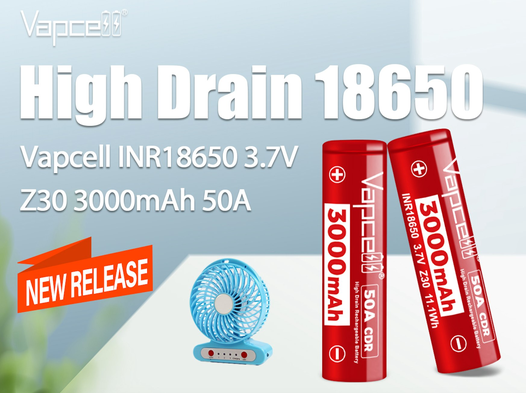
50A 18650.png

50A from an 18650? I'll need to check these out.
 
View attachment 79407
50A from an 18650? I'll need to check these out.
If the cell delivers 3ah and you try to pull 50a from it, you'll get about 3.5 minutes of runtime. If your battery contacts don't melt first.

I'm thinking there's a missing decimal point and the actual maximum draw is 5.0a which is much more believable.
 
Last edited:
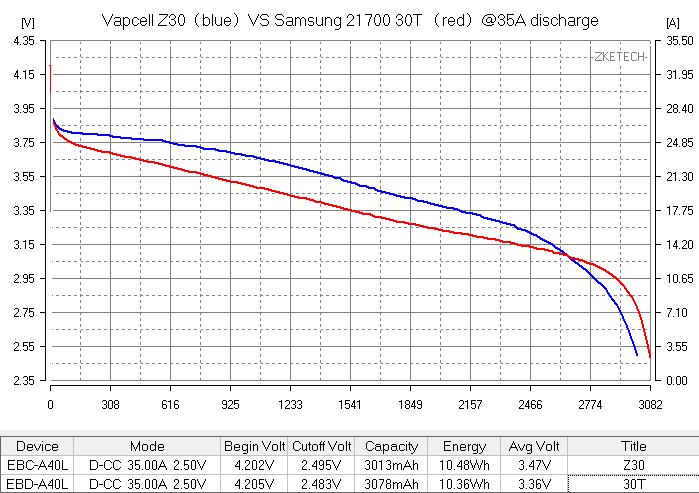
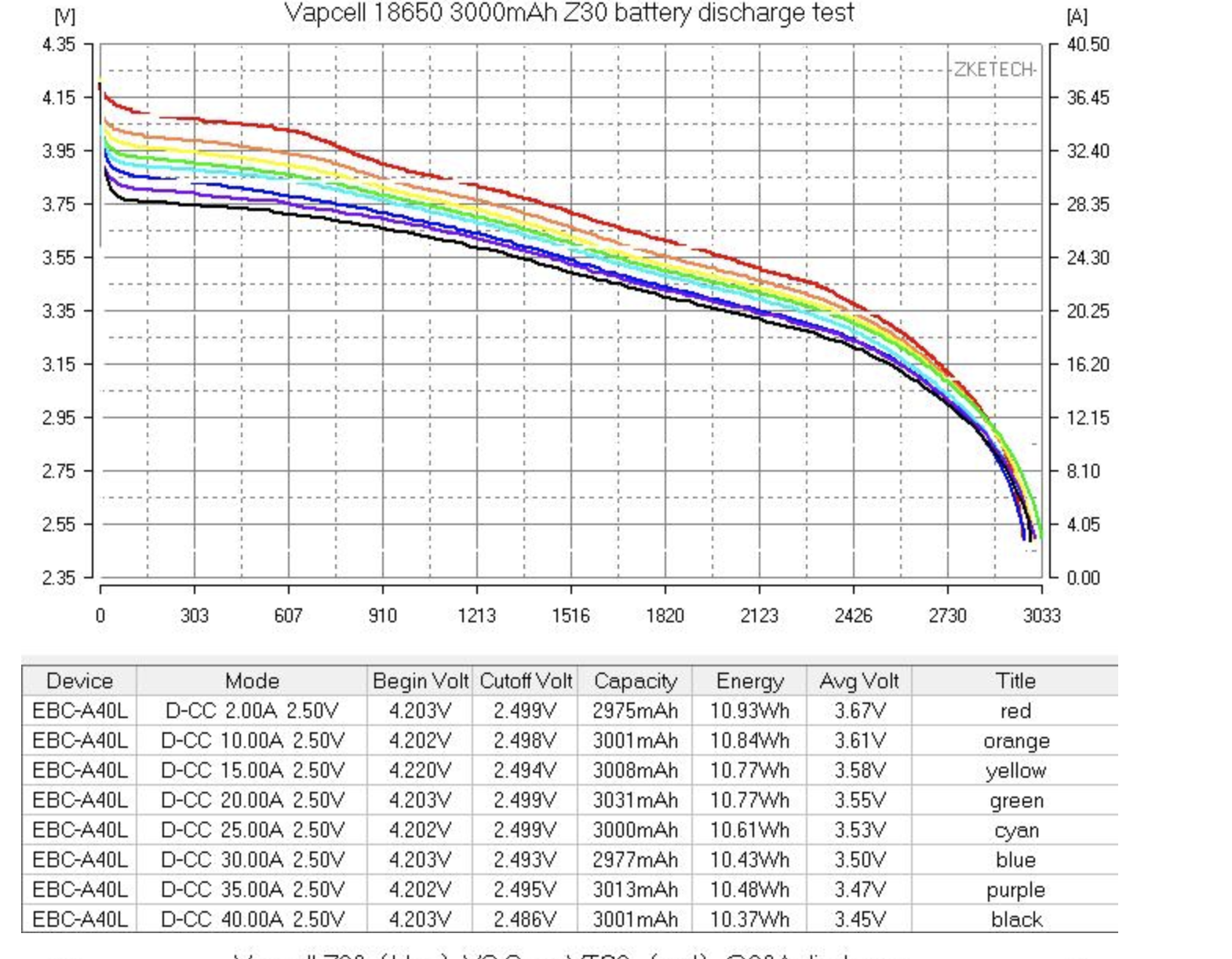
I have just ordered some and will be interested to see how they test. My instinct is that I wouldn't be rating them at 50A. But the test data on the Vapcell website shows no dropin capacity up to 40A. In fact capacity at 40A is higher than at 2A. I would have said that's impossible, but I am ready to be proved wrong. Interesting that they don't show results for discharge at 50A.
Screenshot 2025-05-26 at 19.03.38.png
 
Last edited:
I have just ordered some and will be interested to see how they test. My instinct is that I wouldn't be rating them at 50A. But the test data on the Vapcell website shows no dropin capacity up to 40A. In fact capacity at 40A is higher than at 2A. I would have said that's impossible, but I am ready to be proved wrong. Intyeresting that they don't show results for discharge at 50A.View attachment 79522
The capacity at 50A is probably doodoo, they CAN hit that peak sustained, but the power delivery is probably like 65% or so...
 
As an Amazon Associate we earn from qualifying purchases. Product prices and availability are accurate as of the date/time indicated and are subject to change.
If the cell delivers 3ah and you try to pull 50a from it, you'll get about 3.5 minutes of runtime. If your battery contacts don't melt first.

I'm thinking there's a missing decimal point and the actual maximum draw is 5.0a which is much more believable.
You can already pull 35A from a Molicel P30B, so it's certainly not missing a decimal, as Vapcell wouldn't release a battery with 30A less CDR and the same capacity as a popular battery.
 
lethal tasers?
I meant more in terms of flashlight use, but 50A cdr in other use cases is handy. High torque battery impact drivers for truck lug nuts, EV battery banks in performance EVs or electric motorbikes etc.

A lethal taser could probably be done with less battery power and just a capacitor maybe?
 
+

There are very few 18650 lights that are even 25A,, maybe some overdriven drop-in...
so, what you get with a very high discharge 18650 cell is peace-of-mind that on Turbo it can absolutely take it.

Alot of battery advancements are in lowering charging time,,
meaning you can charge them at high Amps,, the flipside to that is they have the ability to do very high discharge rates.


I don't think there are any flashlight brands that are driven hard as Nightwatch.
They are mainly 21700 lights

edit typo
 
Last edited:
When Larry Niven wrote in "The Ringworld Engineers" the characters had "flashlight LASERs" with batteries that could be made to explode like grenades, I went "Nahhhh. No way that could work."

Forward a couple decades from 1979 and here's Lithium-Ion batteries with some serious 'splody capability if handled wrong, and a couple decades more there are handheld LASERs capable of some serious damage, but they still make lousy flashlights.

What opened my eyes to the potential of Li-Ion to go seriously wrong was a some blog or forum post by a guy who wrote about recharging some 18650's for a flashlight. He didn't pay attention to things and just took the two cells off the charger and put them in his light. A bit later he heard a hissing sound, realized it was coming from the light. He chucked it onto his balcony and ducked down behind his kitchen counter. The blast ripped a shallow crater in the stone floor of the balcony and shattered his sliding glass door. He included photos of the damage and the remains of the flashlight.

An 18650 that might be able to put out 50 amps, even very briefly? That is downright scary. Fortunately we have much better power/charging tech now. I still wouldn't want to use these beasties in a dual cell light without individual cell monitoring and reverse charge protection. That's why Olight discontinued all their models with removable dual cell Li-Ion. One guy died holding one in his mouth when he used unprotected 123A cells. Mostly likely the same thing happened as did to the guy who blew up his balcony.
 
+

Vapcell buys bare sell from companies like Panasonic, Samsung, Molicel, ect,, and puts their name on them.
Very common thing to do.


My Vapcell 45A 21700s' are actually Molicel INR21700P45B (4500mAh cells that'll do 45A continuous)
bought them from illumn
My Vapcell 18500s' are likely Panasonic base cell,, got the Vapcell because of the button top.
also bought from illumn
 
Just for my own info as a non-cell-expert: Is it true that w/li-ion chemistry(ies), max capacity and max continuous output current are generally performance characteristics which fundamentally 'trade off' against each other by design, and that most cells are generally optimized for one or the other?

If true, would that mean that I should probably not select a 50A-continuous cell when my flashlight application demands a max current of, say 5A, or 10A continuous?
 
Back
Top