Anyone else completely against lights with built in batteries?

Candle Power Forums

Help Support Candle Power:

I've changed my thinking on the non-replaceable battery front. If it's a keychain light used very intermittently during the day, that is just as likely to be lost or damaged as to wear out its internal battery, then the trade off of lack of serviceability might well be worth the gains in compact size and improved reliability. All my replaceable battery lights need periodic cleaning of the battery contacts. If it's a lamp used hours every day and is more likely to run out of battery cycles before it gets stolen, well, that's a case for replaceable batteries. Proprietary? Meh, I've got one spare OLIGHT battery for my headlamp and flashlight - for my very light service case, not sure if the batteries will wear out before I do. If I had dozens of 18650 lights I'd be more worried about proprietary batteries. I currently use a 9-year-old phone and an 18 year old iPod on their original non-replaceable batteries. I did have to replace the LiIon pack in my netbook after 12 or 13 years, and was glad it was user-replaceable. I guess not all of us are prepared for The Day when only our stock of hoarded lithium AA primaries is all that stands between us and the zombie army.
 
Same here. I never liked warm weather from the time I was a kid. Now that summer's starting I'm in hibernation counting the days until fall.
I've always considered myself to be an indoor person...until I worked in Alaska in the summer/early fall. I was outdoors almost every moment I could be there. I even took up hiking, going up mountains, etc. People started to wonder what got into me up there.

Due to my health, the heat and humidity here absolutely drains my body. However, I absolutely love severe weather, so the tropical systems and daily thunderstorms make up for it. Not to mention some serious HVAC in all of my places. We even travel with a small desiccant wheel dehumidifier.

I agree 100% with this. Other than lower energy density LFP checks all the boxes-longer cycle life, longer calendar life, no risk of fire or explosion, less costly, etc
Eh...this firefighter (also mechanical engineer for EVs) would beg to differ:


and a follow-up with more details on that same incident:

I've changed my thinking on the non-replaceable battery front. If it's a keychain light used very intermittently during the day, that is just as likely to be lost or damaged as to wear out its internal battery, then the trade off of lack of serviceability might well be worth the gains in compact size and improved reliability.
I used to carry a Rovyvon A5 on my keychain. I like it as a light, but invariably it was always dead or near dead when I needed it. A Lumintop EDC01 is about the same size and I've never seen it fail. I replaced the Rovyvon with an EDC15/Tool AA 2.0 mutt. I don't notice the size/weight difference and it's brighter with better runtime.
 
Interesting. You condemn Olight for making a 3-connection cell so that it can be replaced. Mot makers just wire up internal. And then you condemn them for internal cells.

My advice for Olight users that dislike having a proprietary cell just glue the battery in, put on a little sticker "No user parts inside."
 
Like the OLIGHT ArkPro, it looks great! But as soon as that battery dies, you're toast!

You also have to wait for a recharge and can't just swap the cell

18650 and 21700 lights should be around nearly forever
Yes. I absolutely will not buy a light that has a non-replaceable battery.
 
Proprietary cells are one thing (looking at you, Nitecore "I"-cells), but so long as they are user replaceble, I can accept it.
I'm sorely tempted by the features of some of the Nitecore i-Series lights, but so far, I haven't taken the bait. The P10iX tactical floodlight and the "Intelligent 21700 Battery System with Lantern and Charger" kit are particularly calling to me. Honestly, the only reason I haven't bitten on that hook is I don't like the idea of the switch mechanism on the P10iX.
 
I agree with the sentiment, and have never (I’m pretty sure?) purchased an Olight.
The exceptions to my rule against proprietary batteries are lights that I am willing to treat as disposable. E.g., the Nitecore Tube — I bought a few of those and still use a few as nightlights in hotels. They ride in my toiletries kit. If I forget to pack it up and leave it behind me in a Hilton somewhere, I will not cry. (As opposed to the time that I left a Quark Atom 0 in a hotel and they couldn’t find it, sniff/sob.)
I also EDC a Nitecore TINI2 as a second or third backup light — it rides in my wallet. Because of its digital display, I can check its charge level every few weeks and verify that it’s full. That’s a semi-disposable: not as cheap as the Tube, and actually quite a nice combo of runtime or output (85 hours at 1 lumen or up to 500 lumens on brief blast). So, if that dies I will be sad to toss it, but toss it I will.
Here’s an example of built-in versus replaceable. I bought a Nite-ize Glow stick a couple of years ago: think, battery-powered Chemlight. I wanted to have a light to hang on my bike or myself if I had an unexpected walk or ride in the dark. Unfortunately, each time that I have wanted it, it has been drained. And since the battery is a little proprietary li-ion cell soldered to the board, there is no way of carrying a spare.
Well, just last week I decided that I had lost patience with it. I ordered on EBay the old “Glotoob” brand of Chemlight replacement, in the model that runs in AAAs. AAA cells I always have and can always find. That’s one fewer proprietary battery in my go-bag (goodbye Nite-ize) and one more standard replaceable (hello Glotoob).
 
As an Amazon Associate we earn from qualifying purchases. Product prices and availability are accurate as of the date/time indicated and are subject to change.
I'm sorely tempted by the features of some of the Nitecore i-Series lights
Honestly, me too. Some of the I-series lights are interesting to me, but it feels like I would risk locking myself to that ecosystem.
There is apparently a "gen. 2" now, that is usable in most other devices, but the initial release of the Nitecore I-series batteries were only usable with an I-series flashlight, and vice versa.

I have 2 issues with that. They should have considered that earlier, and most importantly...they don't say which generation is which. There is also a Nitecore UMS4 "gen 2" charger now, with USB-C instead of Micro-USB. There is NO difference in part number or EAN as far as I can tell.

If I were to order a Nitecore I-cell now, or get into that ecosystem from different sources, I wouldn't know which generation I will receive, and thus where I can safely use it. I don't know any obvious design differences either, making the whole I-system less user friendly at best, and outright dangerous at worst, with risk of short circuits.
 
No to proprietary batteries since 4-Sevens debacle. Built in non-replaceable is okay for a cheap keychain light, but nothing else.
 
Are we making a distinction here between "Not hot swappable" and "Not user replaceable"? Sometimes "Not got swappable" is annoying, but I tolerate it on certain lights for certain purposes. "Not user replaceable" comes in two flavors. One is sealed shut, it ain't happening, and two is, there are screws, so anyone with a screwdriver, a soldering iron and some initiative has a good chance of getting it done...
I prefer lights with hot swappable cells. After that, I'll make exceptions for certain things. Past that, I have an Olight I1R keychain light. I consider it fully disposable, unless someone knows something that I don't..
 
Are we making a distinction here between "Not hot swappable" and "Not user replaceable"? Sometimes "Not got swappable" is annoying, but I tolerate it on certain lights for certain purposes. "Not user replaceable" comes in two flavors. One is sealed shut, it ain't happening, and two is, there are screws, so anyone with a screwdriver, a soldering iron and some initiative has a good chance of getting it done...
I prefer lights with hot swappable cells. After that, I'll make exceptions for certain things. Past that, I have an Olight I1R keychain light. I consider it fully disposable, unless someone knows something that I don't..
I know something! The Imini2 might be more practical for keychains! If only they would stop lumen chasing and put bigger resistors in there to drop it to maybe around 5-10 lumens max, they could bump the useful runtime up like crazy (at least a factor of 3×.) I've been nagging olight to do something like that for a while, but I believe they're convinced that the average consumer still currently wants the brightest thing available...Meanwhile, the strengths of these tiny magnetic lights is their ease of use, hands free capabilities, and ease of rechargeability...I wouldn't expect a tiny light to deliver searing lumens, so it'd be great to have something that capitalized on its strengths rather than trying to "punch above its weight".
 
I know something! The Imini2 might be more practical for keychains! If only they would stop lumen chasing and put bigger resistors in there to drop it to maybe around 5-10 lumens max, they could bump the useful runtime up like crazy (at least a factor of 3×.) I've been nagging olight to do something like that for a while, but I believe they're convinced that the average consumer still currently wants the brightest thing available...Meanwhile, the strengths of these tiny magnetic lights is their ease of use, hands free capabilities, and ease of rechargeability...I wouldn't expect a tiny light to deliver searing lumens, so it'd be great to have something that capitalized on its strengths rather than trying to "punch above its weight".
The I1R is a special case. I only use it as a necklace in very wet environments when I can't carry anything else, like canoeing. I won't go without a knife, a light and a lighter.
 
Last edited:
Are we making a distinction here between "Not hot swappable" and "Not user replaceable"? Sometimes "Not got swappable" is annoying, but I tolerate it on certain lights for certain purposes. "Not user replaceable" comes in two flavors. One is sealed shut, it ain't happening, and two is, there are screws, so anyone with a screwdriver, a soldering iron and some initiative has a good chance of getting it done...
I prefer lights with hot swappable cells. After that, I'll make exceptions for certain things. Past that, I have an Olight I1R keychain light. I consider it fully disposable, unless someone knows something that I don't..
That's a good point.
To me, it should be tool-less for most lights. I want to be able to swap them in the field.

For some lights, maybe standard screws.

Definitely NOT soldered-in batteries. I travel. My soldering station stays home.
 
I like lights with built in batteries, it can be charge anywhere with cell phone charger.
I never carry one flashlight with me.
I always check my lights battery, if it less than half power, charge it up.
If the lights with built in batteries die and cannot charge, it will be a few years.
Buy a new light, lights come out new and better every year.

 
If only they would stop lumen chasing and put bigger resistors in there to drop it to maybe around 5-10 lumens max, they could bump the useful runtime up like crazy (at least a factor of 3×.) I've been nagging olight to do something like that for a while, but I believe they're convinced that the average consumer still currently wants the brightest thing available...
That goes for every major brand, it seems. In my case, mainly Nitecore and Fenix. They are always pushing the Lumen number, more and more, with crazy 30-second Turbo times that drops the battery power 50 %.

I guess it's still down to the lack of knowledge among the consumers, where a bigger Lumen number always = better. All brands could have dropped the Turbo mode, and anything that isn't termally sustainable, for all I care. If they want to make a claimed 10.000 Lumen light or above, then make it the size of a water bottle - not the size of a pencil. Anything big enough to handle the heat.

I honestly find it all a bit ironic, because I was one of those who thought a higher Lumen number is always better. But now I know what a Lumen number really mean, and how it isn't that much difference between 5000 Lumen and 10.000 Lumen (obviously depending on reflector and emitter model and all that).

These days though, what I first look at (after finding the battery type), is what is the highest sustained output number. Because that, to me, is what a flashlight is actually capable of. Which is why I feel quite cheated by the Acebeam E75 - they state it is a 4500 Lumen flashlight (only applicable to the 6500K LED option), whereas the 519A is only 3000 Lumen. And only 1000 Lumen sustained.
 
...These days though, what I first look at (after finding the battery type), is what is the highest sustained output number. Because that, to me, is what a flashlight is actually capable of....
That's something that I like about the Streamlight Sidewinder series. The highest output, when running a CR123, is 275 lumens. That is a sustainable output for that cell. The highest output when running a single AA, is 140 lumens. That too is a sustainable output for that cell.
And the run-time claims are modest as well. They claim 2:45 hrs for the CR123, and 4 hrs for the AA. My guess is that the output at the end of those periods is pretty close to the output at the beginning -- not just 10% of the initial output. (Of course an alkaline AA will sag a lot more than an Eneloop AA will). And they provide real low modes that give over 100 hours of usable light.
This may have something to do with the military being a central part of their market. Hype will only get you so far when you are sheltering in a basement.

ETA: on second thought, I see that Zebra gives only 2.1 hours at 140 lumens (H2.2) on an SC54. And their drivers are pretty efficient. So the Streamlight figure of 4 hours at 140 probably is building in a fair bit of reduced output towards the end of that period. Still, 140 lumens is a more sustainable high for an AA alkaline than the 300s and up that some AA lights list for their highest level.
 
Last edited:
All my replaceable battery lights need periodic cleaning of the battery contacts.
???

I've never once cleaned a battery contact on my replaceable battery flashlights, nor needed to. That's with 100% rechargeable batteries or lithium primaries only, cause friends don't let friends use alkalines. All my lights are top quality (26 Zebralights, Malkoffs, etc.). Not sure if it's the metal in these lights, and my environment is harsh (the hot wet South), but there is no noticeable corrosion on my lights.
 
Last edited:
Yes!!!!


Most of the time 🤦🏻‍♂️
IMG_0294.jpeg

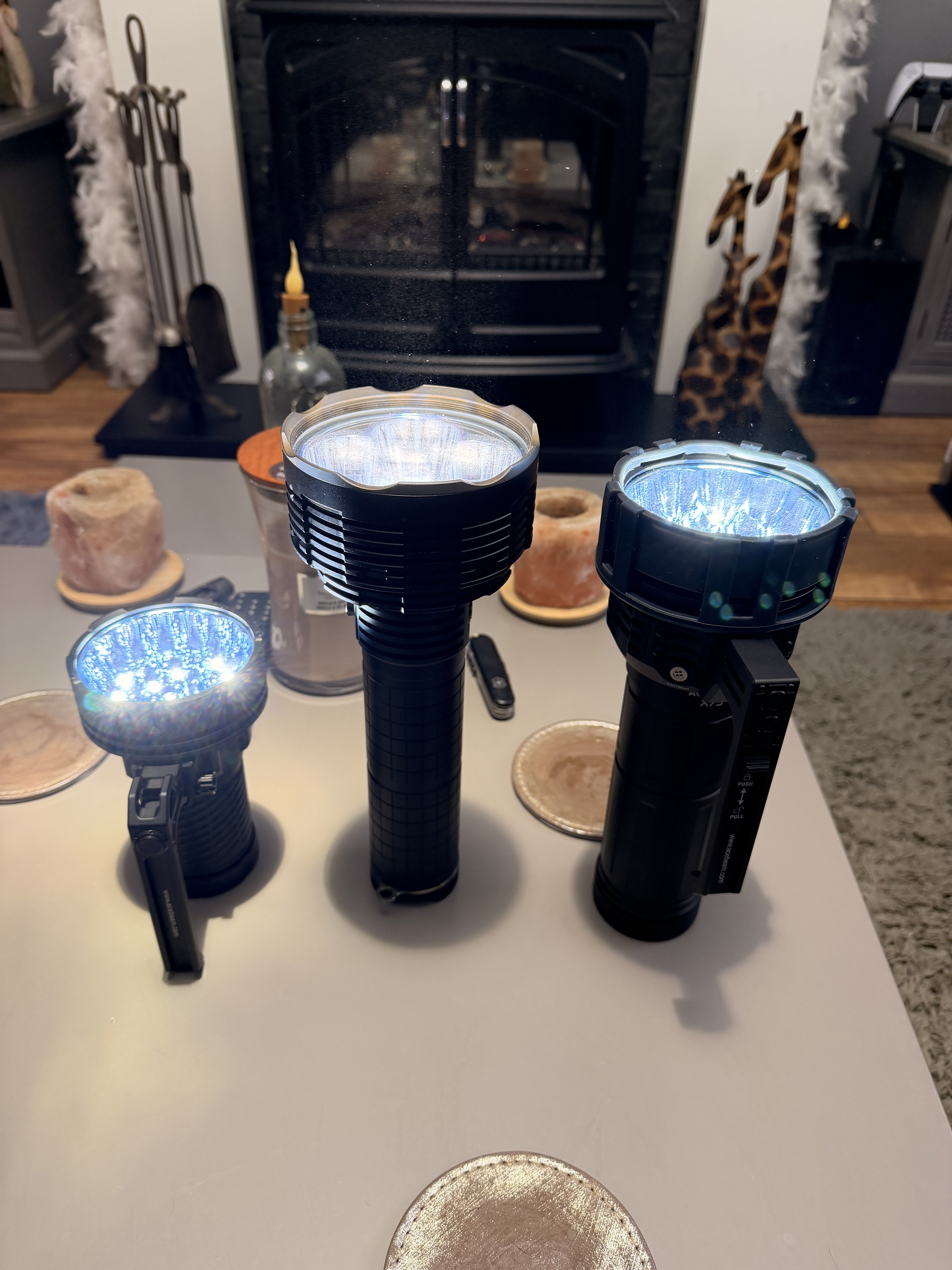
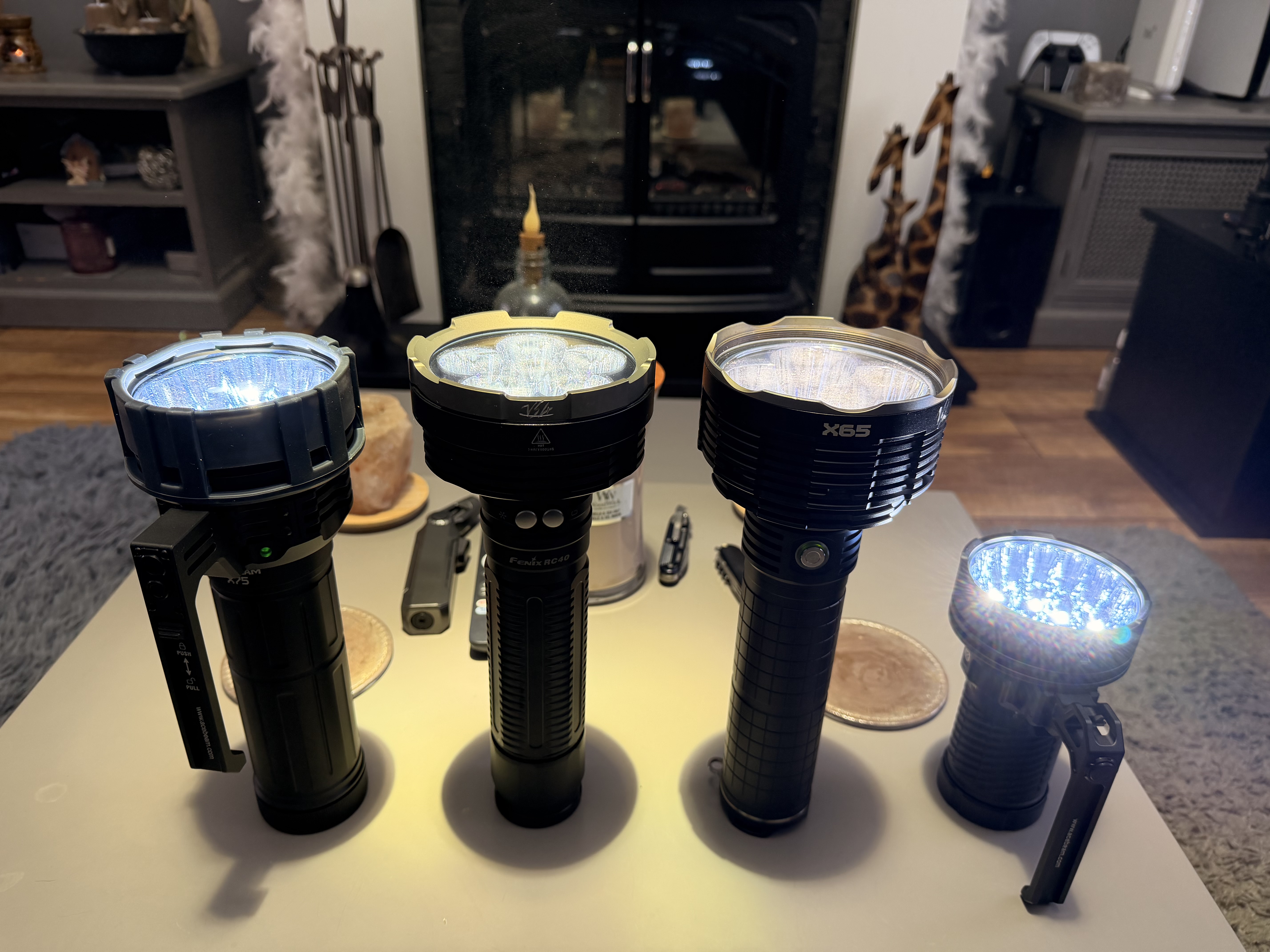
Pros and cons and even though I have several more, if want crazy outputs off the shelf, manufacturers only seem to provide built in packs for safety reasons. Now as with most I’m not a fan, end of day it’s an expensive paper weight in 5-10yrs!
IMG_0298.jpeg

However rebuilding the packs is not too bad. So come that time , for the cost of 6 or 8 18650 or 21700, your back on it. I’ve found that by the next time, you’re probably done and moved on anyway. With the way tech moves forward, I like to try something new and fresh. Still the good old xhp35 HI 5000k are just 👌🏻 after many years.
End of day it’s just a torch, buy a pack, get old one rebuilt, buy latest and greatest. Several choices come that time. Don’t want to risk X amount on a possible paper weight, don’t! Just a shame it seems crazy output fun lights are mostly that way🤷🏻‍♂️
 
Back
Top