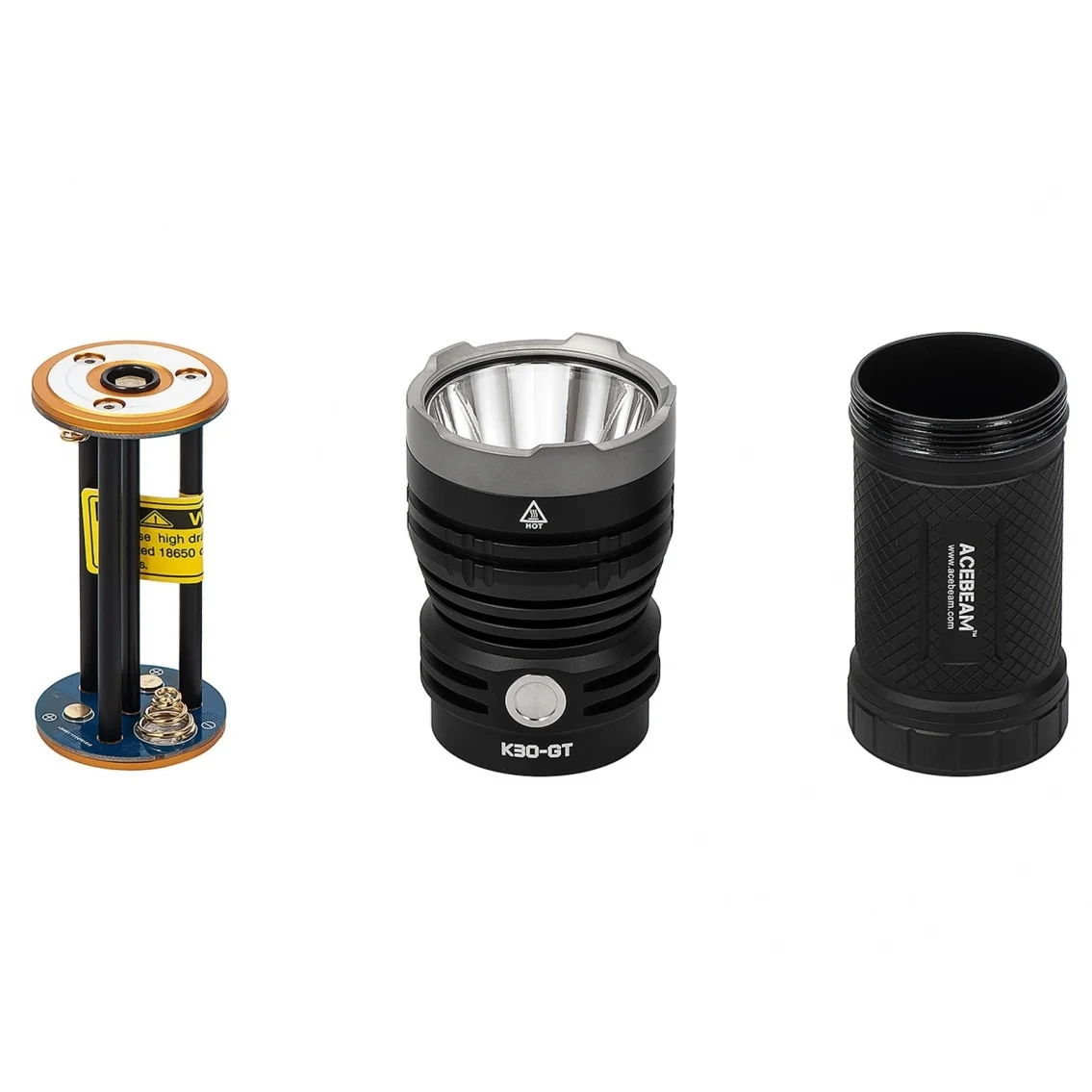
Look at the Acebeam K30 GT battery carrier, using 18650
two up, one down series voltage.
For Convoy, just do that w/ 21700s'
same Watt Hours or mAh of your cells
I am familiar with the design. But the mAh is multiplied in a parallel configuration compared to a series configuration.
I don't know much about electronics, and have frankly almost given up on it, but I do know that one. Volts * Amps = Watts. Or in terms of mAh, it stays the same as a single battery in a series configuration. What I do NOT know anything about is how drivers work, or the voltage range of any emitters, or how many amps it's possible to feed them before they burn out.
3x 5000 mAh, 3,7 V in series = 5000 mAh, 11,1 V
3x 5000 mAh, 3,7 V in parallel = 15000 mAh, 3,7 V
Amps and Watts (and heat) of course depending on the draw (driver, number of emitters etc.), and how much the cells can deliver.
^ Do we agree on that? If we do, then we agree all the way.

Higher voltage means less Amps, and that, as I said above, means less heat - and THAT is ALWAYS a good thing, on that we heartily agree!
I do wonder how my Fenix TK75 / TK76 configuration works though. They have a "2P2S", 4x 18650 battery carrier. With 3500 mAh cells, that should make each carrier 7,4 V, 7000 mAh - but how does it work with 3 such carriers in a series configuration? On paper, it should triple the overall voltage, which I would assume would be burning out the LEDs. But the light works the same whether it's with 1 or 3 carriers.
My guess has been the driver is sorting all of that out (though a 7,4 - 22,2 V driver would be wild in a flashlight, especially in a light as old as the TK76). It would also explain why Fenix says 3x carriers is the maximum. 4 carriers is borderline the physical maximum before needing to cut and shorten the carrier springs.
I would trust a parallel configuration more than a series one though, especially with unprotected cells. But again, that may just be down to my limited knowledge.
If something fails in a series config, the appliance would stop working. If something fails in a parallel config, it would still work, but with increased load on the remaining parts.