Comprehensive Grease and Lube Thread

Candle Power Forums

Help Support Candle Power:

i like nyogel 760g as well, but you could give Krytox a try.
And speaking of overpriced...

I really hope that one comes in different versions. I googled the name, and the first hit with a local price was "KRYTOX-XHT-BDZ-T 227GR" at equivalent of ~1000 USD. ^^
 
Regular SuperLube synthetic grease is NOT Silicone based. In the Technical Data Sheet (linked here, and attached) it states 'There is no Silicone in Super Lube® Multi-Purpose Grease with Syncolon® (PTFE)'.

There is also a compatibility chart (also linked and attached) which indicates that the compatibility is 'Excellent' with Nitrile (aka Buna-N) and Neoprene, but only 'Good' with silicone. So perhaps there is an ingredient which is less than ideal for silicone, I'm not sure what to make of that.

Note that Super Lube makes multiple types of grease, including a silicone grease (which of course is NOT compatible with silicone). But their synthetic grease, which is their most common / standard product, is not silicone based.

I have been using the Super Lube O Ring lubricant. So far. So good.
 
227 gram / 8 oz. I have no idea what I found. ^^
Without specifications or a product link, I think I'll stick to Nyogel 760G

Googled a bit more, and it was apparently this:
"KRYTOX XHT-BDZ Extreme High Temperature Grease, NLGI Grade 2, Tube, 8 oz."
Check out the GPL series

If you want something more "budget" friendly, and recommended by someone who's experienced in the flashlight industry, https://darksucks.com/products/nano-oil-1cc
 
Last edited:
As an Amazon Associate we earn from qualifying purchases. Product prices and availability are accurate as of the date/time indicated and are subject to change.
227 gram / 8 oz. I have no idea what I found. ^^
Without specifications or a product link, I think I'll stick to Nyogel 760G

Googled a bit more, and it was apparently this:
"KRYTOX XHT-BDZ Extreme High Temperature Grease, NLGI Grade 2, Tube, 8 oz."
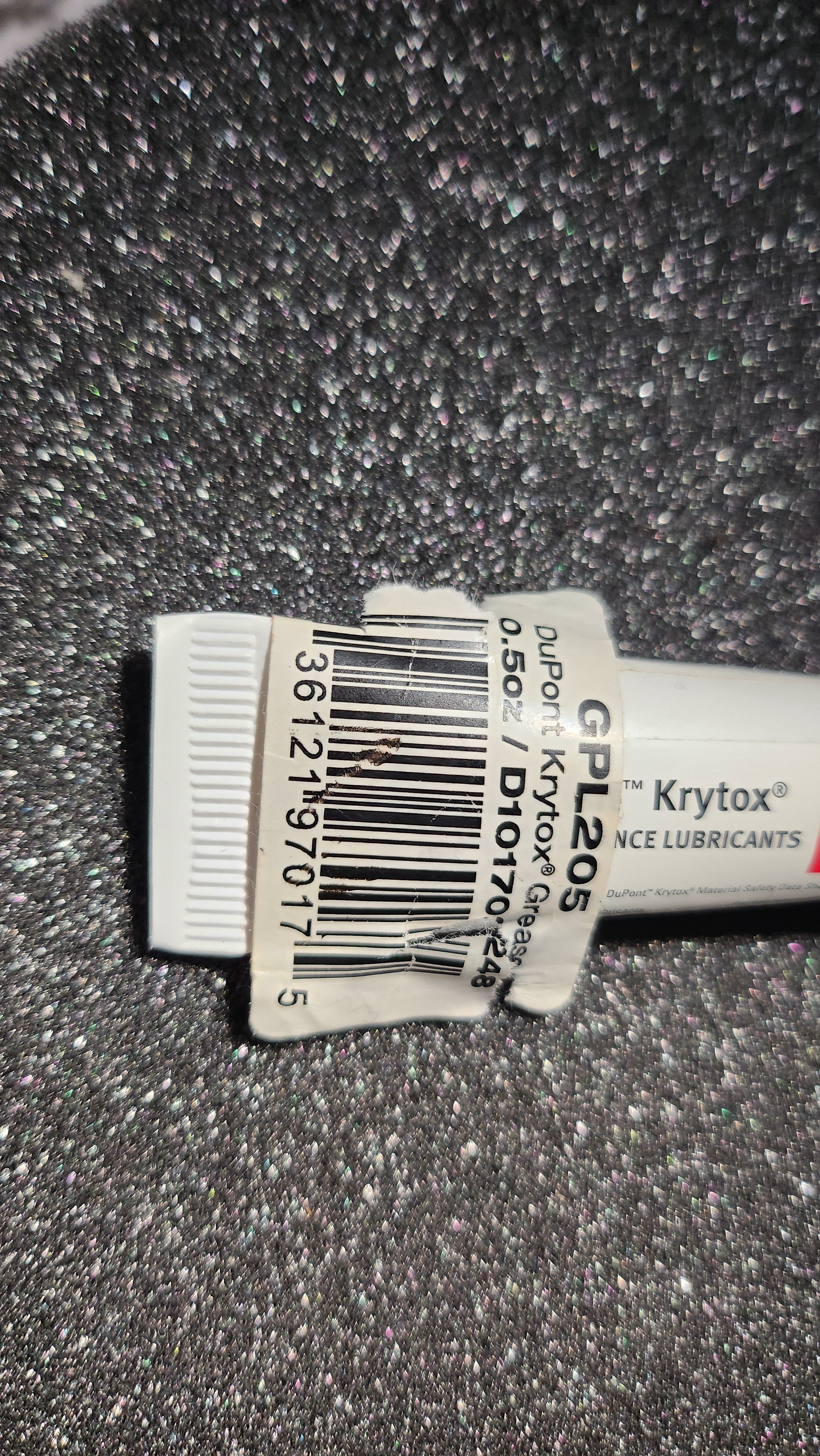
I found my Krytox. Hope this can help with your search.
1000006848.jpg
 
Does anyone know if water-based lubricant made for speed-cube harm o-ring? I did some speed-cubing in the past and have extra speed-cube lube laying around. Most of them are silicone-based but one is water-base and I'm wondering if I can use water based one to lubricate the lights?
 
Does anyone know if water-based lubricant made for speed-cube harm o-ring? I did some speed-cubing in the past and have extra speed-cube lube laying around. Most of them are silicone-based but one is water-base and I'm wondering if I can use water based one to lubricate the lights?
Ask a mathematician.
 
Yeah, that's true that the water-based speed cube lube are pretty short lived, that's why I didn't use it much. I figured cleaning flashlight threat is much easier than taking a cube apart and clean the inside of a speed cube..
 
No clue if its been mentioned already or not. Im sure it has so thisnis just another anecdotal testimonial.

Progold makes two greases as well as the cleaner and anti oxidatant sprays. One is just a lube, the other contains the antioxidant additive and cleaner. I've been using them for a few years... so there is also thenchance that they've been discontinued. I haven't checked to see if they are still around.
I started using it when I could no longer get Nyogel.
I've also used SuperLube a few times. Whichever one is closer when I need to lube a light gets used.
 
I use to use plain old Vaseline for years without any issues at all however I have re-greased all my lights with LOX-8
 
I typically use Nyogel 760 on my aluminum lights, and CRK Krytox on the titanium ones. Lately it appears Nyogel is better for the Ti, as well. Can anyone confirm or deny? I used 760 on my new FWAA. But it's a bit rough, and I'll need to clean it off, polish the threads a bit, and reapply.

I picked up Super Lube Oil for some sticky situations I found myself in with an antique drill press and a dirty pistol. Not the grease, though. Haven't tried it on a light.

I don't recall seeing Mobil-1 Red Synthetic there before. I don't have that, but have a tub of Redline CV-2 red synthetic grease. Because it hasn't previously been recommended, I've never tried it on a flashlight. It's been great in automotive and light industrial applications. But, it looks like both Mobil-1 and CV-2 are premium NLGI No.2 greases, but in a different base. CV-2 is non-soap, and contains a (supposedly non-toxic) organic Red Moly. This gives CV-2 a wider operating temp range. According to Bob the Oil Guy, CV-2 is less likely to separate or bleed out.

Before trying it out on my lights, does anyone else here have experience with Redline CV-2 red synthetic grease on Aluminum, Titanium, or Copper flashlight threads and, more importantly, O-Rings? Can anyone with more expertise in this area take a look at it and see if there's a reason it would not be a "Very Good", or recommended, flashlight lube? Will it stay off the list due to possible incompatibility issues with Silicone O-Rings?
 
Last edited:
Easy to overthink, but silicone grease is the universal choice for torches. Compatible with your o-ring material of choice; EPDM, FKM, NBR, silicone etc (I only use EPDM and silicone).

The main factors with lubricant compatibility and o-rings are swelling and degradation due to incompatibility.(There’s also a range of other issues depending on the application but none of that will apply to torches).

Not only is silicone grease universally compatible with torch body and o-ring materials, it’s cheap and easy to source from pool supplies or hardware stores.

Keep in mind that a well used torch will still need occasional cleaning and replacement of lubricant and to a lesser extent, replacing the o-ring at the threaded end of battery insertion.

Regarding titanium threads; that’s just the nature of them particularly on cheap titanium lights.
They’ll get grubby more quickly and require cleaning and replacement of lubricant, they’ll generally feel more rough from galling unless they’re high quality.
Polishing the threads sounds excessive to me or at least very particular.
I can get away with just using deoxit gold on my Haiku threads but they are well made. Silicone grease works well on them also.

As far as nyogel 760g goes, I’d save it for where you need dielectric grease personally.

Long story short, plain old silicone grease.
 
Haha, these exotic lube threads crack me up. I'm still using a tube of General Lube from Radio Shack that's a least 20-years old.

I've never had an O-Ring failure or leak from a light that wasn't supposed to leak due to the lube.
 
  • Like
Reactions: F89
Haha, these exotic lube threads crack me up. I'm still using a tube of General Lube from Radio Shack that's a least 20-years old.

I've never had an O-Ring failure or leak from a light that wasn't supposed to leak due to the lube.
You need to get onto the unicorn oil, I swear by it.
 
Easy to overthink, but silicone grease is the universal choice for torches. Compatible with your o-ring material of choice; EPDM, FKM, NBR, silicone etc (I only use EPDM and silicone).

The main factors with lubricant compatibility and o-rings are swelling and degradation due to incompatibility.(There’s also a range of other issues depending on the application but none of that will apply to torches).

Not only is silicone grease universally compatible with torch body and o-ring materials, it’s cheap and easy to source from pool supplies or hardware stores.

Keep in mind that a well used torch will still need occasional cleaning and replacement of lubricant and to a lesser extent, replacing the o-ring at the threaded end of battery insertion.

Regarding titanium threads; that’s just the nature of them particularly on cheap titanium lights.
They’ll get grubby more quickly and require cleaning and replacement of lubricant, they’ll generally feel more rough from galling unless they’re high quality.
Polishing the threads sounds excessive to me or at least very particular.
I can get away with just using deoxit gold on my Haiku threads but they are well made. Silicone grease works well on them also.

As far as nyogel 760g goes, I’d save it for where you need dielectric grease personally.

Long story short, plain old silicone grease.
According to a quick google search, to verify what I thought I remembered, from an unrelated project. “Silicone grease” is okay for some of the rubber orings in your list, but NOT on actual silicone orings.

FROM SEARCH:

“Using silicone grease on silicone (VMQ) O-rings is generally not recommended. Because both the grease and the O-ring are silicone-based, the O-ring can absorb the lubricant, causing it to swell, degrade, or lose structural integrity.”
 
According to a quick google search, to verify what I thought I remembered, from an unrelated project. “Silicone grease” is okay for some of the rubber orings in your list, but NOT on actual silicone orings.

FROM SEARCH:

“Using silicone grease on silicone (VMQ) O-rings is generally not recommended. Because both the grease and the O-ring are silicone-based, the O-ring can absorb the lubricant, causing it to swell, degrade, or lose structural integrity.”
It’s fine.
VMQ 60A has a volume swell reference of < 2% when using silicone grease which is totally fine.

Pretty much all lubricants make all o-rings swell to a certain extent but some combinations are unacceptable.
Petroleum jelly for example will have excessive swelling on any o-ring you’ll likely find on most torches.

Overall NASCAR is right, there’s a lot of over thinking in these threads.

I’ve used silicone grease on silicone rings plenty. No excessive swelling or premature failure.

The internet is funny like that.
Your quote above was the first thing my browser AI picked out also.
Here’s an example of another quote my browser AI suggested which is completely at odds:

Silicone-based greases are recommended for silicone O-rings because they are chemically inert and compatible with most rubber and plastic compounds.
 
Last edited:
Back
Top