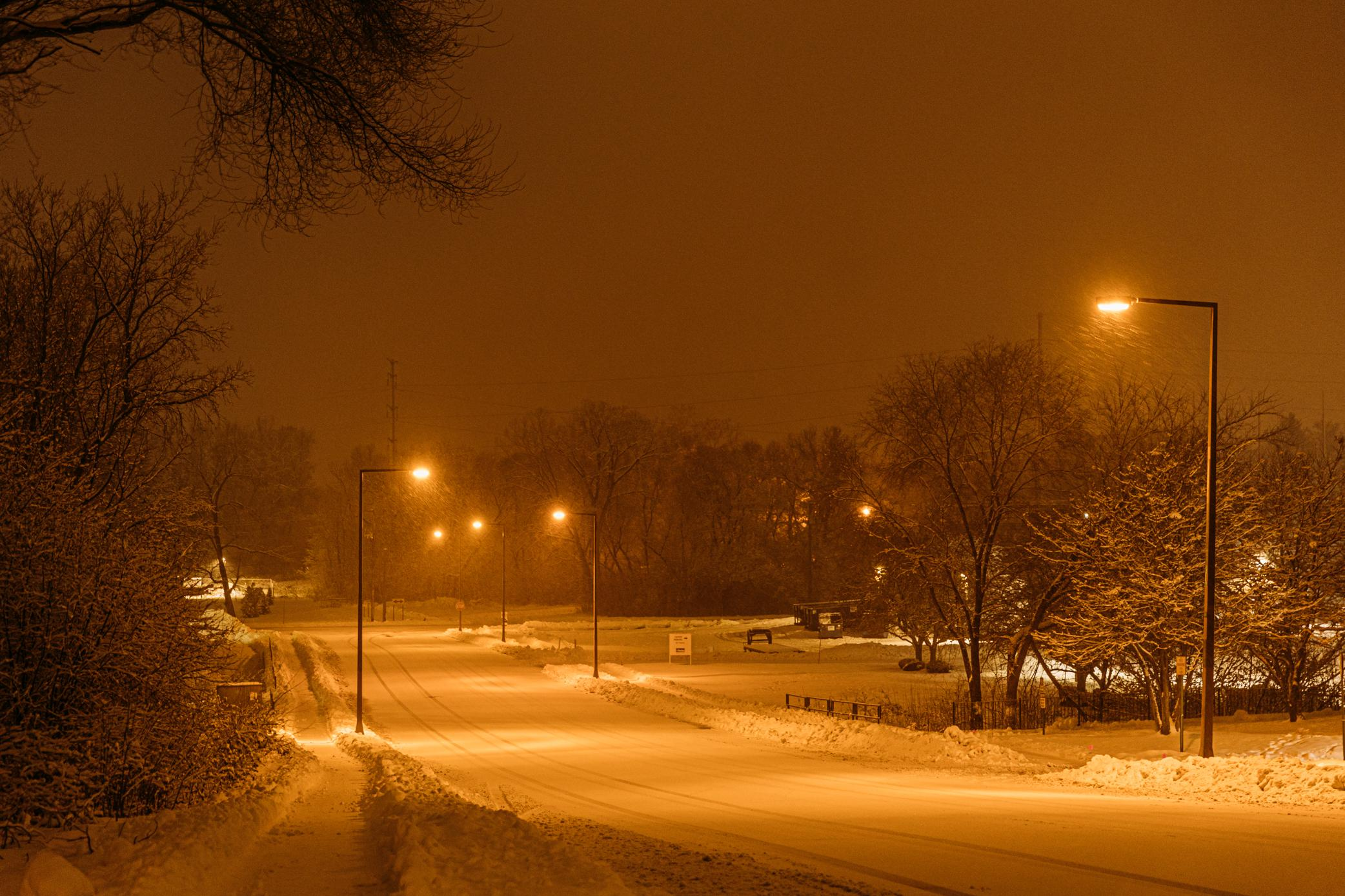
That's mostly applicable to places where snow might sit around all winter. In cities and many suburbs the roads are plowed in a matter of hours.
Seeing the actual color of things is important. If the lighting is going to make red look like brown and blue look like black, why bother? I'd rather have no lighting than bad lighting.
Yes, there's a lot of light here, to the point you can easily read on most streets. As for preferences, snow is white, isn't it? I like lighting that makes it look white, not yellow.
I guess everyone has different preferences. I absolutely want to puke looking at that picture. I feel like I have gauze over my eyes when on a street lit like that. Natural lighting at night (i.e. starlight, moonlight) is high CCT. Yellow lighting absolutely destroys the beauty of night. As I said no light is preferable to that.
Yes, I'm 63. I'm old enough to remember how I hated the sodium lights compared to the mercury vapor ones. No driver's license, so my only experience is piloting a bike under them Absolutely awful. No depth perception. I couldn't tell if a black spot on the road ahead was a pothole or just a slight dip in the pavement. The 4500K LEDs NYC initially put in were so much better. At least they left those on the arterials.
Personally unless you have an essential job to get to, I don't think people should be driving in blizzards at all.
0 CRI means no depth perception. Yellow light means poor peripheral vision. These are all valid safety concerns beyond the aesthetic ones. A properly lit street should have the same colors as during daytime, except of course at much lower intensity levels.
We really should try high CRI for streetlighting. For the "blue light bad" crowd this reduces the size of the blue light spike. 4500K, 95CRI puts out less blue light than 2700K, 70 CRI. It also increases apparent brightness at any given intensity, which means you can reduce the intensity to achieve the same overall effect. And lastly high CRI just makes things look better.
Agreed on DST but sadly the states that want to do away with clock switching want to keep permanent DST instead permanent standard time! As for messing with sleep cycles, there are lots of causes besides high CCT lighting. We have too many distractions. People keep their phones by their beds and check for messages all night. Not to mention without enough exercise you're not tired enough to sleep well.
Because we make laws based on feelings and not real data. Some of the streetlight laws like Florida's are a perfect example of this. The regulations should cover things like light trespass, proper cutoffs, and so forth. You want to light the street while leaving everything else as dark as possible. Requiring low CCTs when the science says this negatively impacts safety is a law based on feelings or preferences. It's not just that low CCTs make peripheral vision and depth perception worse. The bluer light coming from higher CCTs keeps drivers awake, which is something you want. I recall riding once and actually falling asleep for about two blocks. Granted I was very tired but the HPS lights made a bad situation worse. To this day I don't know how I remained upright and kept my feet going while I dozed off. It was sheer luck I didn't collide with anything.
Even once snow is plowed, it tends to blow in the wind. Often, the most dangerous driving during winter is a day or two AFTER the snowfall, when the cold comes, and the winds pick up.
Also, our brains adjust to lighting and "fix" the colors across the range of CCTs. Snow isn't necessarily white, it's technically just highly reflective, and the sun has a full spectrum of light, so we're just used to seeing snow reflecting the full band of colors - which is white. This is that pedantic point that white and black
technically aren't colors, but the presence of ALL, or the absence of ALL.
But, back to our brains, when I use a very warm CCT, my brain adjusts for that in a few seconds, and I can differentiate colors just fine. I have an NTG and FFL 1800K emitter in some flashlights. They are fascinating because, AT FIRST, things look orange, but then you VERY QUICKLY are able to differentiate most colors just fine.
And, remember, moonlight is
fairly rare. There's only a couple days of full moonlight, so as humans, moonlight isn't our PRIMARY night time light source; it's fire. Fire predates
homo sapiens, and so we've been co-evolving with fire (there's very interesting arguments that the shrinking of our digestive tract correlates to the adoption of cooking via fire, which then allowed us to rapidly increase the size and energy expenditures of our brains). That means, for humans, our PRIMARY light source for the entire existence of our species has been about 1800K in the form of candles, campfires, torches.
So, while you can say it "destroys" the beauty of the night, historically speaking,
it is the only way to experience the night.
Being in the Midwest, driving in snowstorms is likely more common than in major cities, simply because things are spread out. It's quite easy to get caught in a storm during what would be a normal drive. Our weather is really unpredictable. So, it's kind of an inevitability that you're going to HAVE to drive in a snow storm. It sucks, but that's why half our population moves to the sunbelt, hahahaha.
I agree in terms of high CRI lights. I think the problem is politicians don't care, and they aren't interested in learning. Heck, neither is the general public.
You can try and talk to people about how halogen or HID headlights are far superior to 7000K AliExpress LED headlights, but they'll just keep going, "But, mine are brighter."
I also agree that lighting should be LESS INTENSE. I read once about how bright street lights don't ACTUALLY reduce crime, but just make people FEEL safe. Its kind of like the TSA. They don't ACTUALLY stop terrorism, but without them, no one would fly because people wouldn't FEEL safe.
Specifically, because street lighting destroys your night vision, you can't look into dark areas, and because of the light they emit, they create very bright areas, immediately surrounded by EXTRA dark areas. Street lights create
the shadows that criminals rely on to ambush people. So, you either need to fully light an area (just like during the daytime), or keep it dark, if you want people to ACTUALLY see what's around them.
But, good luck convincing the local Karens who insist they NEED to go jogging alone at night at 1AM, haha. "Feeling safe" is all they care about, and they will raise a huge ruckus for your city council if they don't get what they want.
Permanent DST would be such a disaster. It's funny, because when the US tried that in...1979? it was SUCH a disaster that Federal law actually BANS permanent DST, because they KNEW people would be dumb and forget how much of a disaster that winter was after a few generations - and, here we are!
That's why DST has been creeping and creeping, starting earlier, and ending later.
I recently discovered that many of the people I work with ACTUALLY think DST is the Government "gifting" us extra sun. They simply cannot understand why the Government INSISTS on making sunset so early in December... And their vote counts just as much as mine, hahaha.
Though, I'll strongly disagree that blasting drivers with blue light to wake them up is a good idea. All that blue light is
why they aren't sleeping, and
why they're actually tired.
Return to monke. Return to fire! Fire make sleep good!
NUO, U SHUDDUP! THAT'S THE HYPERDRIVE BUTTON!
I'm so glad I'm not the only one who does that for that exact reason, hahaha.
It's awful, and you can't see a thing, but I have 100% been in my car, doing my best Patrick Stewart impression, going, "ENGAGE!"
(I prefer Star Trek to Star Wars, haha)


 This is actually kind of funny. I wonder how many CPF members are using such bright light sources at night that they cause the sensors to turn the streetlights off?