Minimum usable illumination -- ideas?

Candle Power Forums

Help Support Candle Power:

Then I found Anduril, and the rest is history.

Anduril goes as low as the Rotary, and lower than the Ti3
Anduril has both Stepless Ramping, and Stepped modes, I can even choose how many steps.

Anduril also moved me past glow tape and tritiums, since the Aux lights work as markers.
I also stopped thinking about LiIon battery protection, since Anduril has LVP built in.
I even stopped debating battery chemistry, since my KR1AA is AA/14500 dual fuel.
So Very Very True !

It's a Great Time to be a Flashlight Enthusiast !

😎
_

Oh, and for a bit of Flashlight Nostalgia,
here's one of my CPF posts from 2006 !
< wink >

 
Last edited:
I think my Fenix E12 v2.0 covers all the bases I normally need for a utility light:

1. 5 lumen Low mode is useful without being too bright.
2. 30 lumen Medium mode is a good level when you need to read something at arm's length.
3. 160 lumen High mode is a good level when you need to read something across the room.
4. Takes a single AA battery.

I just today received a Fenix E20 v2.0, which uses 2xAA, and adds a 350 lumen mode on top of the E12 v2.0's three modes, with correspondingly longer run times for those three modes, thanks to the doubled battery capacity. Neither the E12 v2.0 nor the E20 v2.0 have any memory; they always turn on in their lowest modes, which preserves both battery life and prevents inadvertently blinding yourself.

My other light is a Fenix PD36 TAC, which in "Duty" mode has 30/150/350/1000/3000 lumen modes

The 30 lumen lowest mode is more than you really want at night for a utility flashlight, but now that I have the E20 v2.0, the PD36 TAC will be kept in Tactical Mode only, which is 2000 lumens only.
 
I tried buying some glow-in-the-dark stuff from County Comm. Compared to what modern flashlights, LEDs, and electroluminescent lights can do, there's very little reason to buy glow in the dark stuff these days.

However, there was one standout in the order: A glow in the dark parts tray. https://countycomm.com/products/glow-parts-tray-armorer-non-slip-limited-edition

I have it on the nightstand and it's where I keep my glasses and a few other key items. In this particular use, I'll say it's better than a flashlight.
 
OK, I lied. Last night, in the middle of the night, I woke up with an itchy ear, and reached out for my box of Q-Tips, but I couldn't find them in the dark. I grabbed my old Leatherman Serac S3, and thankfully, I had my hand cupped over the bezel, because clearly 7 lumens was way too much for my "just woke up in pitch blackness" eyes.

So, instead of my Nitecore EC11 going to the kitchen table, the Serac S3 will go to the kitchen table, and I will use the EC11 on my nightstand, since it has a 1 lumen white mode and a 5 lumen red mode. I'm reviewing the operation of the buttons to make sure I don't forget. Momentary press the Mode button for the red light, press and hold the On/Off button for 1 lumen white light.

Try to remember that, because the EC11 has parasitic drain, so I keep the tail cap loose. When you tighten down the cap, after its startup sequence, where the red LED flashes out the battery voltage, a momentary press of the On/Off button gives you 900 lumen Turbo mode, and a press and hold of the Mode button also gives you 900 lumen Turbo mode. Once it's been activated that first time, it has memory, so it remembers the last brightness setting, when you momentary press the On/Off button.

So, "minimum usable illumination" for me, when I have just woken up in the middle of the night, is "less than 5 lumens", but if I've been up for a bit, 5 lumens is my minimum.

Unfortunately, I can't find a light with a 1 lumen mode that makes any more sense than the EC11.
 
So many variables, what is enough, what is useable light, eyesight, surrounding areas …..some that reflect light and some that don’t etc.
The glow pulse ring on my Fenix E03R v2 is fine for a firefly type light but it would be a slow walk down the passage at night. Pity Fenix don’t make that ring a constant on feature. I would love that. The red on this light is just perfect for night ops like bathroom visits and then you have the four white settings 5 lumens, 30, 150 and 500. Plenty of light to do anything inside a house and check a small back yard or signal to someone etc.
 
OK, I lied. Last night, in the middle of the night, I woke up with an itchy ear, and reached out for my box of Q-Tips, but I couldn't find them in the dark. I grabbed my old Leatherman Serac S3, and thankfully, I had my hand cupped over the bezel, because clearly 7 lumens was way too much for my "just woke up in pitch blackness" eyes.

So, instead of my Nitecore EC11 going to the kitchen table, the Serac S3 will go to the kitchen table, and I will use the EC11 on my nightstand, since it has a 1 lumen white mode and a 5 lumen red mode. I'm reviewing the operation of the buttons to make sure I don't forget. Momentary press the Mode button for the red light, press and hold the On/Off button for 1 lumen white light.

Try to remember that, because the EC11 has parasitic drain, so I keep the tail cap loose. When you tighten down the cap, after its startup sequence, where the red LED flashes out the battery voltage, a momentary press of the On/Off button gives you 900 lumen Turbo mode, and a press and hold of the Mode button also gives you 900 lumen Turbo mode. Once it's been activated that first time, it has memory, so it remembers the last brightness setting, when you momentary press the On/Off button.

So, "minimum usable illumination" for me, when I have just woken up in the middle of the night, is "less than 5 lumens", but if I've been up for a bit, 5 lumens is my minimum.

Unfortunately, I can't find a light with a 1 lumen mode that makes any more sense than the EC11.
Have you tried lights that sport the Anduril 2 firmware?
 
As an Amazon Associate we earn from qualifying purchases. Product prices and availability are accurate as of the date/time indicated and are subject to change.
What are some practical benchmarks that you would specify for the minimal usable illumination from a flashlight? I mean tasks that you need it to perform. And imagine these with dark-adjusted eyes, plus corrective lenses if you need them.
I am not asking for minimum lumen measurements (though it will probably be in the range of 0.05-0.5 lumens). And I don't mean candelas, though that comes closer to the issue, since at very low light levels it is important to concentrate the lumens. I mean: tell me some jobs that a light has to be able to do, in order for you to find it minimally adequate.
Here's an example:
At a minimum, I need to be able to clearly and easily read small print at a range of 12"-16" (30-40cm). If the light puts out less than that, then it is not doing a useful job.
At a minimum, I need to be able to look down a flight of stairs, e.g. 10 feet or 3 meters vertical distance, and be able to make out an object the size of a golf-ball lying on the floor (assuming decent contrast between object-color and floor color).
At a minimum, I should be able to read the top 3 rows of an E-chart (https://en.wikipedia.org/wiki/E_chart) at standard distance (20 feet or 6 meters).
At a minimum, the light should show some "bounce" i.e. reflection, on a white wall at 30 feet/10 meters.
What are some other concrete pass/fail measures that you would specify?

My reason for asking is because I am playing around with turning down the output on a light in order to extend the run-time. But there's no point in having a long run-time that robs you of useful light. The lowest fire-fly levels on a ZL AA light, for instance, will last for months, but they are not useful for practical purposes (other than finding the light itself in the dark). But lots of us use sublumen levels for, e.g., trips to the bathroom at night.

Clearly the answers to this question are going to be subjective and vary from person to person and scenario to scenario. That's okay. I will still be interested in hearing a range of answers. The most helpful answers will specify a concrete task, and also have a fairly clear go/no-go or pass/fail structure.
Thanks!
If I'm indoors, I don't use more than 30 or so lumens. Typically I use the lowest or second lowest mode of my light du jour, almost always 10-20 lumens.
If I use the light as a lantern with a diffuser, I'll want 60-100 lumens. Less than that is too murky, more makes the diffuser itself too blinding to look at.
When outdoors, unless I'm using a thrower and want to look at something far away, I have never used more than 300 lumens for any notable length of time. I tend to stay at 100-ish lumens, less if I can get away with it.
During blackouts, 10 lumens or less have seen me through every single time. When there's no light pollution, even <1lm moonlight mode seems like a bright light, and any torch on "eco" mode (lowest mode but brighter than moonlight) illuminates my place well via ceiling bounce.

My EDCs can go months without charging as a result. And it's only gotten better with the newer hi-cap INR cells and the brighter emitters with their inherently more efficient lower modes. Heck, my favourite emitter by far is the B35AM, and that's a relatively dim emitter compared to other brands. I have a couple of FC40 and SFT70 lights that produce more lumens, but they're always a one-click affair, I simply don't change modes or use the ramping on them.
 
It's that time of the year in the northern hemisphere -
Obviously not written for Florida. Tornado Watch = go find your camera. Tornado Warning = go outside and look for the tornado. Seriously, that's how it works here. Unless you're living in a trailer or it's a fall/winter tornado at night, the ones we get here aren't going to hurt you. I've unintentionally been in 3, one while driving. Ms. TPA's been through one on her own.

I was out in Iowa at one time and they issued a tornado watch and the people I was with were insisting that I go in the center hallway with them...for a WATCH. I said heck no and stayed by the windows looking. They thought I was nuts. I thought they were nuts camped out in a hallway for 5 hours for a tornado which never developed.
During blackouts, 10 lumens or less have seen me through every single time. When there's no light pollution, even <1lm moonlight mode seems like a bright light, and any torch on "eco" mode (lowest mode but brighter than moonlight) illuminates my place well via ceiling bounce.
For regular blackouts, unless it's going to be an extended outage (hurricane), I'm the opposite -- FULL brightness lighting.

The Uni I attended used to toss their APC SmartUPS when the batteries died. For those who don't know, the control circuits on those run exclusively off battery. So if the batteries are toast and the unit loses power, it won't power up again until the batteries are replaced. I must have picked up 30 of them over the years I was there. I'd replace the batteries, run them a bit, then sell them locally as refurbished at a nice profit. Because of this, the majority of my lamps are on UPSs. When the power goes out, the lights stay on. I even had a neighbor knock on my door and ask if my power was out. I told him it was and he walked away. Then he knocked again asking why all of my lights were on if power was out.

At my beach condo, we had large generators and some of the spare UPSs powering things. The only way you'd know power went out was the dining room & kitchen overhead lights would go out for 15 seconds while the generator started up.
 
Then he knocked again asking why all of my lights were on if power was out.
At least he didn't demand assistance, lol. Some people will ridicule you for prepping things, but then get angry when you won't "share your extras" like they demand.
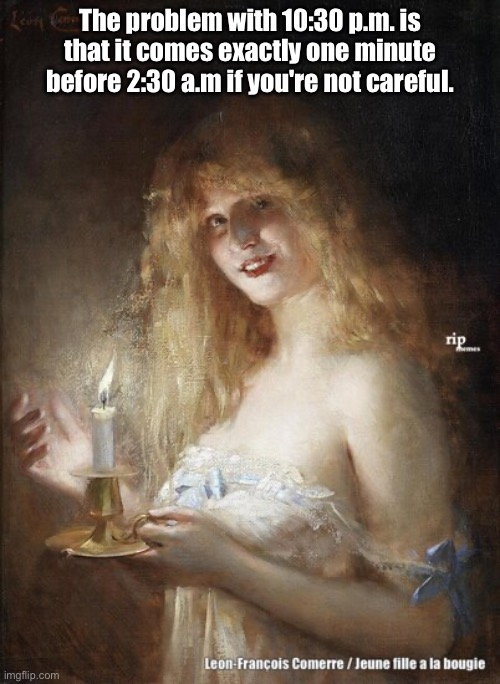
I call hoax — there’s no way that “candle” is running at 1800K — more like 5000K. Clearly a modern LED.
the painting was subject to the artist's brain "auto" mode...auto exposure, auto white balance, etc...
 
When I first started reading CPF, there was one member who suggested that, in his experience, a light in the 7 to 10 lumen range was the most practical and useful for EDC. This was long before the day of HDS Rotaries and Anduril 2 lights. A light that is too bright for a particular purpose can be dimmed by partially covering the beam with your thumb or your clothing. But now that we do have Rotaries and Anduril 2 lights, they would be my pick too. My own bedside light is an HDS Rotary. It has a Surefire F04 diffuser on it, making the beam a little dimmer at all levels. And I have the luxury of being able to choose the exact level of light needed for any task or time, all in a single light. I still use my 1, 2 and 3 level lights, but I consider the continuous range lights to be the latest and most versitile technology.
 
When I first started reading CPF, there was one member who suggested that, in his experience, a light in the 7 to 10 lumen range was the most practical and useful for EDC. This was long before the day of HDS Rotaries and Anduril 2 lights. A light that is too bright for a particular purpose can be dimmed by partially covering the beam with your thumb or your clothing. But now that we do have Rotaries and Anduril 2 lights, they would be my pick too. My own bedside light is an HDS Rotary. It has a Surefire F04 diffuser on it, making the beam a little dimmer at all levels. And I have the luxury of being able to choose the exact level of light needed for any task or time, all in a single light. I still use my 1, 2 and 3 level lights, but I consider the continuous range lights to be the latest and most versitile technology.
If only QTC was a more consistent and reliable dimming material...My two favorite lights right now are a Frazlabs Lumenite IIP and a PeakLEDSolutions flashlight, followed by the Notigon KR1AA and D3AA, by a noticeable margin. Not huge, but noticeable. If there were a way to get a beacon and SOS mode into the Peak, I feel like it'd be more awesomer...imagine a fully dimmable beacon or SOS mode, tailored to visibility needs.

However, as lighting tools, I'm hard pressed to find simple mechanically actuated lights that can be beat to hell with baseball bats, cinderblocks, etc...and still be user serviceable with minimal tools, such as the Fraz and the Peak.
 
Different uses I've had for low levels of light over the years. My night vision has never been great, so I've always done my best to preserve what I have when I have it.
In the Army just enough to dig through a ruck without being visible and without damaging night vision. Similar when camping too. Aslo good for not disturbing anyone around you and waking them up.
Digging through a glove box or trunk and not wanting to damage my night vision.
Walking a path in the dark, but not needing to see a hundred yards away and just needing something to make it easier to see the path. Either just out walking at night, or when camping to find a bathroom without tripping over anything.
When I had a part time job as a security guard and was in a dark construction site at night, a low light just bright enough to light up my book was nice. Again, night vision, but also it didn't draw as much attention to me so if I heard or saw someone it was a surprise when the spotlight or bright flashlight came one.

Not as low, but to check on residents to make sure they haven't died in their sleep or escaped. Just bright enough to make sure they are in their rooms and are breathing. Too bright also reflects off the door windows and in some the wire reinforcements.

EDIT to add: I should add that when I work security at night, there are times my minimum level is around 1000 lumens. I want to be able to light up the yard, or the areas behind their living areas, between the inner and outer fences (think a blend of a mental hospital with a little prison).
 
Last edited:
Back in the old days, 'minimum usable' was either a Bic lighter, or ML incan Solitaire. The Solitaire was just right for finding things in my camera bag at night, and was safer than the lighter;-).

Now there's always an ET D25C EDIT: MKII in my pocket when I'm wearing pants. It does 0.5L, but in an instant can also do 4-5xxL OTF when desired, along with a couple of other options. When required, that can cover ~9x% of my needs, and I never even need to think about the subject.
 
Last edited:
Back in the old days, 'minimum usable' was either a Bic lighter, or ML incan Solitaire. The Solitaire was just right for finding things in my camera bag at night, and was safer than the lighter;-).

Now there's always an ET D25C EDIT: MKII in my pocket when I'm wearing pants. It does 0.5L, but in an instant can also do 4-5xxL OTF when desired, along with a couple of other options. When required, that can cover ~9x% of my needs, and I never even need to think about the subject.
NGL, the only reason why I no longer carry Mag-Lites is because there are better lights available, now. But, I did still recommend a Mini Mag-Lite 2xAA Warm LED for my mother. Modern Mag-Lites with LEDs are perfectly good lights, if you just want a decent but inexpensive light that works. The Fenix E20 v2.0 I just bought is the perfect replacement for a Mini Mag-Lite.
 
Back in the old days, 'minimum usable' was either a Bic lighter, or ML incan Solitaire. The Solitaire was just right for finding things in my camera bag at night, and was safer than the lighter;-).
"Solitaire...I've seen matches which are brighter AND have a longer runtime."

The Mag Lite Solitaire might have been safer, but the Bic lighter put out more lumens! Here's the quote from CPF'er Marduke who made me laugh so hard that it's been in my signature line ever since.
 
Back
Top