Minimum usable illumination -- ideas?

Candle Power Forums

Help Support Candle Power:

lampeDépêche

Flashlight Enthusiast
CPF Supporter
Joined
May 15, 2012
Messages
1,877
What are some practical benchmarks that you would specify for the minimal usable illumination from a flashlight? I mean tasks that you need it to perform. And imagine these with dark-adjusted eyes, plus corrective lenses if you need them.
I am not asking for minimum lumen measurements (though it will probably be in the range of 0.05-0.5 lumens). And I don't mean candelas, though that comes closer to the issue, since at very low light levels it is important to concentrate the lumens. I mean: tell me some jobs that a light has to be able to do, in order for you to find it minimally adequate.
Here's an example:
At a minimum, I need to be able to clearly and easily read small print at a range of 12"-16" (30-40cm). If the light puts out less than that, then it is not doing a useful job.
At a minimum, I need to be able to look down a flight of stairs, e.g. 10 feet or 3 meters vertical distance, and be able to make out an object the size of a golf-ball lying on the floor (assuming decent contrast between object-color and floor color).
At a minimum, I should be able to read the top 3 rows of an E-chart (https://en.wikipedia.org/wiki/E_chart) at standard distance (20 feet or 6 meters).
At a minimum, the light should show some "bounce" i.e. reflection, on a white wall at 30 feet/10 meters.
What are some other concrete pass/fail measures that you would specify?

My reason for asking is because I am playing around with turning down the output on a light in order to extend the run-time. But there's no point in having a long run-time that robs you of useful light. The lowest fire-fly levels on a ZL AA light, for instance, will last for months, but they are not useful for practical purposes (other than finding the light itself in the dark). But lots of us use sublumen levels for, e.g., trips to the bathroom at night.

Clearly the answers to this question are going to be subjective and vary from person to person and scenario to scenario. That's okay. I will still be interested in hearing a range of answers. The most helpful answers will specify a concrete task, and also have a fairly clear go/no-go or pass/fail structure.
Thanks!
 
I have two extremes that matter. One is a firefly mode for night time bathroom visits. Generally this is sub lumen levels. The same flashlight(s) might go up to 300 / 500 lumens but rarely leave the house. My other extreme is 1000 lumens to see the edges of my property at night in case of intruders etc. My best flashlight for that is a Fenix PD40R which claims 3000 lumens but its most useful function is 1000 lumens for several hours (3 or so). Beyond that of course a consideration is small enough size for EDC. For that I use an Acebeam Pokelit AA with a 14500 Lithium battery which tops out at about 600 lumens - good enough for most day to day activity. Even the most powerful flashlight I own will go down to 50 / 80 lumens which is fine for pretty much everything.
 
I got a ton of Convoys for various uses, but they are bad at releasing accurate and trustworthy numbers (apart from 3rd party reviews), so I can't specify many Lumen numbers.

The ones I do know are:
- Late-night walking, winter or summer - Fenix HP30R v2 (headlamp), Flood mode, step 2, ~200 Lumen.

- Outdoor or inside large storage halls - Fenix LR35R, High mode, 3000 Lumen (sustained well enough for my needs), optionally Medium, 1200 Lumen depending on the need. 1000 Lumen sustained lasted me a long time, but when I changed jobs, to a place with a bigger storage hall, I wanted more (scenario: "It's over there." [shining a clearly visible beam at what I want to direct to, 30+ meters away]).

- Indoors in darkness - Convoy S21E, Moonlight or Low (my preference is with a diffuser - can be popped on the tailcap for storage). According to a 1Lumen review, that's 5 or 12 Lumen (with a 519A, 3000K LED). Just tested it (519A, 2700K) in our only room in the house with no windows or "always-on" lights. 5 Lumen on open floor space, 12 Lumen if there are trip hazards. Goes up to 1300 Lumen, with 400 Lumen sustained - that is plenty indoors.

I probably missed it, but are you looking for a single light to do all the things you listed, are you amenable to buy several lights, specifically for each task, or are you asking for what lights others use for their tasks of similar nature?

Since all the things you mention are indoors, and at a fairly short range, I'd say Convoy S21E (sorry for always banging on about that light, but I really, really like it!), 519A 4000K or SFT-40 / SFT-70 (at request), 3000K (so hCRI for seeing that white ball against a grey floor in the dark)...and since you specify reading tasks, I'd say a 30° / 45° / 60° bead TIR-lens, depending on how much spill you want. For reading tasks, you do NOT want any sort of hotspot that naturally comes with a reflector.

Sizewise, all my go-to lights are 21700 now, single or dual (anything outdoor is dual, so rather big bodied lights). I tried having a single AA-light at my nightstand, but I just kept knocking it on the floor - that doesn't happen with a 21700 light due to the increased weight. Also, a body colour that stands out is a preference (so Blue, Green, Orange - anything high contrast to your nightstand colour).


....
I probably missed it, but are you looking for a single light to do all the things you listed, are you amenable to buy several lights, specifically for each task, or are you asking for what lights others use for their tasks of similar nature?
Thanks, PaladinNO and Toulouse42!
I'm not looking for any particular product -- I have plenty of flashlights, by any normal (=non-CPF) standards, covering plenty of ranges of lumen-output, color temp, beam angle, etc..
Instead, I am looking for tasks and tests: tell me about jobs to do that you think are the minimum that a flashlight should be able to do. Tell me about tests that a light has to pass, and if it fails it then it is not worth using.
Let's start from the bottom end: tritium tubes. A small trit-vial, the kind you might put into a tailcap, is fine for finding the light. But you cannot use that amount of light for anything else. You cannot read with it. You cannot navigate with it, even indoors in a familiar place. It fails the minimum tests of functioning as a flashlight.
I'd say the same for the lowest level on a Photon Freedom in the red LED color. On its lowest output, you can barely see your hand waving at arm's length. The combination of the very low output and the red color makes it useless for any practical tasks.

So, that's my question: what are the practical tasks that you think a flashlight should be able to accomplish? Now, refine that a bit: what are the *minimal* tasks that it should be able to accomplish? I have mentioned some indoor tasks, but I'd also be happy to hear about some outdoor tasks.
 
Very interesting thread here !
😎

That's why I really LOVE the Anduril interface !
It allows me to specify my choice of:

LOW level (floor)
HIGH level (ceiling)
and Number of Steps in between !

So, in total darkness, with dark-adapted eyes,
if I simply need enough light to read my wristwatch,
that's what it provides.

Need enough to read a newspaper ? Done !

Navigate basement stairs ? Done !

Find a tiny screw dropped on Carpet ? Done !

I'm a big fan of having Just Enough Light,
so that my battery(ies) last as long as possible in a crunch.
 
Need enough to read a newspaper ? Done !
Navigate basement stairs ? Done !
Find a tiny screw dropped on Carpet ? Done !
I'm a big fan of having Just Enough Light,
so that my battery(ies) last as long as possible in a crunch.
Great reply! I think we are on the same wavelength.
Now, imagine that you were stuck with a single-mode flashlight -- no Anduril goodness. What output would you set it for, if you wanted to maximize run-time but still have a genuinely useful light-source? And what are the concrete tasks that determine that minimum output?
 
As an Amazon Associate we earn from qualifying purchases. Product prices and availability are accurate as of the date/time indicated and are subject to change.
@lampeDépêche
I see - this is actually a very interesting, albeit quite philosophical question, as this is arguably very subjective since you're asking for "what is good enough?".
And this is why I got 70+ flashlights, as I almost always buy a dedicated light for a specific task...

To keep it simple, for me it is minimum 1000 Lumen sustained. I can always dim down those 1000 Lumen - but if I need more, I can't, and I would want a bigger, more powerful light (which is why I like the Fenix LR35R so much - its UI is also almost confusingly simple, compared to most of their current offerings. And that 10.000 Lumen Turbo cannot be denied).

Most important features for me is high, sustained output and runtime. That makes for big and expensive lights, but they can do everything a small light can do, and vastly outperform them if needed.

Bigger lights also sometimes takes more cells for longer runtime (HUGE fan of dual, parallel 21700 lights - runtime if I want it, power if I need it. And I don't care about the CRI in such a light). And small enough to be much more carriable compared to the Convoy 3x 21700 lights.

Build quality is also important to me. I don't care how good a light performs if it feels like it could break at any time. And for outdoor tasks, I want a light durable enough to handle a drop into the ground. None of us plans for it to happen, but when it does, the light should guaranteed survive it at least once.

And a good light for me should be able to thermally sustain whatever High mode it got programmed (like the Acebeam E75). And not like the Convoy 3X21A, LHP73B (something is wrong with the one I got) which got so hot after accidentally going on High or close to it, even snow was just instantly turning into water when trying to cool it down again.

Bonus features for me is an always-on switch LED (like the Sofirn Q8 Plus and BLF LT1 latern). I would argue that is crucial in an emergency light, because what is the point of an emergency light if you cannot find it in complete darkness (my solution is "having lights everywhere!").

And a Moonlight feature. Didn't think I'd need it, want it or like it, but I've come to appreciate it as a mood-setting mode. Several 519A 1800K flashlights on Moonlight mode spread around a room? Won't need candles ever again.
 
As for a Single-Mode output ? --

I'm 72 years old.
For most of my life, a " standard flashlight "
was 2 D-cell batteries, and a PR-2 incandescent bulb.

This produced perhaps 10 to 15 Lumens,
which was sufficiently bright for us to accomplish
many/most of our required tasks.
Letting us "Gain Control of the Darkness".
< wink >

So (for MY needs, anyway),
I'd choose a Single-mode in the range
of perhaps ~ 20 Lumens or so.

My EDC for Decades was the
Mini-Maglite 2-AA incandescent.
(mfr. rated at 14 Lumens)

This served me Quite Well !
😎
_
 
The only examples I have for this one is walking with my wife around the block at night. I used Anduril lights for several years, but my current favorite is my Olight S1R II. This light on low is just fine for seeing the ground in our suburban neighborhood when we're away from streetlights. Advertised as 12 lumens on low.

Other one is my bed stand light, first gen S1R. enough light to see what's on the bed stand, and usually put it on for 3 minutes and it shuts itself off. Advertised as 0.5 lumen. Would also be plenty to navigate inside the house at night.
 
My indoor EDC is currently a 2700K KR1AA V2, with floor set to level 5/150, the ceiling is set to level 100/150. I disable Turbo.

I set standby Aux to Red, to help see where the light is on my nightstand. Set POVD option 3 to 30, and option 4 to 70. This makes POVD stay Off if I use output step 1 or 2, and makes POVD use Low Brightness Aux if I turn off at Step 3 or 4. POVD only uses Bright Aux if I turn off at Step 5 or above.

Im using Eneloop in this light, because its primary applications are indoors, below 50 lumens.

I use the default 7 stepped modes, and the default last mode memory.

The 7 outputs and use cases are:

Step 1 = 0.05 lm. I ramp down to this output when put the light on my nightstand at bedtime. This is enough light to just turn on with a single clic when I wake up in the middle of the night to walk to the bathroom. I can see the floor and about 5 feet ahead, so I dont step on my black cat.

Step 2 = 1.3 lm. This works well in the bedroom, before climbing into bed. To see where I hang up my clothes and then to turn down the covers at the end of the night. It also works well when I wake up before dawn, for use in the bedroom, getting dressed and making the bed.

Step 3 = 10 lm. I use this to walk through the house at the end of the evening, turning off the house lights. This is also enough light to walk down the steps to the basement. And enough light in the bathroom in the morning. Also enough to read a label in my hands during the day.

step 4 = 42 lm. This is my indoor daytime setting, for things beyond arms reach. In a dark closet, behind the couch, under the bed, in the garage..

step 5 = 105 lm. For outdoor use, enough to see out to 50 feet if I get home after dark, when walking from my driveway and across the yard to the door of my house.

I rarely use Step 6 = 215 lm

all the above outputs are the same on both Eneloop and LiIon.

I seldom use Step 7 = 265 lm on a partly depleted Eneloop @ 1.30V. Or = 390 lm on a fresh LiIon. It can be reached by double clic from off or on. I mostly use it as a ramp position reference, to then ramp down to level 5 outdoors.

None of these outputs are bright enough to burn a hole in my pocket if the light turns on accidentally. Which is pretty unlikely now that I have increased the tailswitch resistance pressure from default 20 oz to 54 oz, with an O ring mod.
 
Last edited:
If shining at my face from about 1.5-2 feet away, if the beam is bright enough to irritate my eyes through my eyelids, that's too bright for night adjusted eyes. For me, that's lower than 2 lumens, between 0.3 to 1 lumen, at whatever candela the El Capitan and Novatac put out at the lowest level. I find that indoors in an average room with white walls and 9' ceilings, 20ish lumens is adequate to light up a space of around 250-300sqft with a ceiling bounce.

**Outdoors, where everything is just a bit darker toned and whatnot, I appreciate CCT higher than 4000k, between 4500k and 5700k. Indoors, I appreciate between 2200k and 3700k, but will tolerate up to 4200k as long as it's SLIGHTLY rosy.

Ultimately, it's super subjective depending on the condition of your eyes, etc...my glasses have them blue filtering stuff, I didn't realize just how much light was being filtered out until I took off my glasses to clean them. The unfiltered light FELT about 20% more intense, and there was definitely a visible shift towards the cooler end of the light spectrum.
 
Last edited:
I’m using 0.05 lumens for bathroom trips and such at night. I’m most comfortable indoors or outdoors with a minimum of around 3-5 lumens in the absence of any other light source if the sole need is merely navigating at a non rushed walking pace and see several feet in front of me.
10-15 lumens, if in total darkness will allow you to accomplish a lot. Also I think the beam will be as important as the output for this. 3-5 lumens with a totally diffuse beam will not be as useful as the same output in a reflector light with a balanced hotspot.
 
This is kind of a loaded question as the amount of ambient light you need to overcome comes into effect. I have worked in total darkness when my eyes were properly adjusted and 1 lumen was enough to accomplish my tasks. Under these conditions 100 lumen was too bright for up close work. I have worked accident scenes where 40 lumen was not enough to make out details due to the light pollution cause by the overhead lights. Walking the dog during a full moon requires anywhere from 20 lumen to 1000 lumen depending on how far out I need to see. If there is lots of snow on the ground and a full moon, I dont even turn on a light as there is enough moonlight being reflected from the snow. If I am walking with a group of people who use their headlamps all the time I usually will need mine at around 200 lumen to offset theirs.
 
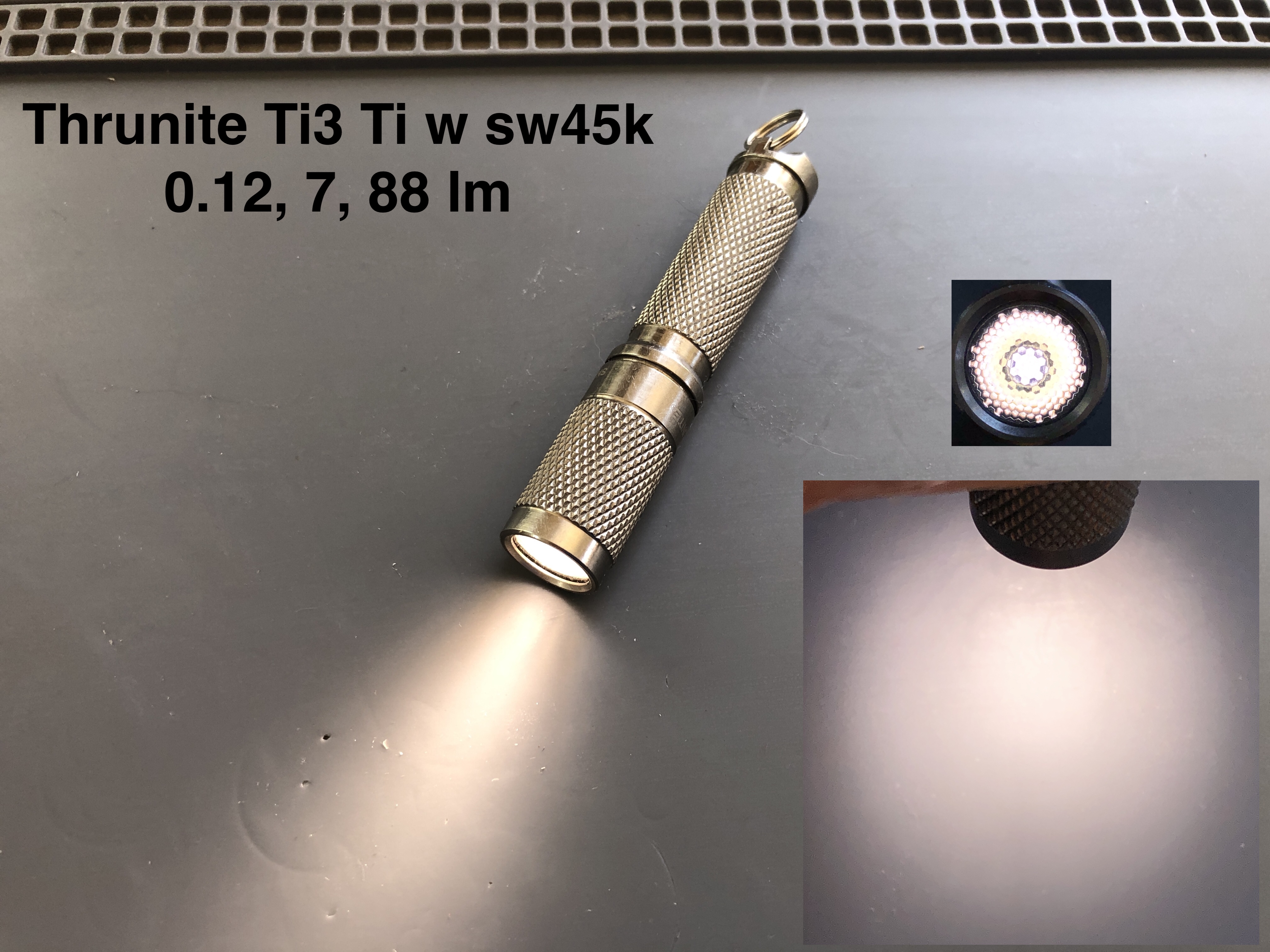
Here is a 3 mode AAA light whose mode spacing can cover my 3 most typical uses.. nightstand to walk to the bathroom, indoors to look in a closet, and outdoors walking to and from the car. And it only weights 26 grams with an Eneloop:

ti3.jpg


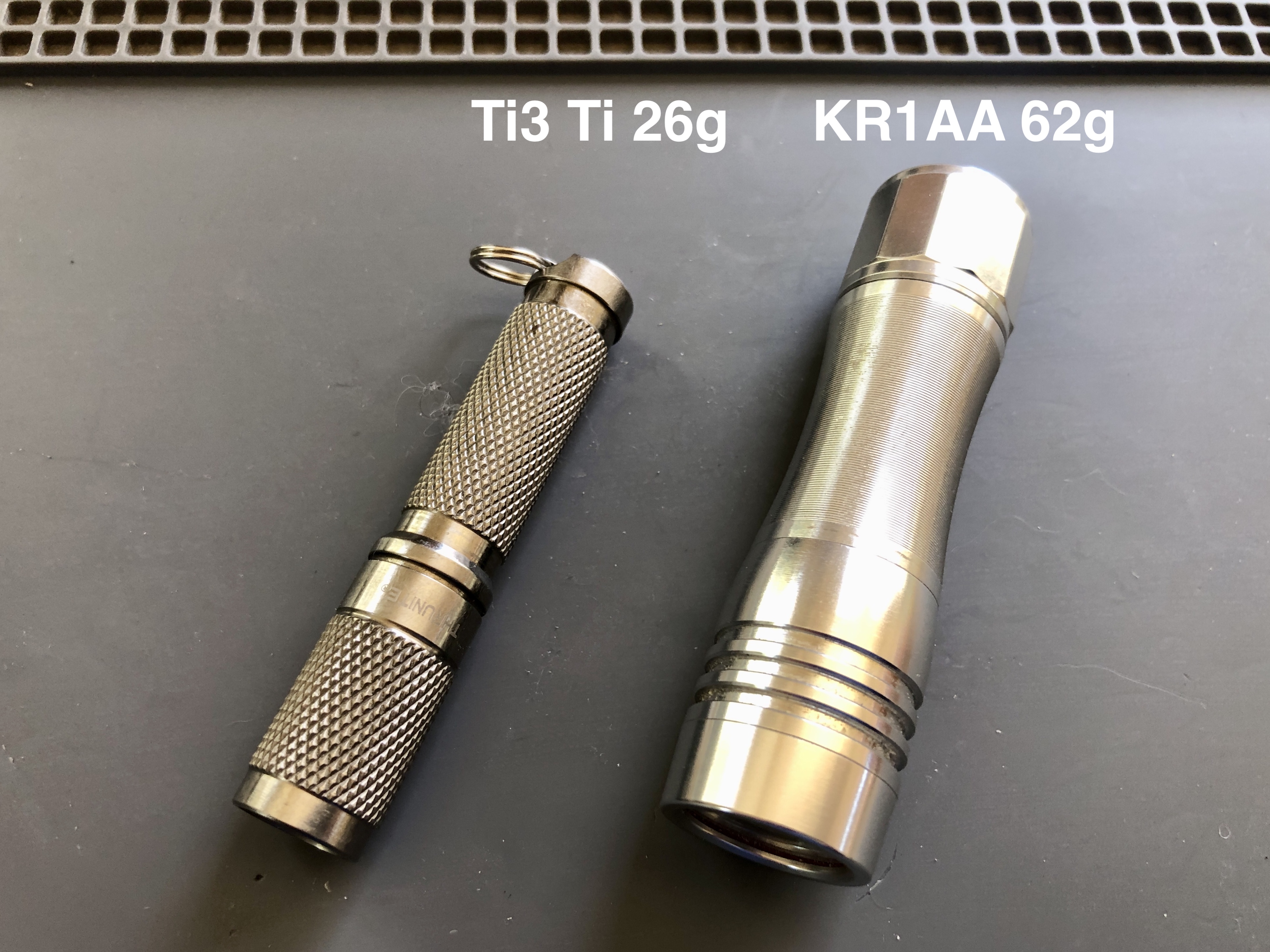
compare weights, with Eneloop AAA and AA:

IMG_3871.jpg


The KR1AA is set up to go from 0.04 lm up to 255 lm
 
Last edited:
Here is a 3 mode AAA light whose mode spacing can cover my 3 most typical uses.. nightstand to walk to the bathroom, indoors to look in a closet, and outdoors walking to and from the car. And it only weights 26 grams with an Eneloop:

View attachment 93799
UNOBTANIUM! That's a sweet light
 
Hobbies are fun and crazy.

We don’t need a $10,000 Rolex to tell time.

We don’t need a $500 knife to open a letter.

We don’t need a 5000 lumen light to find our way to the bathroom.

But, life would be boring without hobbies in my opinion.
 
UNOBTANIUM! That's a sweet light
agree!
from the days when I used to obsess about minimum output specs, and mode spacing.

I stopped thinking about minimums and modes when I found the Jetbeam Stepless Rotary

Then I found Anduril, and the rest is history.

Anduril goes as low as the Rotary, and lower than the Ti3
Anduril has both Stepless Ramping, and Stepped modes, I can even choose how many steps.

Anduril also moved me past glow tape and tritiums, since the Aux lights work as markers.
I also stopped thinking about LiIon battery protection, since Anduril has LVP built in.
I even stopped debating battery chemistry, since my KR1AA is AA/14500 dual fuel.

We've_Come_a_Long_Way_Baby_(song).jpg
 
Last edited:
Back
Top