- Joined
- May 15, 2012
- Messages
- 1,877
What are some practical benchmarks that you would specify for the minimal usable illumination from a flashlight? I mean tasks that you need it to perform. And imagine these with dark-adjusted eyes, plus corrective lenses if you need them.
I am not asking for minimum lumen measurements (though it will probably be in the range of 0.05-0.5 lumens). And I don't mean candelas, though that comes closer to the issue, since at very low light levels it is important to concentrate the lumens. I mean: tell me some jobs that a light has to be able to do, in order for you to find it minimally adequate.
Here's an example:
At a minimum, I need to be able to clearly and easily read small print at a range of 12"-16" (30-40cm). If the light puts out less than that, then it is not doing a useful job.
At a minimum, I need to be able to look down a flight of stairs, e.g. 10 feet or 3 meters vertical distance, and be able to make out an object the size of a golf-ball lying on the floor (assuming decent contrast between object-color and floor color).
At a minimum, I should be able to read the top 3 rows of an E-chart (https://en.wikipedia.org/wiki/E_chart) at standard distance (20 feet or 6 meters).
At a minimum, the light should show some "bounce" i.e. reflection, on a white wall at 30 feet/10 meters.
What are some other concrete pass/fail measures that you would specify?
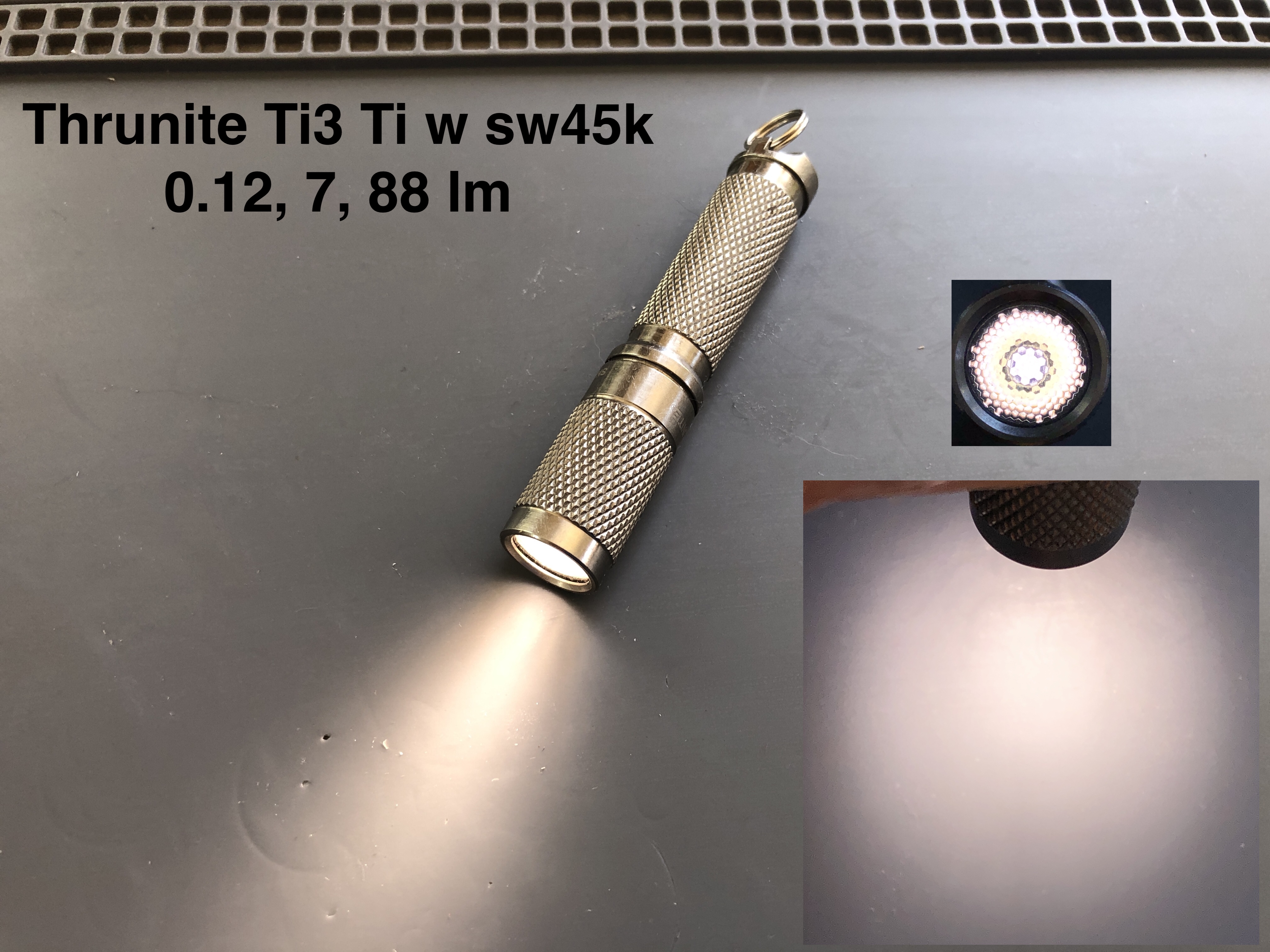
My reason for asking is because I am playing around with turning down the output on a light in order to extend the run-time. But there's no point in having a long run-time that robs you of useful light. The lowest fire-fly levels on a ZL AA light, for instance, will last for months, but they are not useful for practical purposes (other than finding the light itself in the dark). But lots of us use sublumen levels for, e.g., trips to the bathroom at night.
Clearly the answers to this question are going to be subjective and vary from person to person and scenario to scenario. That's okay. I will still be interested in hearing a range of answers. The most helpful answers will specify a concrete task, and also have a fairly clear go/no-go or pass/fail structure.
Thanks!
I am not asking for minimum lumen measurements (though it will probably be in the range of 0.05-0.5 lumens). And I don't mean candelas, though that comes closer to the issue, since at very low light levels it is important to concentrate the lumens. I mean: tell me some jobs that a light has to be able to do, in order for you to find it minimally adequate.
Here's an example:
At a minimum, I need to be able to clearly and easily read small print at a range of 12"-16" (30-40cm). If the light puts out less than that, then it is not doing a useful job.
At a minimum, I need to be able to look down a flight of stairs, e.g. 10 feet or 3 meters vertical distance, and be able to make out an object the size of a golf-ball lying on the floor (assuming decent contrast between object-color and floor color).
At a minimum, I should be able to read the top 3 rows of an E-chart (https://en.wikipedia.org/wiki/E_chart) at standard distance (20 feet or 6 meters).
At a minimum, the light should show some "bounce" i.e. reflection, on a white wall at 30 feet/10 meters.
What are some other concrete pass/fail measures that you would specify?
My reason for asking is because I am playing around with turning down the output on a light in order to extend the run-time. But there's no point in having a long run-time that robs you of useful light. The lowest fire-fly levels on a ZL AA light, for instance, will last for months, but they are not useful for practical purposes (other than finding the light itself in the dark). But lots of us use sublumen levels for, e.g., trips to the bathroom at night.
Clearly the answers to this question are going to be subjective and vary from person to person and scenario to scenario. That's okay. I will still be interested in hearing a range of answers. The most helpful answers will specify a concrete task, and also have a fairly clear go/no-go or pass/fail structure.
Thanks!