Gas prices

Candle Power Forums

Help Support Candle Power:

Nope.
Coefficient of drag (Cd):
1970s-era Mercedes W123 (240D/300TD): 0.47
2026 Nissan Pathfinder: 0.35
So the aforementioned Mercedes has a worse drag coefficient yet gets better mileage.

Weight:
300TD: 3800-3900 lbs
Pathfinder: 4300 lbs
Mercedes weighs 500 lbs less. BUT, we're talking almost 45 years difference between the two cars. Technology has certainly improved over that time, enough that it should overcome a 500 lb difference.

And, technology has improved, however emissions regulations have kneecapped this.
Frontal area times Cd determines energy use. The Pathfinder has a greater frontal area. It also uses higher rolling resistance tires. Between both things that's sufficient to account for the worse mileage not even taking emissions regulations into consideration.

0.35 Cd is awful. We should be aiming for 0.15 or less. This has a Cd of 0.13.
Case in point: my own car. EPA says it should get 22 city, 30 highway. Mine is running different software. Emissions 100% intact. I'm getting 28 city, 45 highway. All via software changes. What's coming out of the tailpipe? I don't know, and frankly don't care. I'm burning 20%-33% less fuel than the EPA-spec cars, which should translate to fewer emissions as well. It won't make a clipboard warrior happy, but I'm about practical gains. It's part of the reason I have this car over a Prius, as it's far more environmentally friendly, cradle-to-grave, including fuel burned.
The Prius is highly overrated if you ask me. As for your economy results with different software ever think this is intentional? The oil companies want you to burn more fuel so the automakers are happy to oblige with software which gives you worse mileage. If the oil companies had their way engines would be running at 100% all the time and we would be controlling speed with the brakes.
You answered part of the reason for this: They're not part of CAFE standards. Additionally, US fuel efficiency standards punish automakers for small vehicles. Instead, they're judged on how much of a physical footprint they make on the ground. It's why many cars are shaped like pyramids these days. Fat bottom = more surface coverage = lower emissions targets. You can still buy a Taliban Taxi aka Toyota Hilux worldwide, except the USA because of our regulations. Same with the Isuzu D-Max. Same story for a lot of smaller, more efficient cars.
That loophole should have been closed the minute automakers exploited it. Then they would have had to either make more efficient vehicles or pay billions in fines.

Speaking of regulations Kei cars would be perfect as a city vehicle but they're a pain to get certified in the US. Our regulations need to be more in line with world standards.
As it's been said before, rail can't do what road vehicles can. NYC is its own animal. 99.9% of the USA isn't NYC, nor can it ever be. Nor could it ever be, even with a clean-sheet design. Rail is good at long distance, for sure. But it also has the most restrictive infrastructure out of all modes of transport. Aviation requires the least infrastructure.
Some combination of bikes, walking, bus, and rail can work in much of the country. Rail works well for medium distances also. Case in point are subways. Aviation by definition is only suited for longer distance transport. It still needs airports which take up far more space than train stations. Noise regulations restrict where they can be located.
Our most recent trip to Mayo Clinic couldn't have happened by rail. Between the medical equipment and supplies we needed to carry, between the two full offices' worth of equipment we needed to carry for our jobs, and clothes, even a regular full size car wasn't going to cut it. Fringe case you say? Mayo was packed today. They treat ~175,000 people a year and this is their smallest campus. The drive was filled, All SUVs, similar stories to ours. There were Bentley and Rolls SUVs there today as well.
And yet at one time people got by just fine without SUVs. A minivan is probably a better vehicle if you need to carry lots of stuff. More aerodynamic and lower rolling resistance tires.
Nope. Electric cars need to be charged. Power generation still generally burning things, especially at night when most EVs are charged at-home.

NY State:
Fossil fuels: 80.2%
Renewables: 2.9%

California:
Fossil Fuels: 83%
Renewables: 3.0%.

Moving the tailpipe from the butt-end of your car to a power plant doesn't change this.
It still helps for four reasons. One, power plants are much more efficient converting the energy in fossil fuels into electricity. Even accounting for generation, transmission, charging, and motor losses more of the energy in the fuel makes it to the wheels compared to burning the fuel in an ICE. Two, power plants can have much better emissions controls. It's not how much fuel you burn but how much pollution gets into the air. Three, what pollution the power plants emit is usually in remote areas. ICEs emit their exhaust in population centers where it does the most harm. Four, EVs emit less noise pollution, especially if we're talking trucks and buses. Noise is increasingly being cited as a long-term health hazard.

Here's a little known fact. It takes about 5 kW-hr of electricity to make a gallon of gasoline. Might as well just use that electricity to power an EV. It reduces pollution and avoids geopolitical problems like we're facing now. War burns a lot of fuel and creates a lot of pollution. I won't even get into the pointless deaths or life-changing injuries.

I'm concerned about this because we first faced this problem in the early 1970s. Not only have we not fixed it but we made it structurally worse with larger, less efficient vehicles and more car dependency. The very definition of insanity is doing the same thing while expecting a different result.

EDIT: Your figures are for total energy generation. Since EVs use electricity we're interested in the portion of electricity generation using non-fossil fuel sources. In NY state that's 46.2% (14.6% renewables and 31.6% nuclear). Nearly all the remainder is natural gas, which burns far more cleanly than gasoline or diesel. So yes moving emissions to power plants gives huge benefits, even if they're 100% natural gas.
 
Last edited:
Great conversation.

I think we all know we can do better. I’m tired of the cost of commuting being determined by the ultra rich and politicians. While EV’s aren’t perfect I think they’re well on their way to being a viable alternative. We shall see.
 
I gotta say, I love our Hyundai Ioniq5. It works like a charm. And with the panels on our roof, we charge it up for free. Our total utility bills -- for heating, electric, hot water, and car -- throughout this last horrible Northeast winter, never went above $150 per month. That's partly because our panels earn so many credits in the summer that we can coast on credits through the low-generation months in the winter. And, it's partly because we are insulated from gas prices by using the EV.
Plus, it's just a hell of a fun car. Zippiest thing I have ever driven. And in the winter, its wide stance and very low center of gravity, combined with all-wheel drive, make it the best car on snow and ice that we have had, too.
They're just better cars, honestly -- performance, pollution, economics, and maintenance. It's true that I used to enjoy tweaking the timing on my Valiant with my old timing-light, and I completely rebuilt the carburetor on my Civic. Can't do those things with an EV, because there is no carburetor or distributor or injectors or cams or exhaust manifold or crankcase or oil-pump or ..... And I hardly use up the brake-pads, because I drive in regen-mode, so that slowing down the car refills the batteries.
There will always be fans of internal combustion engines, just like there are fans of hot-wire bulbs. But for the majority of applications, EV is just clearly superior.
 
China solved this issue already with battery swapping stations:
That's great.... for China. That doesn't help us out in America or other nations.
And, I'm sorry; but car dealers are going to send their lobbyists full-force to Washington D.C to make sure such swapping stations are regulated out of existence, should they come here. No way are dealerships giving up the HUGE profit potentials to such stations.
A better answer to areas with apartment buildings is better transit and bike lanes so most don't need to drive. Nobody in NYC should need to drive to their job to get there reliably. We could have solved this problem in the 1920s.
I'm sorry but this is just unrealistic. You can't force people to give up their cars. It's just not happening. I'm at that point in my life where I refuse to use public transit in NYC. Far too many dangerous nut-jobs are now on the buses, and subway trains. Along with genuine low-life trash. Speaking from experience after countless years of using public transportation in NYC.

Awhile back, blind woman on the bus randomly attacked by a man. They caught him. His reason? He claimed that God told him she was a demon, and to brutalize her. Another recent incident, woman fell asleep on the subway. I've done that countless times! Random homeless guy insane out of his mind, walked up to her while she was sleeping, and poured gasoline on her! Lit her on fire! Apparently it was horrific! The trains, the buses.... They're not clean, they're not safe. Then again, they've never been clean. But they weren't ever as dangerous as they are NOW!

As far as bike lanes, I've seen a massive effort in creating them in several neighborhoods. Along with Citibike stations that take up a handful of free parking alongside city streets. Those stations are almost always full of bikes. Not nearly as successful as former Mayor Adams expected them to be. I'm at the point in Life where I will never work in Manhattan ever again. And, if I do need to travel to an appointment where driving my own car would be a hassle, I call a local cab service to get me there. No lie, no joke; last year I needed to get finger-printed to keep my OTHER full-time job. I figured, it's not too far away. I'll just buy a Metro Card with enough money for two rides on it, and just go. (Literally over a decade since I took the bus.) What's the worst that can happen?.... I got physically assaulted by an Asian woman who thought she had the right to put her hands on anyone. I told her off. Had it been a man, things would have gotten a lot more physical. Not going to lie! But I know full well that sexism is alive and well in NYC. Had I treated her like a man, basically with Equality; I would have been the one getting arrested and losing both of my Full-time jobs.

The solution for people living in apartments is Hybrid vehicles. (Obviously not Plug-In Hybrids.) But again, Massive costs for battery replacements in just a few short years. Plus, nearly every car brand is pushing EVs and trying to quietly get rid of Hybrids.
Only matters if you can't charge overnight at home. In the US as a whole most people do in fact have a garage or driveway, even if that's not the case in NYC.
Again, most folks live in apartment buildings without reserved parking for tenants. It's not just in NYC. Name any remotely large city in America. You're going to see apartment buildings. It's what the masses can afford. That's one thing that really bothers me with those in power pushing EVs onto the masses. They KNOW it's a terrible idea for apartment dwellers. For MOST Americans. Yet, they don't care. They push their agenda anyway because all they see are profits.
In NYC EVs with built-in solar panels can partially solve the issue. They can add 5 to 25 miles of range per day. For many city commutes this is enough. If nothing else the panels will reduce the frequency of trips to charging stations.
I'm sorry but no. That's what the people with an agenda to push are reporting. Solar technology to this day is still in its infancy. Not even remotely efficient. You need massively huge panels just to get anything resembles decent output. The space on top of a car, not even remotely enough. Could you actually get an extra 5 to 25 miles? Sure.... Provided you go 3mph. It's just not remotely realistic.
Did you watch the video? The degradation is typically very small. And that's with older NMC batteries. The EV industry is well on the way to transitioning to LFP batteries now that energy density has gotten close to that of NMC batteries. LFP batteries last upwards of 2,000 cycles, compared to 500 for NMC.
Yes, I did. Don't believe everything you see online in a video. EV's have been around just long enough that we know their batteries need replacing long before that greatly exaggerated amount of miles. I mean if that wasn't the case, why would the Chinese even bother with those Swap Stations that you mentioned above? They'd be unnecessary. Again, let's set up an actual network of common as dirt outdoor Quick-charging stations before looking at the new wave of batteries. Seriously, this whole EV push is being done @$$ backwards. And, we don't have those new type of batteries now. So, now is not the time to buy any existing EV.
I can't answer this one way or another but I suspect that market will grow as the number of EVs on the market does.
Not really. There is a relatively large number of EVs currently on the market. Again, the problem is capacity of the battery. Older an EV gets, the less range you have. It's constantly dropping.
This is becoming less and less of an issue as we move to LFP and sodium-ion batteries which don't catch fire.
True. But where is that mass market of LFP vehicles. Currently, it doesn't exist.
As for toxic clouds of smoke, those emit from current ICE vehicles when operating normally.
No, it's nowhere near as bad. I'll never forget that one CPFer over a decade ago who had an issue with a multi-lithium battery flashlight VENTING WITH FLAME. He came back a decade later, and to this day has severe lung and health issues. After having breathed in a bit of those fumes. Had to sell off a good chunk of his worldly possessions to pay for medical bills. Those lung and health issues are never going away. When I say "Toxic," I mean literally toxic. The fumes a gasoline powered car gives off, don't destroy your lungs if you breath in a bit of those fumes. There's annoying, and then there's toxic. Two very different things.
I'm sick and tired of economic shocks due to oil prices. Get off the stuff yesterday like our lives depended on it. It's a failure of government that we didn't do this 50 years ago.
I do agree with you that alternatives should have been given a very serious look in this country, decades ago. I just don't agree that EVs are the answer, for the masses.
 
Last edited:
The data say otherwise:
You're being lied to.
If we're going to have a discussion at least let's use the current state-of-the-art, not state-of-the-art in 2005. I still have people telling me LEDs are not any more efficient than incandescent bulbs. Not here obviously.
We are having such a discussion. People lie to get what they want. Not saying YOU are lying. Am saying you are being lied to. Numbers can easily be manipulated.
 
Last edited:
As an Amazon Associate we earn from qualifying purchases. Product prices and availability are accurate as of the date/time indicated and are subject to change.
Clearly superior? You're going to want to seriously view the following video:

So, it is clearly unacceptable to have a car that cannot survive a water-spill in the back seat.
On the other hand, the technology for waterproofing floors is pretty well-developed by now. No new scientific breakthroughs will be needed in order to make sure that water on the floor does not fry the wires. This is just an oversight in the manufacturing, and something that Hyundai should remedy -- it tells us very little about the core technologies of EVs, or how they stack up against ICE's.
Thanks for the link, though -- I'll make sure not to spill a lot of water in the back seat of our car!
 
You're being lied to.

We are having such a discussion. People lie to get what they want. Not saying YOU are lying. Am saying you are being lied to. Numbers can easily be manipulated.
The numbers are plausible given my knowledge of batteries and the range of EVs. Let's say an EV has a range of 250 miles, and maybe you cycle the battery about 80% of that between charges. So 200 miles per cycle. Decent NMC batteries get 700 to 1000+ cycles, especially in an EV with all sorts of battery protection mechanisms. So that's 140K to 200K miles before the battery degrades enough that it might need replacement. Even then if you never need the full range you can continue to use the vehicle.

On more recent vehicles ranges of 300 to 500 miles are typical, and they use mostly LFP batteries good for 2,000 to 5,000 cycles. Doing the same math the battery should be good for ~500K miles on the low end, as much as 2 million miles on the high end. Sodium-ion will do even better. 10,000 cycles is possible. A 5 million mile battery is within possibility. That's a lifetime of driving for most people.

Manufacturers these days typically warranty the battery for at least 100K miles and 8 years. That's sort of a bare minimum warranty in the industry. If the failure rate during that time span wasn't miniscule they would go bankrupt offering such a warranty.

There are certainly valid reasons not to own an EV these days but battery life isn't one of them. Not having a place to charge at home is the primary reason. Fast chargers, even if they exist, cost 3 to 5 times more than charging at home. Even if charging isn't an issue you might not be able to afford a new vehicle if your old one is still serviceable. This is why I don't tell people to run out and buy an EV now. Wait until you need a new vehicle, then strongly consider one. I really think this war will do more to promote EVs and public transit than everything the Dems did for the last 25 years. In the end pocketbook issues are what gets people to adopt new technology.

As an aside EVs like this are what we really need to mass produce. Note that it has integrated solar cells. Due to the very efficient design it can gain up to 40 miles of range per day while parked just from the solar cells. It's small, nimble and a perfect city car. We should mass produce these with a sales price target of $7,500 to $10,000. On the lower end the EV tax credit will mean you get a free, very inexpensive to run new vehicle. Worst case you pay $2,500 out the door. A decent e-bike costs that much.
 
+

The average EV owner can't figure out the massive energy loss going from say Nat Gas, burning that~ turning turbine~ sending that out in AC~ then the massive loss going from AC to DC.

These owners think their saving the world, but can't wrap their head around this loss.
How many trillions of Watts, globally, every year in wasted energy 'loss'.
Renewables used,, is a sliver in the global pie chart

= Gasoline is a simple petroleum distill, then powering car =

btw: who's going to buy your used EV ? small laugh here
 
Last edited:
That's great.... for China. That doesn't help us out in America or other nations.
And, I'm sorry; but car dealers are going to send their lobbyists full-force to Washington D.C to make sure such swapping stations are regulated out of existence, should they come here. No way are dealerships giving up the HUGE profit potentials to such stations.
It's time the American public starts fighting back against companies that see them as a cash cow. Cars are the ultimate example of how they get an income stream from people. Payments every month for the car loan, the fuel, the insurance, regular maintenance, etc. This is why I never drank the Kool-Aid. I saw how much cars cost other people and said to myself if I owned one I'm essentially working just to pay for it. The extra time some trips might take is offset by needing to work far less.
I'm sorry but this is just unrealistic. You can't force people to give up their cars. It's just not happening. I'm at that point in my life where I refuse to use public transit in NYC. Far too many dangerous nut-jobs are now on the buses, and subway trains. Along with genuine low-life trash. Speaking from experience after countless years of using public transportation in NYC.

Awhile back, blind woman on the bus randomly attacked by a man. They caught him. His reason? He claimed that God told him she was a demon, and to brutalize her. Another recent incident, woman fell asleep on the subway. I've done that countless times! Random homeless guy insane out of his mind, walked up to her while she was sleeping, and poured gasoline on her! Lit her on fire! Apparently it was horrific! The trains, the buses.... They're not clean, they're not safe. Then again, they've never been clean. But they weren't ever as dangerous as they are NOW!
Carry a gun or a knife. I'm serious. I used to carry the latter all the time until the late 1990s when crime rates started dropping. It probably saved my life several times just pulling it out when things got tense. Remember people get carjacked, too. Not to mention you're surrounded by sociopaths driving other vehicles. Half the drivers in NYC are sociopaths. I would be damned if I were forced to own an expensive, finicky piece of machinery when we have subways.
As far as bike lanes, I've seen a massive effort in creating them in several neighborhoods. Along with Citibike stations that take up a handful of free parking alongside city streets. Those stations are almost always full of bikes. Not nearly as successful as former Mayor Adams expected them to be. I'm at the point in Life where I will never work in Manhattan ever again. And, if I do need to travel to an appointment where driving my own car would be a hassle, I call a local cab service to get me there. No lie, no joke; last year I needed to get finger-printed to keep my OTHER full-time job. I figured, it's not too far away. I'll just buy a Metro Card with enough money for two rides on it, and just go. (Literally over a decade since I took the bus.) What's the worst that can happen?.... I got physically assaulted by an Asian woman who thought she had the right to put her hands on anyone. I told her off. Had it been a man, things would have gotten a lot more physical. Not going to lie! But I know full well that sexism is alive and well in NYC. Had I treated her like a man, basically with Equality; I would have been the one getting arrested and losing both of my Full-time jobs.
The city is doing it wrong. I've been pushing elevated bike lanes on viaducts above arterials for a long time. That's the way forwards. Riding a bike doesn't lend itself to stopping frequently. You need to engineer bike lanes with little or no stopping as they did in the Netherlands. The only way to do that in a big city is to put the lanes above (or below) the streets. Tunnels aren't feasible given the utility lines underground so we need to use viaducts.

As for Citibike a full dock isn't a sign of anything. They need to keep the docks reasonably full so bikes are there when people need them. The usage numbers for Citibike are very high. Bike share is a great answer for people worried about bike theft if they use their own bikes.
The solution for people living in apartments is Hybrid vehicles. (Obviously not Plug-In Hybrids.) But again, Massive costs for battery replacements in just a few short years. Plus, nearly every car brand is pushing EVs and trying to quietly get rid of Hybrids.
Hybrids are the worst of both worlds. Frankly ICE vehicles aren't much better. They have a huge number of complex mechanical parts. EVs don't. If they have hub motors they don't even need gears.
Again, most folks live in apartment buildings without reserved parking for tenants. It's not just in NYC. Name any remotely large city in America. You're going to see apartment buildings. It's what the masses can afford. That's one thing that really bothers me with those in power pushing EVs onto the masses. They KNOW it's a terrible idea for apartment dwellers. For MOST Americans. Yet, they don't care. They push their agenda anyway because all they see are profits.
The answer in cities is bikes, walking, public transit, and city-sized vehicles like Kei cars. I recognize the need for personal transportation but SUVs and pickups don't belong in cities at all unless you need them as a commercial vehicle. NYC should ban them, or at the very least require a CDL to drive them.
I'm sorry but no. That's what the people with an agenda to push are reporting. Solar technology to this day is still in its infancy. Not even remotely efficient. You need massively huge panels just to get anything resembles decent output. The space on top of a car, not even remotely enough. Could you actually get an extra 5 to 25 miles? Sure.... Provided you go 3mph. It's just not remotely realistic.
An SUV no. A small, light radically streamlined EV yes. Solar panels are feasible to add tens of miles of range daily just sitting in the sun to such a vehicle. Solar panels are actually in a midway state in their development comparable to where LEDs were maybe 15 years ago. Efficiency of the best panels is in the low 20s. Lab research says we can eventually more than double this.
Yes, I did. Don't believe everything you see online in a video. EV's have been around just long enough that we know their batteries need replacing long before that greatly exaggerated amount of miles. I mean if that wasn't the case, why would the Chinese even bother with those Swap Stations that you mentioned above? They'd be unnecessary. Again, let's set up an actual network of common as dirt outdoor Quick-charging stations before looking at the new wave of batteries. Seriously, this whole EV push is being done @$$ backwards. And, we don't have those new type of batteries now. So, now is not the time to buy any existing EV.
The swap stations have two benefits. Faster turnaround times than many of today's EVs which take 10 minutes or more to charge, and the end user no longer has to worry about potential battery replacement. It's also less costly to buy a vehicle when you're not buying the battery.
True. But where is that mass market of LFP vehicles. Currently, it doesn't exist.
It does exist. Production LFP cells are now exceeding 200 Wh/kg. You need fewer components for an LFP so on a pack level LFP is now very competitive with NMC in terms of range per kg of battery mass.
No, it's nowhere near as bad. I'll never forget that one CPFer over a decade ago who had an issue with a multi-lithium battery flashlight VENTING WITH FLAME. He came back a decade later, and to this day has severe lung and health issues. After having breathed in a bit of those fumes. Had to sell off a good chunk of his worldly possessions to pay for medical bills. Those lung and health issues are never going away. When I say "Toxic," I mean literally toxic. The fumes a gasoline powered car gives off, don't destroy your lungs if you breath in a bit of those fumes. There's annoying, and then there's toxic. Two very different things.
I won't minimize the effect of lithium fires but that is becoming less and less of an issue as we move away from NMC batteries. Car exhaust may not have such drastic immediate effects but breathing it in daily, combined with outgassing from the plastic interiors of today's vehicles, is why cancer rates are through the roof. We've known for well over a century that burning fossil fuels causes cancers and other health issues. We knew this from the time we started burning coal during the Industrial Revolution. These illnesses are a huge burden on society.
I do agree with you that alternatives should have been given a very serious look in this country, decades ago. I just don't agree that EVs are the answer, for the masses.
No, the long-term answer would be investing heavily in rail transit, both local and long distance, to replace most car travel and most domestic air travel. We could just as easily have chosen this path instead of the one we did. China is hedging their bets. Yes, unfortunately they built highways and pushed auto ownership as a sign of "prosperity", despite the fact car ownership makes you broke. But they also massive built out local and high-speed rail. And they're pushing EVs for those that do own cars. I can't help but think they're better positioned to weather shortages in oil supplies. Economic competitiveness dictates we should do likewise. Think of all the jobs a domestic metro and high-speed rail industry would create here.
 
+

The average EV owner can't figure out the massive energy loss going from say Nat Gas, burning that~ turning turbine~ sending that out in AC~ then the massive loss going from AC to DC.

These owners think their saving the world, but can't wrap their head around this loss.
How many trillions of Watts, globally, every year in wasted energy 'loss'.
Renewables used,, is a sliver in the global pie chart

= Gasoline is a simple petroleum distill, then powering car =

btw: who's going to buy your used EV ? small laugh here
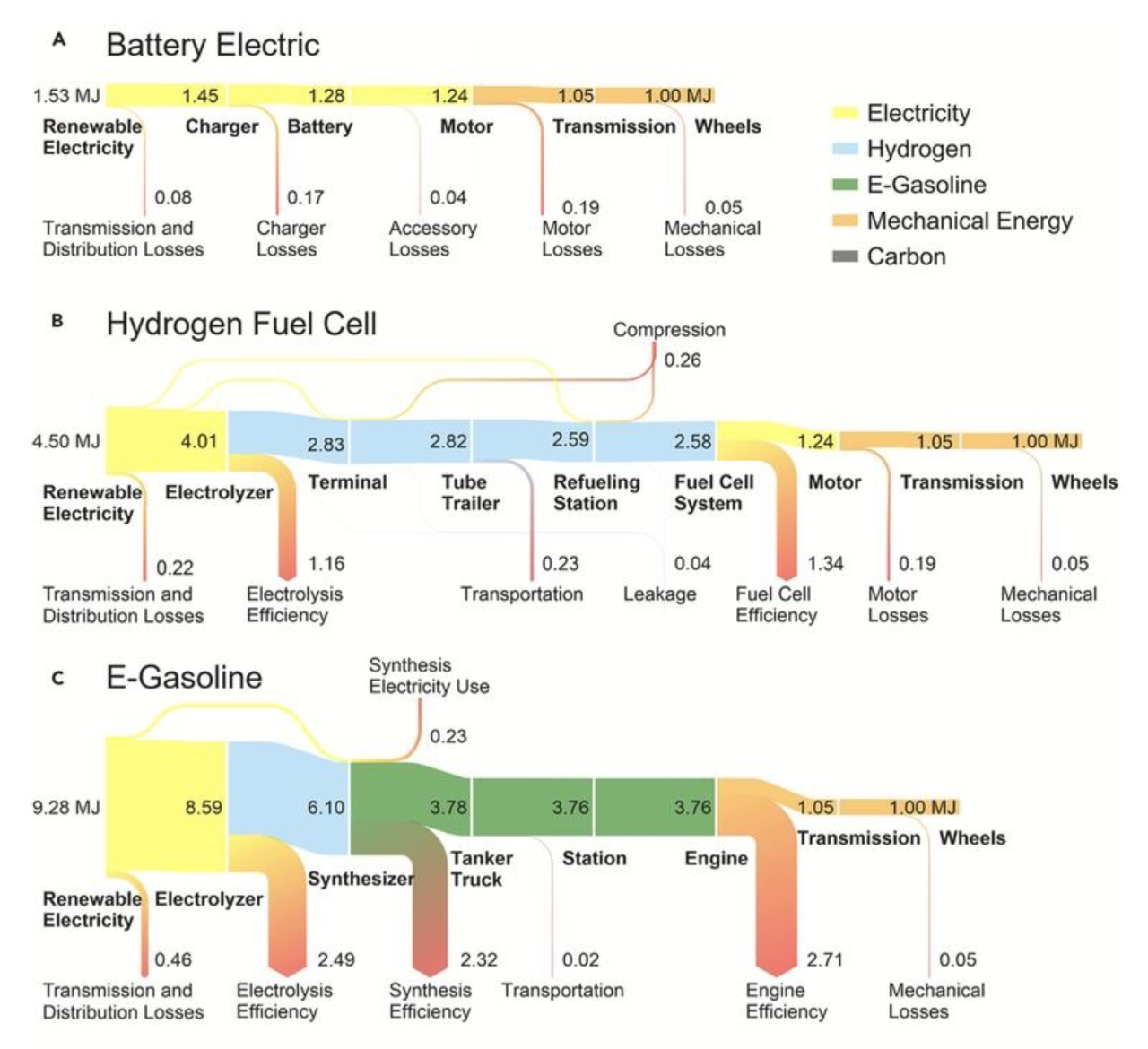
1775662169636.png


The losses pale next to an ICE. 9.28 MJ of gasoline energy to get 1 MJ at the wheels. Compare to 1.53 MJ renewable energy for the same thing. Even if we account for power plant generation efficiency (40% to 50% typical) you only need 3.06 to 3.83 MJ of fuel energy to get 1 MJ at the wheels.

The chart also shows H2 which is awful compared to EV. It's uses about three times the energy to go a given distance.
 
+

I'll say this on energy:::

If anyone wants to challenge me on putting solar energy {DC @ 29.2V} into LFP batteries more than me, bring it.
I run alot in my house every year via LFP // inverters.

Would I buy an EV?, never.

edit: typo
 
Last edited:
+

I'll say this on energy:::

If anyone want to challenge me on putting solar energy {DC @ 29.2V} into LFP batteries more than me, bring it.
I run alot in my house every year via LFP // inverters.
I just made myself a 60 Ah, 29.2V LFP battery to use with solar panels I bought a few years ago. I'm just getting into this now with eventual goal of going completely off grid. I'll need to insulate my home much better of course but people should do this regardless. It saves energy. Conservation is the best path forwards.
Would I buy an EV?, never.
If it can't work for you then don't buy one. To me EVs are somewhat better than ICEs but in the end they're still a car, with all the enormous problems that implies. We never should have mainstreamed auto travel in the first place, not when 80% plus can't drive their way out of a paper bag.
 
+

I'll say this on energy:::

If anyone wants to challenge me on putting solar energy {DC @ 29.2V} into LFP batteries more than me, bring it.
I run alot in my house every year via LFP // inverters.

Would I buy an EV?, never.

edit: typo
I think this is interesting. I don’t have power to my garage (don’t ask) and have been thinking about putting a couple panels in the roof to some batteries to run lights and whatever small uses I might need.
 
I think this is interesting. I don’t have power to my garage (don’t ask) and have been thinking about putting a couple panels in the roof to some batteries to run lights and whatever small uses I might need.
+

Yes, absolutely.
Just depends on how much you want to power.

LFP batteries are in a class of their own in life cycle, incredible charge/discharge rates they can do.
One and only one drawback, you should not charge them below freezing

I have aprox. 1100Ah in 24V config ========= that's alot of LFP batteries
have to get a calculator on Watt Hours🤓

you charge LFP at 14.6V or 29.2V (or you can double that again in series for 48V setup)

add: I'v deducted my panels/batteries/controllers/ect for Fed. taxes and your credit carries over year after year.
this sounds perfect, but you have to owe taxes to deduct,, not everyone owes.
 
Last edited:
Last edited:
Here's why EVs, are a miserable failure as a solution to fossile fueled vehicles....
Most folks live in apartment buildings. [...]
With all due respect, it doesn't help your case for the very first point to be that wrong, if you're referring to the US ?
The entire rest of the post refers to the apartment dwellers as 'most folks', so just skimming it I don't really see the validity anymore.

A quick search yields:
20% of the US population live in apartments
2/3 of the US population live in single family homes
 
Back
Top