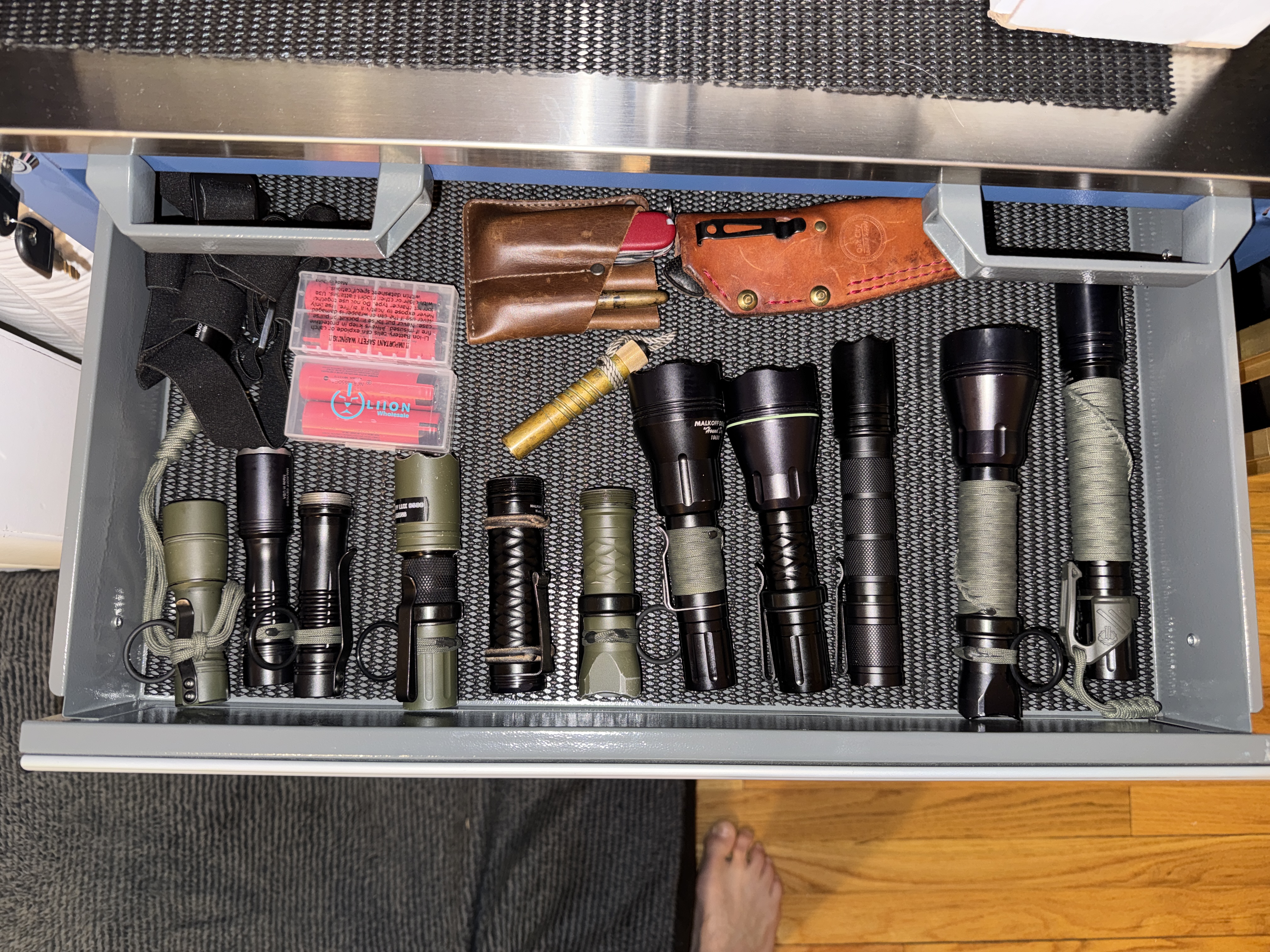
The Malkoff Front Porch

Candle Power Forums

Help Support Candle Power:

I found this IEEE white paper [IEEE Std 1789-2015 Recommended Practices for Modulating Current in High-Brightness LEDs for Mitigating Health Risks to Viewers] addresses many of these issues in substantial and fascinating detail. It includes some very useful charts, and is also extensively referenced as well.
Very interesting

Thank you!
 
Hey, I get it. You aren't experiencing something unless everyone agrees that you are, even if those people can't experience it the same way that you do. The average human can NOT split a plastic bb mid flight at will even with a ton of practice, but there was a Japanese dude a while ago who could. I'd argue that an above average hand eye coordination in an individual is a good indicator that their spatial awareness borders the realm of "ESP".

If I had to summarize your stance in not so many words, "because the performance delta of the average human is so small over the course of specific studies, even if exemplary outliers did exist, they become scientifically irrelevant and therefore insignificant to me because they serve no practical value."

What are your thoughts on that study I sent you? would you consider it bogus, or inconclusive?
A couple of points on etiquette.

You randomly sent me an unsolicited link to a study, with a message about you have the ability to control your goosebumps. The study is also about this.

Then you got upset at my flippant attitude towards this confusing, unsolicited message - which I JUST NOW have learned was supposed to be related to this topic...?

When providing a study of interest, a good habit is to provide a summary of the interesting conclusions you noted from it, and point out how that is relevant to a specific point.

Again, I apologize for not immediately pausing my life to read through a random study about goosebumps you messaged me. I STILL fail to see how that is at all related to this?
I found this IEEE white paper [IEEE Std 1789-2015 Recommended Practices for Modulating Current in High-Brightness LEDs for Mitigating Health Risks to Viewers] addresses many of these issues in substantial and fascinating detail. It includes some very useful charts, and is also extensively referenced as well.

A link (hope it works):

@jon_slider I think you would REALLY enjoy this one, as you seem to be very interested in flicker.

Very interesting

Thank you!
I concur.

Though, related to the discussion at hand, my key takeaways are:
-Flicker causes real issues, generally in ranges below 90 Hz
-People with photosensitive epilepsy should be careful
-Saccade (eye movements) and moving things (which creates a stroboscopic effect) enhance the disorientation and ability to perceive flicker
-Flicker is most perceived when looking directly at the light source (which is why it is most experience with CRT screens)
-Detection is highest at high outputs

Of note, saccade and moving objects creating a stroboscopic effect are kind of "hacks" in that it partitions the visual input into segments; i.e. through eye movement or spinning objects, I can reduce the effective frequency of modulation.


So, circling back, unless you are looking at spinning objects to "detect" flicker (you're creating said stroboscopic effect), rapidly darting your eyes around (which...is probably going to cause strain, no matter what), or looking directly at the emitter at higher powers, you should be fine.


Maybe the actionable takeaway from this is, what's the modulation depth Gene uses? Even in the worst case scenario (I'm using the light at a very high brightness, shining it into my eyes, through a rapidly spinning object, and zipping my eyes around said spinning object), the issue prevalence declines rapidly as the depth of the modulation does.
 
A couple of points on etiquette.
Sure, I was attempting to pose a counterpoint without further clogging up the thread, thought you might pick up on that. The ettiquette is easy to pull out of context, isn't it? I even summed up the article for you. I already mentioned I was gauging the extent to which you would indulge in self-contradictory logic, and it's clear that you really can't be bothered even after being the initiant for the topics being discussed...

in this post below, to be precise.

Post in thread 'The Malkoff Front Porch'
The PWN is at 310 Hz...

This reminds me of, in audiophile circles, how guys INSIST they can hear a difference between copper and gold wires...

I think, for a lot of people, they know there IS PWN, so they start to psychosomatically manifest PWM artifacts.

I'm very skeptical that 310hz is within the range of human perception. 60 Hz? Oh yeah, we could see that. MAYBE 120 Hz, I could buy that...but 310 Hz is beyond the limits of established human perception - whose maximal range is about 200 Hz in actual studies.

"I don't care, bro. I can totally hear the difference in these gold wires!"
"I can sense the presence of my dead grandma!"

At a certain point, there's no point in arguing with people who FEEL that they have extra-sensory perception. They're convinced it's true, and despite Science's best efforts to document these abilities, they're convinced they're the rare exceptions - truly, unicorns.
But let's agree to drop the subject moving forward?
 
Sure, I was attempting to pose a counterpoint without further clogging up the thread, thought you might pick up on that. The ettiquette is easy to pull out of context, isn't it? I even summed up the article for you. I already mentioned I was gauging the extent to which you would indulge in self-contradictory logic, and it's clear that you really can't be bothered even after being the initiant for the topics being discussed...

in this post below, to be precise.

Post in thread 'The Malkoff Front Porch'

But let's agree to drop the subject moving forward?
Still not getting why you sent me an article about people controlling goosebumps...

And I still stand by my point. As the ensuing article posted above notes, flicker is primarily an effect below 90 Hz, and when it manifests at higher frequencies, this is due to external mechanisms being used to induce it (saccade and stroboscopic effects).

So, if that's "indulging in self-contradictory logic" to you, then...okay?

You keep vagueposting mostly opaque things, suggesting stuff, and then getting upset that I'm not responding how you want.

Say what you mean, or move on.

Like I said right from the start, this entire topic is a waste of time. No amount of data will change your mind. You believe you have some kind of ESP (was that the point of the goosebumps thing?) that makes the 310 Hz of the PWM on the MDC AA impossible to use.

I'm skeptical of that, but I fundamentally don't care what you believe. I'm not going to tell you what you believe, but I'm also not going to change my views without reliable data. I am sorry if that makes you upset. If it helps, I truly believe that you can hold whatever beliefs you want, even if I disagree with them.

I won't hold it against you, and I'm more than willing to move on (and was from the start, haha).
 
what's the modulation depth Gene uses?
fwiw, I have found that discussions of PWM on CPF tends to create arguments, so I usually avoid talking about PWM here ;-)... but since you asked...

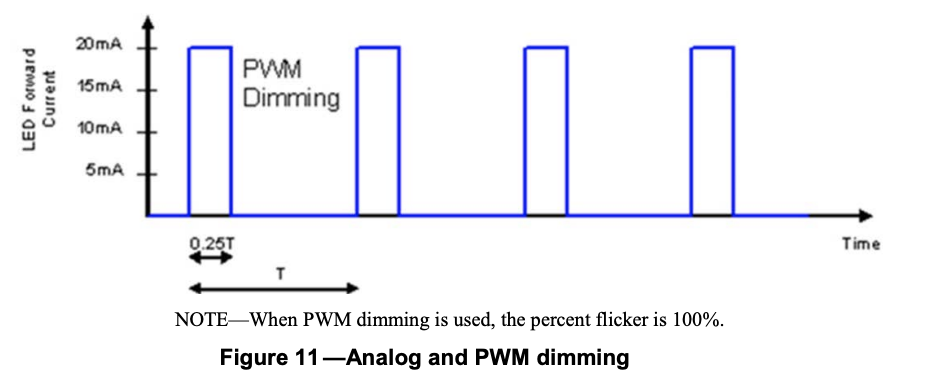
PWM turns the LED completely Off and On, therefore, the modulation depth of PWM is by definition, 100%..

here is a chart of PWM from the article you linked me to:

Screen Shot 2026-04-15 at 7.08.27 AM.png

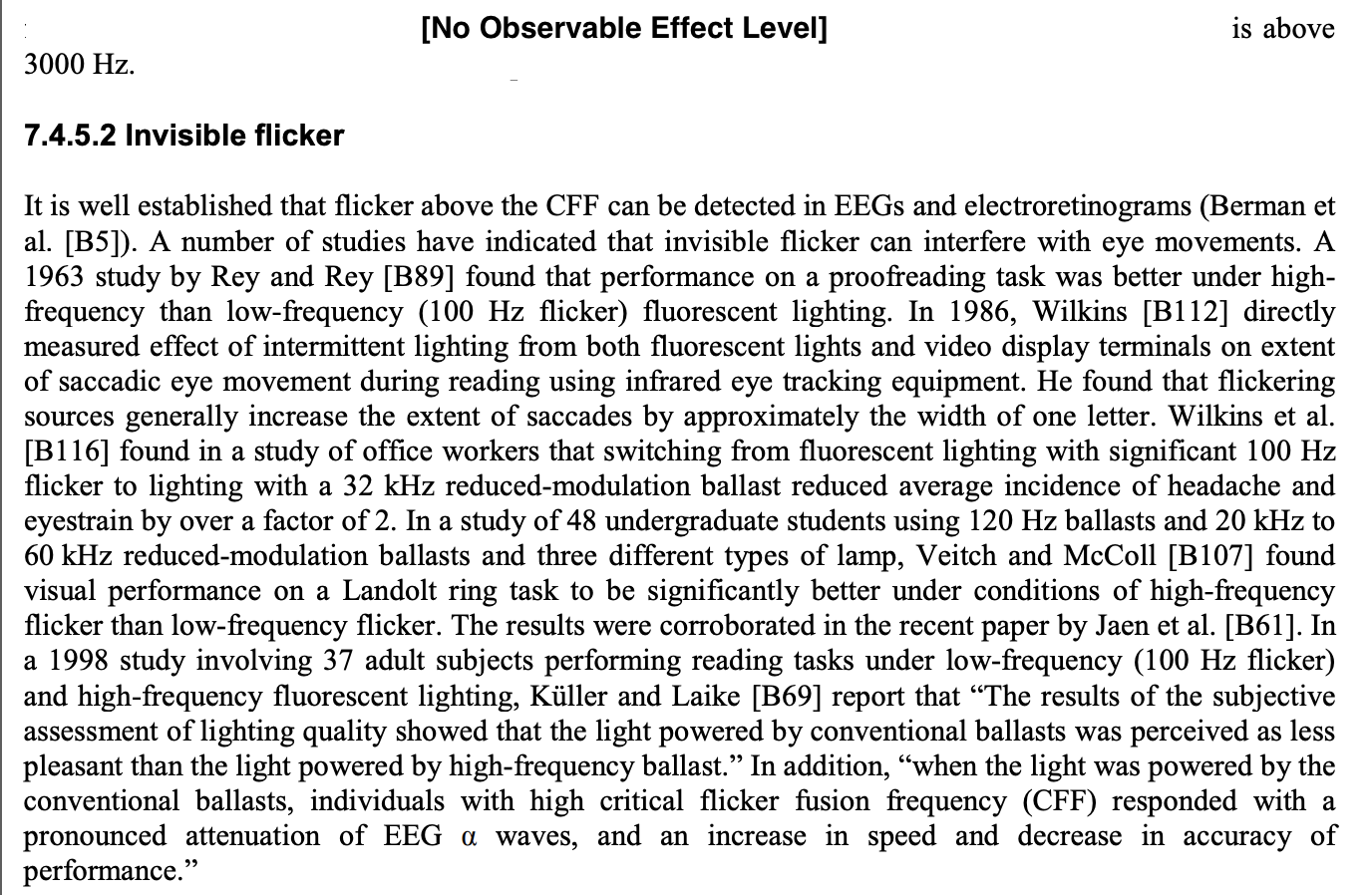
page 53 says there are No Observable Effects above 3000 Hz.

Screen Shot 2026-04-15 at 7.31.36 AM.png


The Malkoff PWM driver uses a frequency of 310 Hz, which is considered to be in the Invisible range that has effects described above.

However, the effects of Invisible PWM are related to extended use for multiple hours, of an ambient light source for reading.

Extended use as ambient light for reading is not usually how we use a flashlight.


I like to use an Opple Light Master to measure the Flicker Index, frequency, and modulation depth of my own flashlights.

I mostly avoid using lights with PWM, out of personal preference. Even if I cant see it and even though I dont get migraines. This preference protects my wallet from buying Malkoffs.. LOL!
 
As an Amazon Associate we earn from qualifying purchases. Product prices and availability are accurate as of the date/time indicated and are subject to change.
Single mode or high/low switch Malkoff for me only. Although the new programmable one sounds worth a go.

I have two Malkoff lights that I’ve essentially given up on as much as I’ve tried to like them because of the strong PWM visible.
One is an M361N XPG2 which has a nice tint and beam but horribly visible PWM. The other is an Illumn AA MDC 219B, same problem with the horrible PWM.

I don’t go studying fans in motion or what have you, I can detect the unpleasantness of the PWM simply by using them. Even a slow scan of an area, no wild fast actions, I’ll detect the PWM.
I simply can’t use these lights.
Can’t say I’m a fan of the UI either but I could overlook that if it weren’t for the PWM.

I’ve read on here somewhere that the frequency was increased from the older models so maybe it’s much better now.

I don’t mind using lights with PWM as long as I can’t see it at all.
 
fwiw, I have found that discussions of PWM on CPF tends to create arguments, so I usually avoid talking about PWM here ;-)... but since you asked...

PWM turns the LED completely Off and On, therefore, the modulation depth of PWM is by definition, 100%..

here is a chart of PWM from the article you linked me to:

View attachment 93306
page 53 says there are No Observable Effects above 3000 Hz.

View attachment 93309

The Malkoff PWM driver uses a frequency of 310 Hz, which is considered to be in the Invisible range that has effects described above.

However, the effects of Invisible PWM are related to extended use for multiple hours, of an ambient light source for reading.

Extended use as ambient light for reading is not usually how we use a flashlight.


I like to use an Opple Light Master to measure the Flicker Index, frequency, and modulation depth of my own flashlights.

I mostly avoid using lights with PWM, out of personal preference. Even if I cant see it and even though I dont get migraines. This preference protects my wallet from buying Malkoffs.. LOL!
Yeah, I may adapt your rule ;)

To be fair, the range of detectable up to 3000Hz required the aid of saccade and/or a stroboscopic effect; i.e. unless you're rapidly moving your eyes or looking at spinning objects, the limits were more around 90 Hz. Table 1 summarized the biological effects, which pretty much all fall in those ranges.
I recall their recommending up to 3000 Hz under the context of industrial sites with rotating machinery (since it's an engineering association), because that WILL have a localized source of a stroboscopic effect. And, to be fair, that's a very fair point. If you're working on a lather or something, you probably DO want to be more mindful.

That's why reading under fluorescent lights always created so many problems for people; saccade is REALLY high while reading.

It's kind of interesting for me, too, because back in the CRT and fluorescent light days, I'd say people thought of me as hyper-sensitive to the flicker from those. It's kind of interesting, now, to see why that was. The part about moving monitors up to 90hz and increasing the frequency of ballasts brought back some dark, dark memories of being in some OLD buildings with some awful ballasts. I remember getting my first non-CRT monitor, and just loving it to death.

I do miss that little fuzzy "power off" noise they made. I found an OLD, OLD TV (IIRC, it was made in the 70s) in an old building a few years ago, and I plugged it in just to enjoy the sound of the static and power on/off cycles. It'd been over 20 years since I'd heard those, haha.
If only I'd had a 219F in 1800K with me, it could have been nostalgia overload!

Single mode or high/low switch Malkoff for me only. Although the new programmable one sounds worth a go.

I have two Malkoff lights that I’ve essentially given up on as much as I’ve tried to like them because of the strong PWM visible.
One is an M361N XPG2 which has a nice tint and beam but horribly visible PWM. The other is an Illumn AA MDC 219B, same problem with the horrible PWM.

I don’t go studying fans in motion or what have you, I can detect the unpleasantness of the PWM simply by using them. Even a slow scan of an area, no wild fast actions, I’ll detect the PWM.
I simply can’t use these lights.
Can’t say I’m a fan of the UI either but I could overlook that if it weren’t for the PWM.

I’ve read on here somewhere that the frequency was increased from the older models so maybe it’s much better now.

I don’t mind using lights with PWM as long as I can’t see it at all.
That's a good point. I have no idea what frequency the older lights used. I do remember reading a lot more complaints in the really old threads.
 
Still with the PWM!!!?????!!!!!

For the love of God stop beating that dead effing horse!
What’s irrelevant about it?
It’s the difference between usable and unusable for me.
I get that guys on here went well deep and philosophical on it, I didn’t even bother reading the argument in detail.

As was just pointed out it used to be a rather large bone of contention in the Malkoff forum.

Anyway, I don’t have further interest going forward. I made a valid point.
The way I see it, if you’re not interested then stay effing out of it.
 
Still with the PWM!!!?????!!!!!

For the love of God stop beating that dead effing horse!

What’s irrelevant about it?
It’s the difference between usable and unusable for me.
I get that guys on here went well deep and philosophical on it, I didn’t even bother reading the argument in detail.

As was just pointed out it used to be a rather large bone of contention in the Malkoff forum.

Anyway, I don’t have further interest going forward. I made a valid point.
The way I see it, if you’re not interested then stay effing out of it.
I don't think he's saying it's irrelevant, it's just more that there are two views, and they're generally incompatible, so the discussion just kind of circles.

I think it's a lot like religion conversations.
And, much like that, I hope everyone knows, I think we're all allowed to believe what we want, and so long as your beliefs make your life better, I'm happy for you.

It's right there in the Constitution:
Congress shall make no law respecting an establishment of a PWM stance, or prohibiting the free exercise thereof; or abridging the freedom of speech, or of the press; or the right of the people peaceably to assemble, and to petition the Government for a redress of PWM grievances.
 
Love PWM in my incans!
Are you teasing? Initially, that seems kind of interesting with the way the wires work.

What are the advantages? Is it just a way to get overall lower power consumption? Is there an appreciable decrease in output?
No programmable, please!
One mode or High / Low only.
Good news is he's still offering versions with and without EZP.
 
There was an aftermarket PWM multimode switch for C-series SureFire incandescent flashlights, way back when. It could also technically be used with an LED dropin instead of a lamp, of course, but the rate was incredibly slow.
 
The original SF A2 uses PWM for the bulb, circuit designed by Willie Hunt. AlanB, JimmyM, wquiles, and AW all built PWM circuits for Mags and Surefires years ago. Essentially flat regulation for incans. Still use them and appreciate the advantages of PWM for these lights.
 
I'll link your excellent historical post below for reference @leukos ...


Latest posts

Back
Top