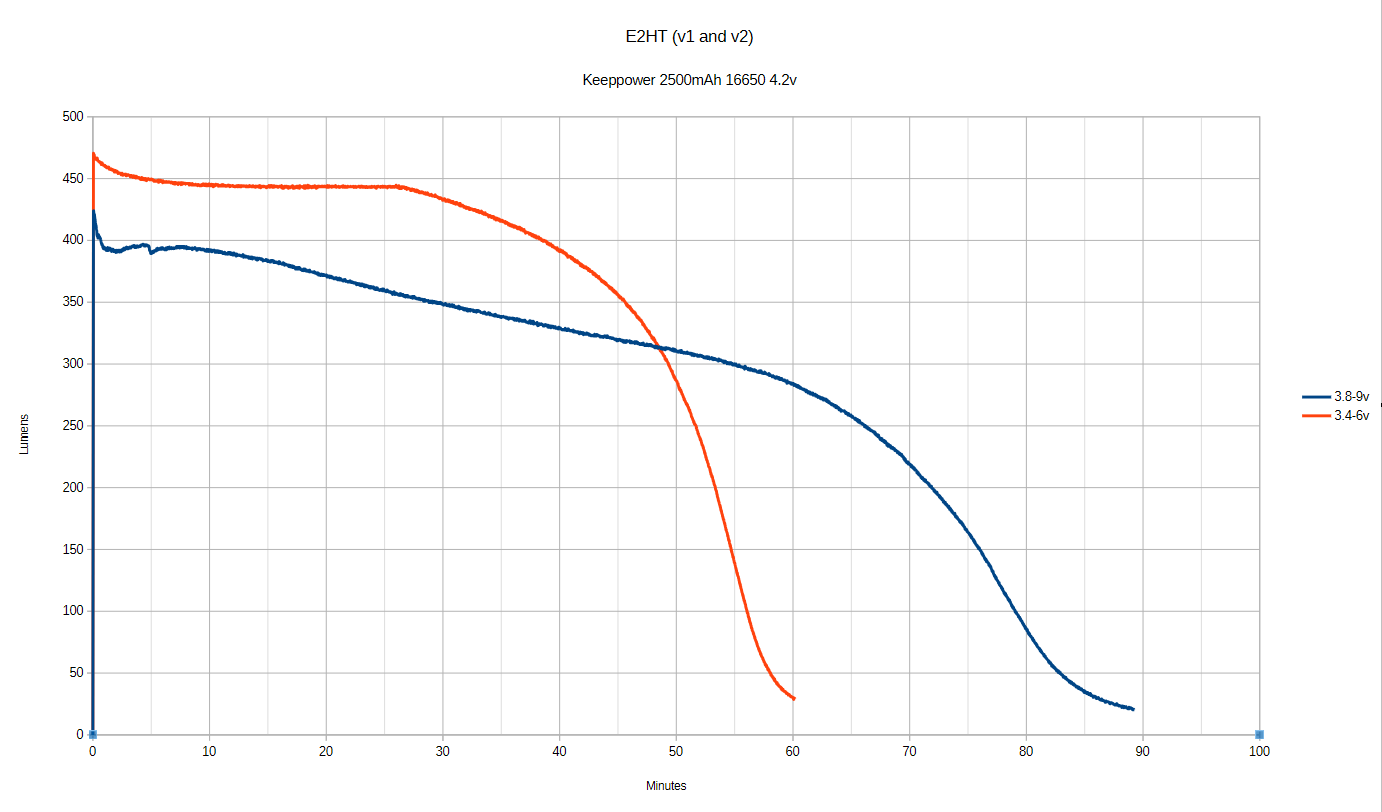
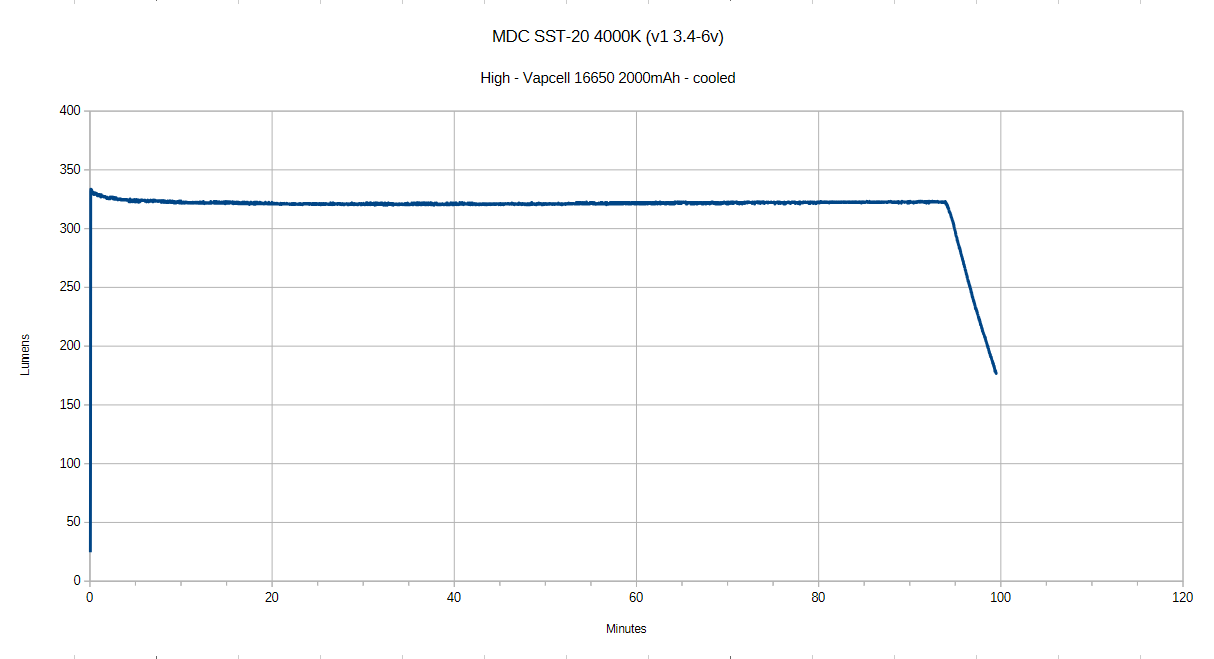
So you prefer that, and you previously mentioned you can tell the difference between a light that is still on and one that shut off 30 minutes ago. So a light that is still bucking or boosting the voltage/still regulating the output at whatever matching levels is going to run longer. Maglite tends to have at least one timed step-down and often a couple. You could make them much more frequent and gradual, something like Anduril's sunset timer except changed to prolong battery life rather than help you unwind/go to sleep. Something that gives an output curve similar to an unregulated light. Nothing like this exists that I'm aware of, so I can't show a direct runtime comparo. But it would likely run much longer than a FET light losing output at a similar rate, because the driver would be more efficient.
So even with your preferred light pattern vs consistent output, the new driver doesn't do any favors for 1xLi-ion users because they are not getting good efficiency. I share your suspicion that this change is for CR123 users, but that was my initial point, that I don't feel like I'm the target audience for these lights and that they are losing their appeal to me. And thus a couple of wishes that could change that.
Now I'm curious if I could set an Anduril light at ~450 lumens but set the sunset timer for some absurdly long time, and get it to ramp down to where by the time it died it was still at like 100 lumens...

I like the way you think, haha.
Maglite is an interesting one to bring up, because using some of their lights over a long time,
I never realized they were dimming the whole time.
While I'm sure this all started as a bug due to batteries (as far as I know alkaline, CR123A, and Li-ion cells will "naturally" slope like this, while NiMH and LiFePO4 are more flat). it's kind of an interesting "feature." The net result is you get a REALLY LONG runtime, and you don't really notice the slow dimming.
I think, from a technical standpoint, I'd always opted for headlamps with a regulated output, but then using them versus a random FET driver, it's been interesting to note that the abrupt drop in output and cutoff is maybe MORE annoying than a steady decline (since I'm usually in the middle of doing something). Again, I'm not sure which I prefer, but I just thought it was interesting that I've kind of learned to appreciate both.
BUT, that all being said, I think this all comes back to CR123A batteries. I think the people I thought were nuts were just
used to that kind of an output curve, due to CR123A batteries. I never got into CR123A stuff, cause it was just way, way too expensive. A garbage 2xAA incandescent (to me) that ran on awful NiCd batteries was just so cheap to operate in comparison, I was too young and broke to get into flashlights in the halycon days of incans, Surefire P60s, CR123A cells, etc. I only really started getting into flashlights once Eneloops became a thing, and they have a good, stable voltage output, so even the cheapest AA lights "feel" regulated, haha.
The Alpha was the first light I've ever seen that was intentionally dimming slowly to use this effect, and it's quite compelling. It's probably the closest "out of the box" light with a controller doing SOMETHING like you're wondering about (though, I guess you could just run something direct drive).I know the Malkoff bodyguard catches a bit of FLAK for the
very abrupt drop-down, but the advantage is it's a bit of a stopwatch, then.
But, overall, while I know it's not really feasible, I do kind of wish Gene would offer different drivers, even if it was just in batches. Maybe that's something we'd have to ask Kosen to do, though...
Now that I think about it, maybe we should all ask Kosen to do a run of "old style" M61 drop-ins with a neutral emitter. 300 lumens, flat output, lower voltage range max, and maybe the 219B? Heck, I'd buy that. That sounds almost perfect, as I agree on your point about the SST-20 vs. 219B vs. 519A; I think the size of the 519A hotspot in Malkoffs isn't as good as with the 219B, and the SST-20 (to me) works the best with Don's emitter. Well, I guess the XP-L ones (M91) also work pretty well.