Wish list from Malkoff Devices

Candle Power Forums

Help Support Candle Power:

Talking about MDC's

I'd like to see a 2AA/1-CR123 that was......

3/20/100 lumens

I will admit that I would use the 3/20 lumen modes probably 99% of the time (for me)

This range (3/20/100 lumens) would work out perfect for me, and my needs for an MDC (for me)

I rarely/never use the 210/300 mode on my current MDC's (except when I "accidently" get there), and find the 210/300 lumens mode on an MDC, to be a waste of batteries (for me)

If I need 210/300 lumens, I have FAR better flashlights to use, than an MDC (for me)

For me, a 1AA/2AA/1-CR123 flashlight is about "lower lumen" levels, and I can find NO use for an MDC over 100 lumens (for me)
 
Talking about MDC's

I'd like to see a 2AA/1-CR123 that was......

3/20/100 lumens

I will admit that I would use the 3/20 lumen modes probably 99% of the time (for me)

This range (3/20/100 lumens) would work out perfect for me, and my needs for an MDC (for me)

I rarely/never use the 210/300 mode on my current MDC's (except when I "accidently" get there), and find the 210/300 lumens mode on an MDC, to be a waste of batteries (for me)

If I need 210/300 lumens, I have FAR better flashlights to use, than an MDC (for me)

For me, a 1AA/2AA/1-CR123 flashlight is about "lower lumen" levels, and I can find NO use for an MDC over 100 lumens (for me)
I like this line of thought.

Similar to before, where I said I "stage" specific lights near their purpose, this is kind of how I use my lights, too.

If I NEED a lot of light (e.g. outdoors), I just grab one of my full MDC lights, but otherwise, especially around the house, it's mostly low or medium modes.

I actually think a two mode AA MDC would be pretty sweet. Something along that .3 and then 20-30 lumens. Optimize it around runtime, and you'd have a really great dedicated night use light.

For me, the highest setting on the MDC AA is nice sometimes in the day, but it MOSTLY just accidentally blinds me at night, haha. So, I still love the MDC AA more than any other light, but man... a two-mode, low and ultralow would be pretty slick. That's ALMOST what I've been trying to do with an M31W in a FiveMega MD1 and a high/low ring, though the stock high/low ring seems to not work once the voltage drops a bit on a NiMH, and/or it's a bit tricky to get it backed off enough to consistenly work with my MD1 body (I half wonder if the smaller battery inside decreases spring pressure).
 
My wish list stems from some frustration/realization that perhaps I am not the target market for these lights. But here are the main things that keep me from being so interested in the newer lights:

PWM
I don't like PWM in theory due to the lower efficiency. But I really don't like it in Malkoff lights where the frequency is not very fast and it is fairly visible to me. Every high CRI MDC light is a three mode and therefore has PWM. This pushes me to the M31/61s, though a lot of the high CRI ones are M361's.

Multi-cell focus/poor 1xLi-ion performance
There are two aspects of this to me. One is the MD2 bodies now advise against using a protected 18650 (advise buying a tube spacer). I don't know if there was a change from what used to be called "MD2" lights to what are now called "MDX" lights, or if there has always been a space/interference issue? I've almost exclusively used protected 18650's and haven't seen any crush problems, but it makes me apprehensive about getting another. It just seems like another sign that if you like 1xLi-ion, these aren't really the lights for you.

The other is the driver. I hate the 3.8-9v driver. I especially hate it in MDC/E2 heads where there is basically no benefit. There aren't any (at least not commonly) E3/3-cell/9v E-series bodies. So why is 9v needed? Two li-ion are also odd. You could use 2x14500 or 2x16340. But why? The 14500's barely exceed the capacity of a 16650 but are a fair bit larger. 16340's are just worse. How is that trade-off worth it for crappy performance on a single li-ion. I find lights like the new MDC HTL (the dual-fuel sized body) baffling. The body is larger, to where it makes little sense to me if you use it w/ 2xCR123. Just get an E2HT and MDC 16650. And if you use it with a single 18650, the regulation sucks. It's dropping out of regulation when the battery is still like 80% full.

Even in the MD bodies, I don't see the point. While the M61 can be used with any MD body, the expectation is to use it in a 2-cell/6v one. So why does it need to tolerate 9v? There are already M91 drop-ins for this. It pays for this increased voltage with poor regulation when using an 18650. But I can see how it increases the lego-ability of them as 3/4-cell bodies are more common than in the E-series/MDC line.

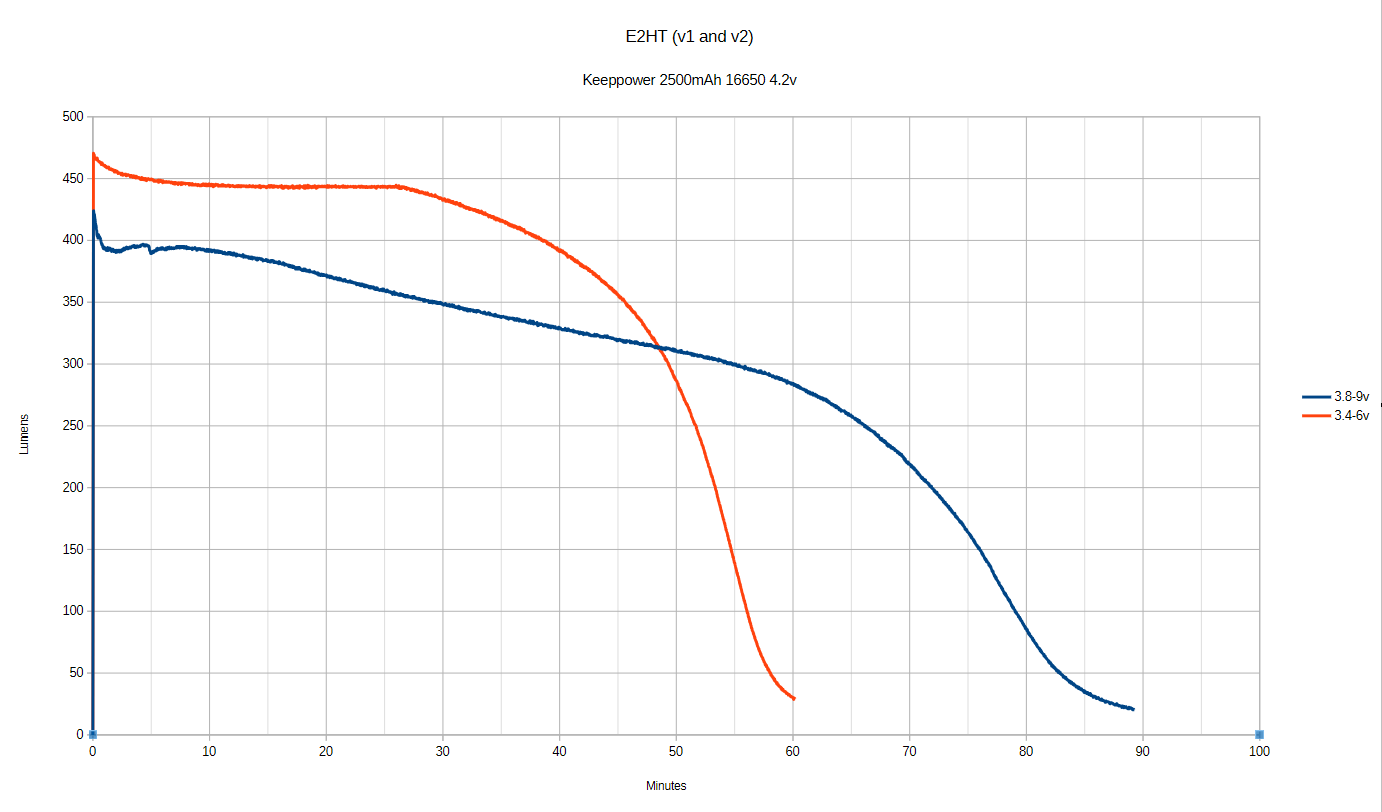
Here's an example of what I mean w/ basically the same light:
1764259556458.png


Unrelated to the above, and more in the actual "wish" vein. I'd love to see the 219b used more. An MDC AA with 219b would be neat. Because it isn't very bright, the 219b isn't giving up many lumens due to its lower efficacy vs the SST-20 or 519a. The 219b has a tighter beam than the 519a, it's not as tight as the SST-20 but the improved tint is worth the trade-off to me.
 
Last edited:
My wish list stems from some frustration/realization that perhaps I am not the target market for these lights. But here are the main things that keep me from being so interested in the newer lights:

PWM
I don't like PWM in theory due to the lower efficiency. But I really don't like it in Malkoff lights where the frequency is not very fast and it is fairly visible to me. Every high CRI MDC light is a three mode and therefore has PWM. This pushes me to the M31/61s, though a lot of the high CRI ones are M361's.

Multi-cell focus/poor 1xLi-ion performance
There are two aspects of this to me. One is the MD2 bodies now advise against using a protected 18650 (advise buying a tube spacer). I don't know if there was a change from what used to be called "MD2" lights to what are now called "MDX" lights, or if there has always been a space/interference issue? I've almost exclusively used protected 18650's and haven't seen any crush problems, but it makes me apprehensive about getting another. It just seems like another sign that if you like 1xLi-ion, these aren't really the lights for you.

The other is the driver. I hate the 3.8-9v driver. I especially hate it in MDC/E2 heads where there is basically no benefit. There aren't any (at least not commonly) E3/3-cell/9v E-series bodies. So why is 9v needed? Two li-ion are also odd. You could use 2x14500 or 2x16340. But why? The 14500's barely exceed the capacity of a 16650 but are a fair bit larger. 16340's are just worse. How is that trade-off worth it for crappy performance on a single li-ion. I find lights like the new MDC HTL (the dual-fuel sized body) baffling. The body is larger, to where it makes little sense to me if you use it w/ 2xCR123. Just get an E2HT and MDC 16650. And if you use it with a single 18650, the regulation sucks. It's dropping out of regulation when the battery is still like 80% full.

Even in the MD bodies, I don't see the point. While the M61 can be used with any MD body, the expectation is to use it in a 2-cell/6v one. So why does it need to tolerate 9v? There are already M91 drop-ins for this. It pays for this increased voltage with poor regulation when using an 18650. But I can see how it increases the lego-ability of them as 3/4-cell bodies are more common than in the E-series/MDC line.

Here's an example of what I mean w/ basically the same light:
View attachment 86786

Unrelated to the above, and more in the actual "wish" vein. I'd love to see the 219b used more. An MDC AA with 219b would be neat. Because it isn't very bright, the 219b isn't giving up many lumens due to its lower efficacy vs the SST-20 or 519a. The 219b has a tighter beam than the 519a, it's not as tight as the SST-20 but the improved tint is worth the trade-off to me.
The battery spacer part is more of a reflection of the battery market than Malkoff himself. Batteries keep "improving capacity," but they're simply getting a larger diameter and/or length. This is actually my pet peeve with Li-ion cells, and why I STRONGLY prefer AA/AAA Eneloops. It's almost gotten to the point that I have to have an individual Li-ion cell for each light, because DEPENDING ON WHEN THE LIGHT CAME OUT, the associated cell of that period is likely too long/wide to be used in any "same sized" light from before that. It's this endless arms race, to the point where 18650 cells really are 19700 cells. I think it's ridiculous, but I think Gene is trapped, as he can't affect this. The spacer is more of a coping mechanism, because otherwise he needs to redesign the entire MD series to accommodate COMPLETELY NON-STANDARDIZED cell sizing.

And, to be fair, in your chart, I think you're missing the actual point; the 3.8-9V has a longer runtime.
Sure, the output drops sooner, but...You're really not going to be able to see a meaningful difference between 450 lumens and 300.

I think you argument is based on a bit of an interesting issue in the light (or sound) community; we LOVE to look at OBJECTIVE numbers, but our sensory experience with light and sound isn't well reflected by the measurements we take with machines.
450 vs 300 lumens?
"Whoa! That's 50% more output!"
But the way our eyes work, you can't appreciate that difference. AND, if you look at that curve, they start within about 10% of each other, then begin to taper their output. I LOVE the Elzetta Alpha because it STARTS bright at 800 lumens, then SLOWLY drops to 535 lumens over 30 seconds. It's like magic, though, because you can't tell the difference because there is more than enough time for your irises to adjust. Human eyes are not a set aperture, so they adjust TO the light conditions, making raw numeric comparisons a bit silly. Sure, people might be able to discern a difference in a direct comparison, starting at a white wall...but...what are you doing?! Malkoff doesn't design lights for paint-drying enthusiasts, but for people who use lights, and they appreciate the voltage flexibility and longer runtimes.

Because, ~20 minutes of longer runtime IS appreciable AND perceptible. My eyes can 100% see that difference, haha.
 
You're really not going to be able to see a meaningful difference between 450 lumens and 300.
I don't want to turn it into a big back and forth, my wishes might not be yours. The candela will vary directly with the lumens. The E2HT is supposed to be a throwy head. If I can't tell the difference between 450 and 300 lumens, and therefore 300 lumens is satisfactory, I'd want a light that puts out 300 lumens for a longer period of time. There is some threshold of lumens, and certainly candela, that is needed for a particular task. I want a light to maintain that. Not only achieve it in the first minute of the first activation until the battery is charged/changed. The V2 driver is basically a FET light with a single li-ion. The output curve basically matches the battery discharge curve.

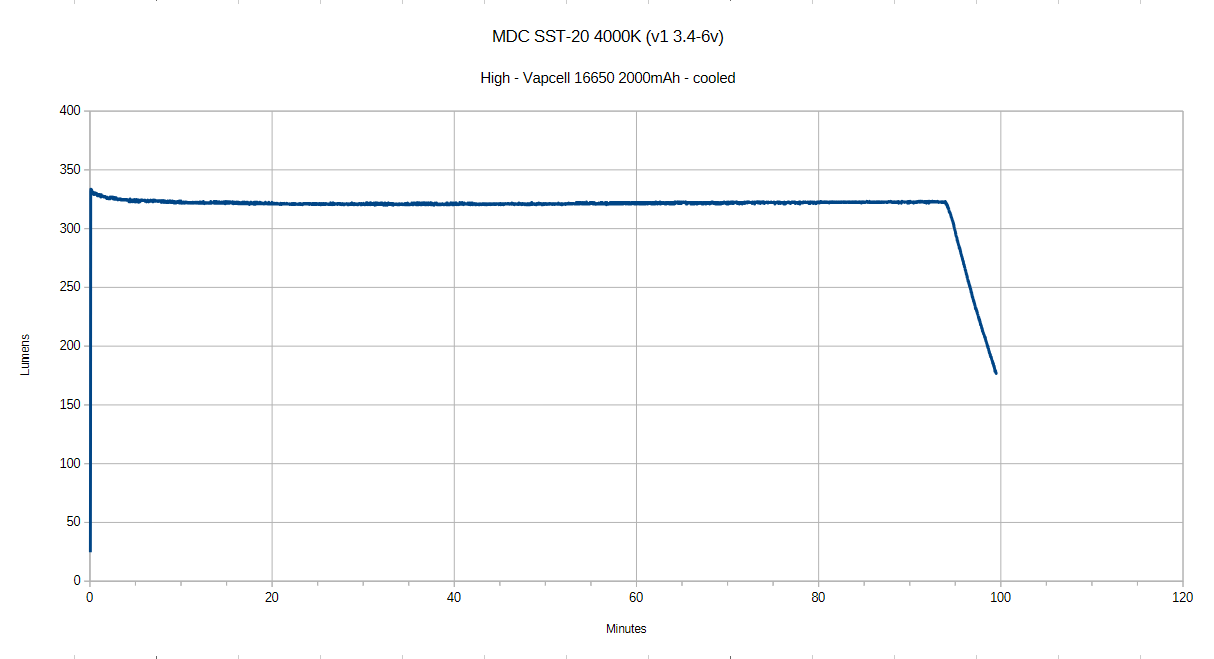
If 300 lumens is good enough, here's a 300 lumen setup that maintains it longer, and gives you high CRI and a warmer temp to boot. From a smaller capacity cell too:
1764264812070.png


Edit: that's good to know about the battery sizes, that maybe my batteries are not a problem. I have some 3800mAh protected cells but maybe I'll just use them in other lights and stick w/ the fairly standard 3500 ones in MD2s.
 
Last edited:
As an Amazon Associate we earn from qualifying purchases. Product prices and availability are accurate as of the date/time indicated and are subject to change.
I don't want to turn it into a big back and forth. The candela will vary directly with the lumens. The E2HT is supposed to be a throwy head. If I can't tell the difference between 450 and 300 lumens, and therefore 300 lumens is satisfactory, I'd want a light that puts out 300 lumens for a longer period of time. There is some threshold of lumens, and certainly candela, that is needed for a particular task. I want a light to maintain that. Not only achieve it in the first minute of the first activation until the battery is charged/changed. The V2 driver is basically a FET light with a single li-ion. The output curve basically matches the battery discharge curve.

If 300 lumens is good enough, here's a 300 lumen setup that maintains it longer, and gives you high CRI and a warmer temp to boot. From a smaller capacity cell too:
View attachment 86789
Nothing wrong with a back and forth.

Sure, candela is about the only thing you MIGHT notice, but again, that's really only going to be if you're measuring it, or looking REALLY HARD for it. That's why so many of us rag on the M361; 200 vs. 500 lumens is almost impossible to discern. You essentially have to shine it at something further away, and look at the light along the fringes to notice anything, or shine it at something quite far away, and pay really close attention to the lux near the center.

That's why, in real world use, you're just not going to see a big difference, if at all. Cast the light on an area with things at different ranges, with the lux splaying across them, and it's a LOT harder to discern those differences.

And sure, if you get a lower output, you can get better runtimes, and it's easier to get that flatter output, but you've sort of moved the goal posts.

Maybe your first point was just unclear. If it's, "I'd like to see a return of the older drop-ins with ~300 lumens with the lower output, lower voltage, and flatter output," I think you'll find most of us will agree. Most of use are on team M61L or M61LL, and often on team "Why can't get get an M61LLL or LLLL!?!" haha.

I think Gene bumped the output to "chase the numbers" so his lights wouldn't look so "bad in comparison" to a lot of the Chinese turbo lights curious people might get recommended from an Amazon or Reddit search. That came with some disadvantages, for sure. Then again, a lot of the changes seem to come at the request of larger orders (usually LE, I'd guess), who are always in the CR123A ecosystem, so maybe the entire goal was to get these to work with a 3xCR123A setup.

And, to belabor it all, while I also find a flat output to be really positive, in actual use, I find that I don't notice a tapering output until it starts to REALLY dim, and I've had to kind of come full circle to the point that a long taper IS kind of nice, because it's a bit of a natural voltage indicator, but you can "stretch" out that usage longer. I used to think that was such a weird argument in the INFRNL runtime thread, but I kind of now see the point behind that view. I'm not sure which I prefer, honestly, but I am amused that a point I used to think was silly has grown on me.
 
I don't notice a tapering output until it starts to REALLY dim
So you prefer that, and you previously mentioned you can tell the difference between a light that is still on and one that shut off 30 minutes ago. So a light that is still bucking or boosting the voltage/still regulating the output at whatever matching levels is going to run longer. Maglite tends to have at least one timed step-down and often a couple. You could make them much more frequent and gradual, something like Anduril's sunset timer except changed to prolong battery life rather than help you unwind/go to sleep. Something that gives an output curve similar to an unregulated light. Nothing like this exists that I'm aware of, so I can't show a direct runtime comparo. But it would likely run much longer than a FET light losing output at a similar rate, because the driver would be more efficient.

So even with your preferred light pattern vs consistent output, the new driver doesn't do any favors for 1xLi-ion users because they are not getting good efficiency. I share your suspicion that this change is for CR123 users, but that was my initial point, that I don't feel like I'm the target audience for these lights and that they are losing their appeal to me. And thus a couple of wishes that could change that.

Now I'm curious if I could set an Anduril light at ~450 lumens but set the sunset timer for some absurdly long time, and get it to ramp down to where by the time it died it was still at like 100 lumens... 🤔
 
So you prefer that, and you previously mentioned you can tell the difference between a light that is still on and one that shut off 30 minutes ago. So a light that is still bucking or boosting the voltage/still regulating the output at whatever matching levels is going to run longer. Maglite tends to have at least one timed step-down and often a couple. You could make them much more frequent and gradual, something like Anduril's sunset timer except changed to prolong battery life rather than help you unwind/go to sleep. Something that gives an output curve similar to an unregulated light. Nothing like this exists that I'm aware of, so I can't show a direct runtime comparo. But it would likely run much longer than a FET light losing output at a similar rate, because the driver would be more efficient.

So even with your preferred light pattern vs consistent output, the new driver doesn't do any favors for 1xLi-ion users because they are not getting good efficiency. I share your suspicion that this change is for CR123 users, but that was my initial point, that I don't feel like I'm the target audience for these lights and that they are losing their appeal to me. And thus a couple of wishes that could change that.

Now I'm curious if I could set an Anduril light at ~450 lumens but set the sunset timer for some absurdly long time, and get it to ramp down to where by the time it died it was still at like 100 lumens... 🤔
I like the way you think, haha.

Maglite is an interesting one to bring up, because using some of their lights over a long time, I never realized they were dimming the whole time.

While I'm sure this all started as a bug due to batteries (as far as I know alkaline, CR123A, and Li-ion cells will "naturally" slope like this, while NiMH and LiFePO4 are more flat). it's kind of an interesting "feature." The net result is you get a REALLY LONG runtime, and you don't really notice the slow dimming.

I think, from a technical standpoint, I'd always opted for headlamps with a regulated output, but then using them versus a random FET driver, it's been interesting to note that the abrupt drop in output and cutoff is maybe MORE annoying than a steady decline (since I'm usually in the middle of doing something). Again, I'm not sure which I prefer, but I just thought it was interesting that I've kind of learned to appreciate both.

BUT, that all being said, I think this all comes back to CR123A batteries. I think the people I thought were nuts were just used to that kind of an output curve, due to CR123A batteries. I never got into CR123A stuff, cause it was just way, way too expensive. A garbage 2xAA incandescent (to me) that ran on awful NiCd batteries was just so cheap to operate in comparison, I was too young and broke to get into flashlights in the halycon days of incans, Surefire P60s, CR123A cells, etc. I only really started getting into flashlights once Eneloops became a thing, and they have a good, stable voltage output, so even the cheapest AA lights "feel" regulated, haha.

The Alpha was the first light I've ever seen that was intentionally dimming slowly to use this effect, and it's quite compelling. It's probably the closest "out of the box" light with a controller doing SOMETHING like you're wondering about (though, I guess you could just run something direct drive).I know the Malkoff bodyguard catches a bit of FLAK for the very abrupt drop-down, but the advantage is it's a bit of a stopwatch, then.

But, overall, while I know it's not really feasible, I do kind of wish Gene would offer different drivers, even if it was just in batches. Maybe that's something we'd have to ask Kosen to do, though...

Now that I think about it, maybe we should all ask Kosen to do a run of "old style" M61 drop-ins with a neutral emitter. 300 lumens, flat output, lower voltage range max, and maybe the 219B? Heck, I'd buy that. That sounds almost perfect, as I agree on your point about the SST-20 vs. 219B vs. 519A; I think the size of the 519A hotspot in Malkoffs isn't as good as with the 219B, and the SST-20 (to me) works the best with Don's emitter. Well, I guess the XP-L ones (M91) also work pretty well.
 
I actually think a two mode AA MDC would be pretty sweet. Something along that .3 and then 20-30 lumens. Optimize it around runtime, and you'd have a really great dedicated night use light.

The stock MDC 1AA is pretty close to that (0.3 lumens/8 lumens/90 lumens) in the 2 neutral I have. Like you I love this light. I use it more for night walks on paved trails and use the 8 lumen setting. Enough light to see, but not too much to blind oncoming users. It does alright at 18 hours on the 8 lumens.

Sometimes use it to spotlight skunks, possums, etc.
 
Sometimes use it to spotlight skunks, possums, etc.
...and other things;-) This is why I never carry a light whose output capabilities meet only my 'average' needs, because life is not always 'average', and in 2025, I see no reason to try to get by with as few lumens as possible. I see no need or virtue in doing so.
 
...and other things;-) This is why I never carry a light whose output capabilities meet only my 'average' needs, because life is not always 'average', and in 2025, I see no reason to try to get by with as few lumens as possible. I see no need or virtue in doing so.
All these lumens and you still don't see...🤣

Personally, I'm still looking for my "do all" light. I want the efficiency and power compatability of the Freeman d3aa driver, I want Anduril 2.0, I want the capability of super low lows, and if necessary 1k+ lumens, high CRI, 7k+ candela, tunable white (which I think using smartfilm with different polarized phosphor layers could achieve), and the robustness of a Malkoff in the form factor of a novatac.

The closest thing to all those criteria seems to be the Emisar Kr1AA, of which I'm still waiting on the official intended release of...

**all in all, I would still carry a malkoff in tandem with whichever fancy schmancy light I have, because Malkoffs just WORK.
 
All these lumens and you still don't see...🤣

Personally, I'm still looking for my "do all" light. I want the efficiency and power compatability of the Freeman d3aa driver, I want Anduril 2.0, I want the capability of super low lows, and if necessary 1k+ lumens, high CRI, 7k+ candela, tunable white (which I think using smartfilm with different polarized phosphor layers could achieve), and the robustness of a Malkoff in the form factor of a novatac.

The closest thing to all those criteria seems to be the Emisar Kr1AA, of which I'm still waiting on the official intended release of...

**all in all, I would still carry a malkoff in tandem with whichever fancy schmancy light I have, because Malkoffs just WORK.
What’s funny is I have basically a perfect light in my collection which is the Zebralight SC64w HI, it literally does it all while using 18650 battery in a small compact package, but nothing makes me completely satisfied for some reason and keep needing different models. It’s a sickening disease
 
What’s funny is I have basically a perfect light in my collection which is the Zebralight SC64w HI, it literally does it all while using 18650 battery in a small compact package, but nothing makes me completely satisfied for some reason and keep needing different models. It’s a sickening disease
That's a nice light...of the lights I currently have, I've carried my Novatacs and Emisar D3AA the most, but if I'm going somewhere unfamiliar or outdoorsey, I will primary carry some form of Malkoff, whether full light or drop-in "mod". The Elzetta ZFL "Bravo" is the most traversed light in that regard, sporting an M61WL for a balance of runtime and brightness.

In any case, I try to carry some assortment of high output, low output, multi-fuel, high CRI, outing-specific lights. I tend to prioritize availability and efficiency of power over almost everything else besides durability, and typically don't have to worry about CRI since most of my lights are higher CRI anyways.
 
I wonder what it would take to get the Malkoff MDC AA to be at least as efficient as Emisar D3AA at mid-range levels, i.e. 15-150 lumens....I used to believe that the less components eating up power, the more efficiently the circuit should be running. However, the D3AA runs for over 2 hours at about 100 sustained lumens on a white eneloop, while the MDC AA barely breaks 1 hour sustained...the longer taper in direct drive is nice, but according to some runtime graphs, it's only for about another half hour or so for a total optimal runtime of only 1.5ish hours.

What about the D3AA driver makes it that much more efficient, and what can be done to bring the MDC AA up to par? Is it a perception issue, and Malkoff is actually under-reporting the lumen numbers AND runtime?
 
I wonder what it would take to get the Malkoff MDC AA to be at least as efficient as Emisar D3AA at mid-range levels, i.e. 15-150 lumens....I used to believe that the less components eating up power, the more efficiently the circuit should be running. However, the D3AA runs for over 2 hours at about 100 sustained lumens on a white eneloop, while the MDC AA barely breaks 1 hour sustained...the longer taper in direct drive is nice, but according to some runtime graphs, it's only for about another half hour or so for a total optimal runtime of only 1.5ish hours.

What about the D3AA driver makes it that much more efficient, and what can be done to bring the MDC AA up to par? Is it a perception issue, and Malkoff is actually under-reporting the lumen numbers AND runtime?

My only guess is that the LEDs he is using in the AA and 2AA are very consistent; I own 3 - 1AA and 2 - 2AA and have handled another 5 - 1AA that I ordered as gifts. Out of those 5 I was going to cherry pick one for myself. I had a hard time, they all looked the same!

All of them had impressive consistent beams for off the shelf flashlights that are meant to be used. Some fine print, all of them were the neutral version (4000K 95 CRI Luminous SST-20).

I agree with you that more run time would be a plus.
 
Is it a perception issue
It is not. The M150, E03ii, and of course the D3AA all run significantly longer at 100 lumens on a single alkaline AA than the MDC AA. The D3AA has an advantage of 3 emitters, but at 100 lumens this is probably less of a factor. The driver is significantly more efficient, even though the 100 lumen level and below is where the driver designer says the efficiency starts to suffer on 1.5v power.
 
Back
Top